Step Aerobic Exercises
What Is Step Aerobics?
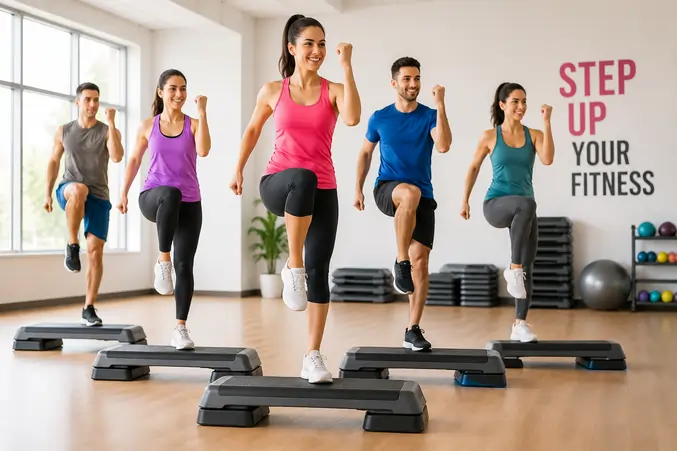
Step aerobics is a traditional cardio workout. It has persisted for decades for one simple reason: it produces results. The “step” is an elevated platform ranging in size from four to twelve inches. You walk up, around, and down from the platform in various patterns to increase your heart rate and respiration while also strengthening your muscles.
Step aerobics movements range from basic to intermediate. The most basic is a step-up/step-down. As you get more expertise, you may do movements that carry you over the top and around the step, forwards, sideways, and backwards.
Most individuals attend step aerobics sessions inside a gym, where an instructor demonstrates each action. The teacher and positive music inspire you to keep going.
How Intense Is Step Aerobic?
The intensity level is determined by the height of the step and the actions performed on it.
Put the step flat on the ground for the least amount of intensity.
To increase the intensity, add risers that boost the step’s height. Use your arms too. The longer you raise your arms upwards, the harder you’ll work.
Areas It Targets
- Core. Your core muscles keep you stable when you step. You’ll also lose fat and get stronger abs.
- Arms. Step aerobics focuses on your lower body, but you may also utilize your arms to perform strength training routines using arm-specific weights.
- Legs. Stepping up and down exercises your calves, quadriceps, and hamstrings.
- Glutes. All of those step-ups will strengthen and tone your buttocks.
- Back. Each step will need you to activate your lower back muscles.
Step Aerobics Benefits
Step aerobics can help you achieve or enhance certain fitness objectives, such as:
- Flexibility. The smooth motions of stepping might help you gain flexibility.
- Aerobic. Your heart will work harder. You will sweat while burning calories.
- Strength. Stepping up and down exercises the muscles in your calves, legs, and buttocks. Many step aerobics courses include strength training using weights. Although you can use modest weights when stepping, it is advised to avoid doing so since you risk injuring your shoulder joint.
- Sport. If you’re an athlete, you might employ step aerobics for cross-training.
- Low impact. Step aerobics is a low-impact exercise since you usually keep one foot on the ground or a bench.
Step aerobics is typically advised to assist in improving cardiovascular health (heart), muscle strength, and bone health; however, the outcomes may vary depending on the rate of your steps and the length of the sessions.
Basic step aerobics routine
Step aerobics requires nothing more than a step or platform. You can practice some of these techniques on your own to acquire confidence before attending a class, or include them in your regular home practice.
Here’s a routine that may be used as a foundation for your own program. Alternate sides, and do not utilize the same leading foot for more than a minute.
Basic right
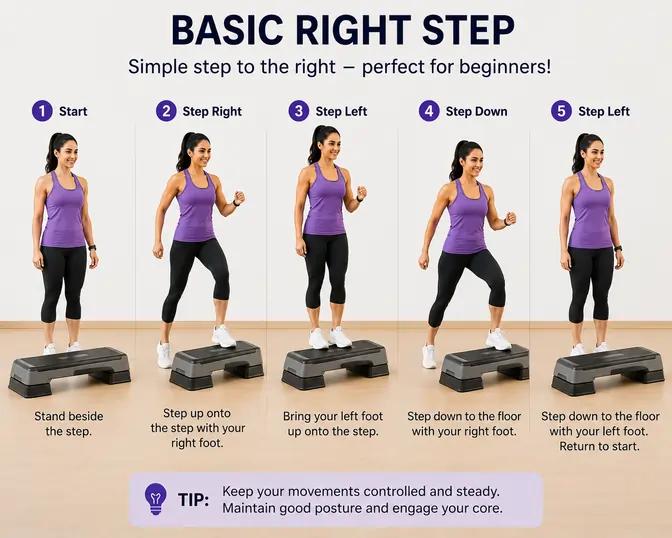
- Step into the step with your right foot.
- Step forward with your left foot.
- Step backward with the right foot.
- Step backward with the left foot.
Basic left
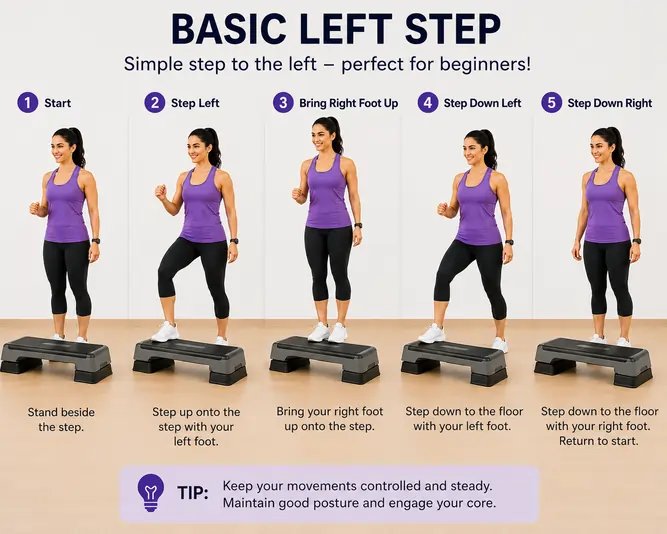
- Use your left foot to walk onto the step.
- Take a step up with your right foot.
- Take a step backward with your left foot.
- Take a step backward with your right foot.
Turn step move
- Start standing sideways to the step.
- Step up with your right foot.
- Lift your left foot onto the step and turn.
- Step down with your right foot.
- Bring the left foot down and meet the right.
A-step move
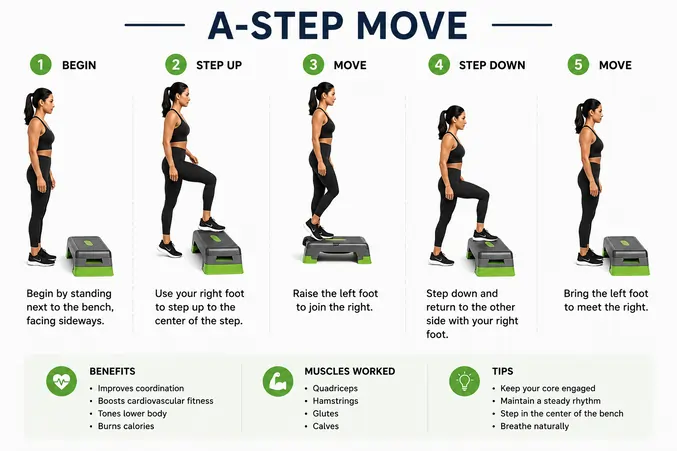
- Begin by standing next to the bench, facing sideways.
- Use your right foot to step up to the center of the step.
- Raise the left foot to join the right.
- Step down and return to the other side with your right foot.
- Bring the left foot to meet the right.
Across the top move
- Begin by facing sideways.
- Step up sideways with the right foot.
- Step forward with your left foot.
- Use your right foot to step off the other side of the step.
- Take a step down with your left foot.
- Press up.
- Step forward with your right foot.
- Step up and tap the left foot.
- Take a step down with your left foot.
- Take a step down with your right foot.
Charleston
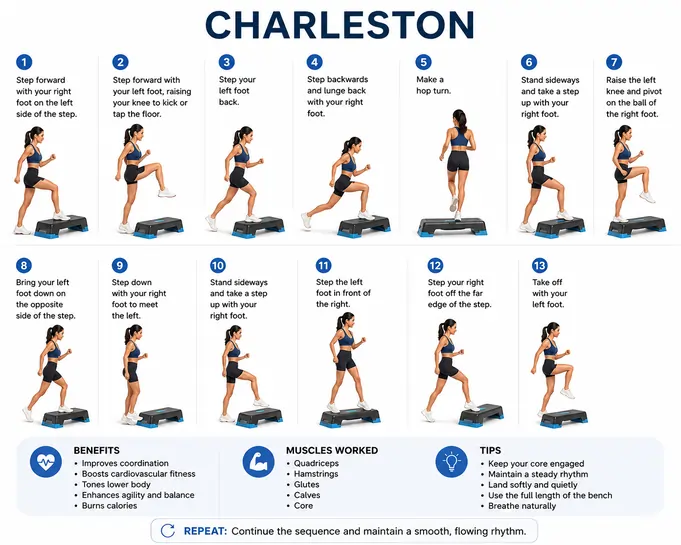
- Step forward with your right foot on the left side of the step.
- Step forward with your left foot, raising your knee to kick or tap the floor.
- Step your left foot back.
- Step backwards and lunge back with your right foot.
- Make a hop turn.
- Stand sideways and take a step up with your right foot.
- Raise the left knee and pivot on the ball of the right foot.
- Bring your left foot down on the opposite side of the step.
- Step down with your right foot to meet the left.
- Stand sideways and take a step up with your right foot.
- Put your left foot ahead of your right.
- Step your right foot off the far edge of the step.
- Take off with your left foot.
Tips
Choose a non-slip surface
Use a non-slip board to ensure your safety.
Avoid using the step
Remember that you may also do these movements on the ground without using the elevated surface. Step and move with the same determination as if you were stepping up. You can still have an excellent exercise.
Adjust the height of your step
Your step height can range from 4 to 10 inches, depending on your fitness and ability level. If you feel pain or discomfort, lower the height.
When your weight is on this leg, choose a height that prevents your knee joint from bending more than 90 degrees. Avoid hyperextending your knees or spine.
Practice your form and posture
Maintain proper posture and alignment by gently activating your abdominal and gluteal muscles. Keep your chest up as you bring your shoulders down and down, tucking your pelvis slightly underneath. Hold your neck straight and relaxed.
Use your ankles and legs
Step up by bending from your ankles rather than your waist. Step up by pressing hard onto your planted foot and lifting the other. This keeps you from placing too much strain on your lower back.
Take one whole step
Place your full foot on the step, with no portion dangling over the side.
Step lightly
Step without pounding your feet. Take gentle steps.
Take little steps
When stepping down, keep your feet no more than one shoe length from the platform and press into your heels for shock absorption. If a motion asks you to take a step back, press into your front foot.
Get comfortable with the footwork
Before you add anything further, make sure you understand the footwork. Begin with a beginner class until you get the hang of things and want to progress your practice.
Use your arms to increase the difficulty
Hold your hands on your hips or at your sides when practicing footwork or increasing your cardio and stamina. If you want extra cardio, incorporate arm motions into your regimen.
Is step aerobics safe for someone with a health condition?
If you have high blood pressure, high cholesterol, or diabetes, your doctor has probably advised you to get up and move. Step aerobics is a great way to achieve this.
If you make it a habit to do it for at least 30 minutes on most days of the week, it can help you lose weight, decrease your bad (LDL) cholesterol, and lower your blood pressure. Lowering these helps to avoid heart disease. It can also boost your HDL cholesterol.
If you already have heart problems, see your doctor first to determine what exercises are appropriate for you.
Aerobic exercise has been shown to assist people with prediabetes in avoiding developing diabetes. Step aerobics can also help manage diabetes when combined with a healthy diet and any medications you take. Follow your doctor’s diabetic treatment plan for exercise.
If you have arthritis, step aerobics can be a suitable weight-bearing exercise since you can alter the step height and intensity of your activity.
The step is not suitable for anyone who suffers from hip, foot, ankle, or knee problems. Consult your doctor or physical therapist about alternative things you may try instead. Swimming, for example, relieves pressure on your joints when exercising.
Pregnant? If you were performing step aerobics before your pregnancy, you should be able to continue as long as your pregnancy is proceeding normally. Confirm this with your doctor. To keep you and your baby healthy, take the following precautions: lower the step as your belly swells and your center of gravity shifts, drink water, and avoid overheating.
Consult your doctor before beginning a new fitness regimen, especially if you haven’t been active in a while.
Conclusion
The longevity and popularity of step aerobics speak for themselves. If you want to add a fun, social workout to your regimen, consider taking a step aerobics class. Enjoy yourself and get into the flow.
You may begin to like it and notice that time passes swiftly as you get all of its benefits. Make step aerobics part of a healthy lifestyle that includes lots of exercise, nutritious food, and stress-relieving hobbies.
Consult your doctor before starting any new fitness program, especially if you are taking any medications, have any health issues or injuries, or want to participate in a high-intensity class.
FAQs
Can I lose weight with step aerobics?
Indeed, step aerobics is a great way to lose weight. It’s a high-energy cardiovascular workout that burns between 400 and 600 calories each hour. The raised platform increases resistance, allowing you to build lean muscle while burning fat.
Is step aerobics superior to walking?
Yes, step aerobics can help you lose weight since it’s an excellent cardio exercise. Is aerobic stepping superior to walking? Both exercises are beneficial, but aerobic stepping is more intense and may help you burn more calories than walking.
Is twenty minutes of step aerobics enough?
So, yes, according to medical recommendations and studies (which we’ll discuss below), 20 minutes of exercise each day is sufficient—as long as it’s moderate in intensity.
What’s another term for step aerobics?
Step aerobics, also known as bench aerobics and step training, is a type of aerobic exercise that consists of stepping on and off a little platform.
How many times per week should I perform step aerobics?
The American Heart Association recommends that individuals engage in at least 150 minutes of moderate-intensity aerobic exercise each week. Alternatively, you can undertake 75 minutes of intense exercise. Step aerobics may be a fun method to work towards your objectives.
Is step aerobics helpful for the brain?
Stepped activities might boost your mood and energy levels. The motions focus on the legs, upper body, and core, promoting strength and flexibility. They also help with balance, coordination, and agility. Aerobic and strength training exercises appear to decrease cognitive decline, according to recent research findings.
Is step aerobics suitable for seniors?
This 40-minute step aerobics workout for elders and novices will enhance heart health and balance, burn fat, develop strength, and total around 3600 steps, depending on your pace. Safety is the most vital thing; the step you choose should be strong and not slide about.
References
- Watson, S. (2025, March 27). Step aerobics. WebMD. https://www.webmd.com/fitness-exercise/step-aerobics
- Cronkleton, E. (2019, May 24). Get a step aerobics routine started. Healthline. https://www.healthline.com/health/step-aerobics#benefits