High Knees Exercise
What Is High Knees Exercise?
High Knees is a high-intensity aerobic exercise performed quickly. It works your core, strengthens all of the muscles in your legs, raises your heart rate, and enhances momentum, coordination, and flexibility.
High knees are utilized in many different activities due to their many physical benefits. They’re also very simple workouts to complete because they can be done anywhere, without the need for a gym or equipment.
What Muscles Do High Knees Work?
You could have thought about the muscles used in high-knee exercises when you were preoccupied with what they are. This weight-bearing workout will have a significant effect on the muscles of the upper and lower body as well as the core.
More precisely, when executing high knees, the following lower-body muscles are most active:
- hamstrings
- calves
- hip flexors
- quadriceps
- glutes
The lower back is maintained safely throughout the whole exercise while the transverse abdominis and obliques are exercised. To help with the high knee form, the abdominals and core are also stabilized. You should anticipate pumping your triceps and biceps if you clench your arms correctly.
How To Perform Standard High Knees Exercise?
While our younger selves may have been able to repeat this action with ease, there’s a strong possibility we didn’t learn how to correctly do the high-knee exercise.
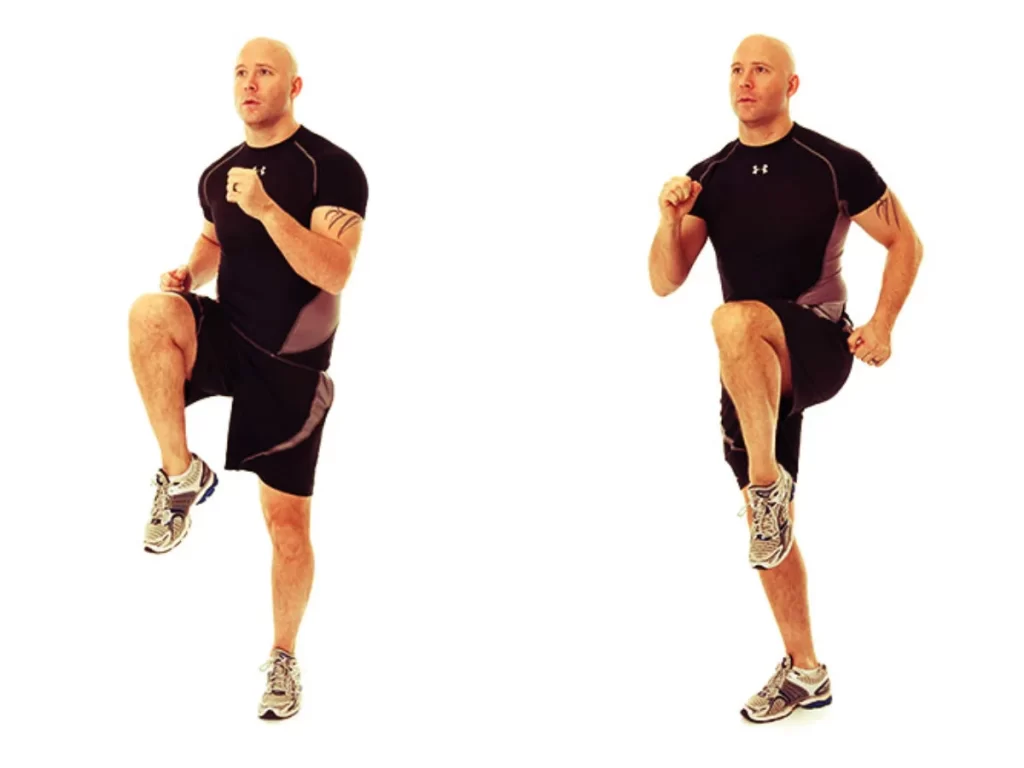
Before you begin, make sure you’re wearing comfortable, supportive shoes. This exercise is best done on a grassy or supportive gym floor if you have knee or ankle issues. Here’s how to perform high knees while keeping that in mind.
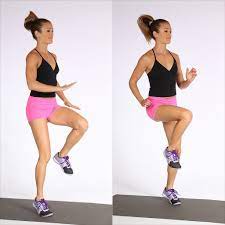
- With your arms by your sides and your feet hip-to-shoulder apart, take a tall stance.
- Use your core muscles, open your chest, and look directly ahead.
- To begin, raise your right knee just over your waist to your chest. Simultaneously, pump your left hand up.
- Quickly drop your right leg and left hand.
- Repeat with the left leg and right hand.
- Alternate between your right and left legs for the required duration.
- Your aim and level of fitness will determine how long you spend doing high knees. Exercise for 30 seconds at first, then take a 30-second break in between sets.
When Is the Best Time to Perform High Knees?
Exercises that may be included in a range of fitness regimens include high knees. However, you may be wondering, “How many high knees should I do?” whether adding them in a warm-up, HIIT, or weight training.
- When creating a warm-up routine, consider completing two minutes of high knees or 100 counts. If you find it too challenging, try 30 seconds with a 15-second break between each.
- A 30-second high-knee workout can be added between each resistance training set to create an effective weight training program. It will be roughly 35 high knees, but it will raise your heart rate and build muscle endurance.
What Are the Benefits of High Knees Exercise?
A great full-body, weight-bearing exercise that warms your upper and lower body muscles, raises your heart rate, and gets you ready for more difficult exercises and activities is the high knees exercise. Here are some advantages of high knees.
Increases heart rate and burns calories
- One type of cardiovascular workout is high knees. Your respiration and pulse rate will both increase within a few seconds of starting the exercise. As you continue to alternate between your arms and knees, you will burn calories.
Targets your lower body
- Your quadriceps, hamstrings, calves, glutes, and hip flexors are all activated by high knees, which enhances their coordination, balance, and muscular endurance.
Recruit your core muscles
- Your abdominal or core muscles must help with high knees. In addition to increasing the movement’s effectiveness, using the core muscles can also aid with posture.
What are some variations on high knees?
High Knees with Twist
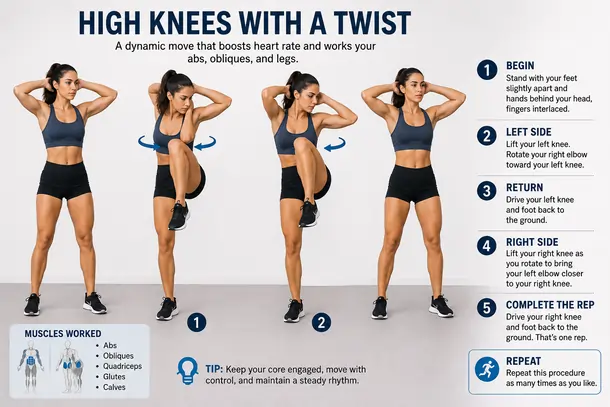
- Place your feet shoulder-width apart. Put your hands behind your head, elbows wide, fingers interlocked.
- Lift your left leg toward your chest while bracing your core.
- Bring your right elbow across to your left knee at the same time.
- As the elbow and knee join, crunch your obliques.
- To begin, lower your left foot and raise your right elbow.
- Repeat with your left elbow and right knee on the other side.
- Switch sides in a deliberate rhythm.
Consider how many times you want to switch your motions throughout each set. For example, one knee lift on either side counts as one rep, as do two lifts, and so on. This is an advanced variation of high knees. Only try steam engines until you’re familiar with the normal high knee workout.
High Knee March
- Start with your feet slightly apart and your weight concentrated on the balls of your feet.
- Lift your left knee as high as you can comfortably and bring your heel to your glutes.
- Drive your left knee and foot back to the ground while raising your right knee as high as possible and bringing the right heel toward your glutes.
- As indicated in step 3, drive your right knee back toward the ground while lifting your left knee.
- Always pump your arms in natural running form. This will help you build enough momentum to maintain your knees up even when you start to become winded.
- Repeat for 10 seconds, progressively extending the exercise’s length.
The difference between this version and the conventional high knee exercise is that, rather than bouncing off the ground in a running action, you slow down and march. You will continue to explode with each stride, but your knees will be less stressed. Make sure you land gently. Pump your arms harder if you want a tougher exercise.
Lateral High Knees
- Begin by standing with arms bent at a 90-degree angle to the sides. Then run on the spot at a quicker rate by raising the knees to the height of the waist. With every stride, alternate between taking two or three strides to either side. Throughout the lateral high knees workout, continue to swing your arms and resemble sprinting.
Jumping High Knees
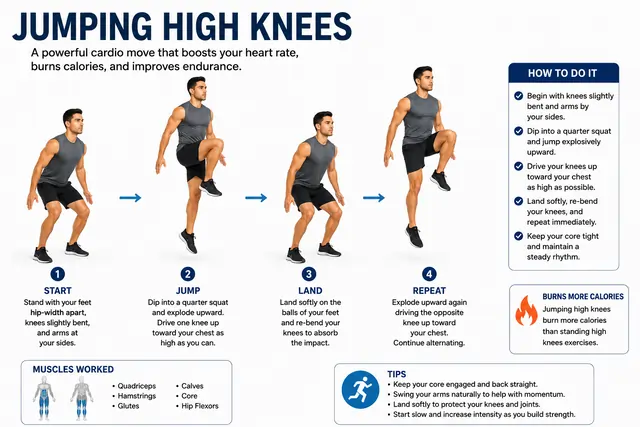
- Begin carrying out this exercise with your knees slightly bent. Then stretch your arms beside your sides and stand comfortably.
- Then, with a quarter squat and a perfect dip leap, do an explosive upward action. As you do this, make sure your knees travel towards your chest and try to touch them. Thus, you must raise your knees and jump as high as you can.
- Make sure you land securely by reextending your legs and repeating the entire exercise.
- Jumping high knees is thought to burn more calories than standing high knees exercises.
When should you do high knees?
Warmup
Doing 2-3 minutes of high knees before working out raises your heart rate, warms your muscles, and prepares your body for more difficult actions.
Aim for 30 seconds on and 15 seconds off, then repeat for two to three minutes if performing continuous high knees is too challenging.
Cardio or HIIT routine
High knees may be included in any cardio or high-intensity interval training (HIIT) exercise. If you’re creating a bodyweight exercise, incorporate high knees among other cardio exercises like:
- jumping jacks
- high kicks
- lateral hops
- mountain climbers
- burpees
- uppercuts
- plank jacks
- skaters
- squat jumps
Cardio bursts during weight training
Circuit training, also known as high-intensity circuit training, will help keep your heart rate up in between strength training activities.
Between each set of resistance training exercises, perform a 30-second high-knees cardio burst. You can still rest before the following set, but instead of a complete rest, reduce the duration by half.
Common Mistakes To Avoid
- Make sure your posture is correct. Look straight ahead and maintain a straight back.
- Move your arms organically. When running, avoid making excessive arm movements that you wouldn’t ordinarily experience.
- To aid with stability, do use your arms. With your elbows bent at a 90-degree angle and your fingers outstretched, keep your arms close to your body. This aids in keeping your body under control and balanced during the workout.
- Imagine using your abs to lift your legs up. Focusing on your lower abs and the pulling action will help you maintain proper posture and keep your core engaged.
When to Avoid
- Acute knee or ankle injury
- Hip Joint Pain
- Balancing difficulties without support
Conclusion
High knees can be used as a warm-up activity, a cardio burst in between strength training exercises, or as part of an HIIT or aerobic exercise regimen.
Incorporating this exercise into your regular exercise regimen can help you increase your cardiovascular fitness, burn calories, build muscle in your lower body and stomach, and get your body ready for more challenging tasks.
If you have any pain in your ankles, knees, or hips, see your doctor or a physical therapist before doing this technique. They can assist you in determining whether high knees are good for you and how to adapt the technique to keep you safe.
FAQS
Will high knees reduce abdominal fat?
Yes, high knees help you lose belly fat by increasing your heart rate and calorie burn. However, spot reduction (reducing fat solely in the middle) is difficult; high knees promote general body weight loss, which eventually lowers belly fat.
What exactly is the high-knees workout for?
A dynamic calisthenic exercise that enhances lower-body strength, cardiovascular endurance, and general agility is the high-knees exercise. It works numerous muscular groups at once, including the core, quadriceps, hamstrings, and glutes, making it an excellent workout for burning calories and warming up the body.
What is the recommended duration of high knees?
The length of time you should practice high knees is largely determined by your fitness goals. Warm up for two to three minutes. For a heart-pumping cardio workout, aim for 30 to 60-second intervals repeated 3 to 5 times.
What will happen if I do high knees every day?
High knees may provide a high-intensity cardiovascular workout. Learning how to execute high knees will activate your entire leg, develop your hip flexors, enhance your lower body’s coordination and flexibility, and add momentum to your stride.
References
- Lindberg, S. (2021, August 9). It’s time to revisit the high knees exercise you learned in PE. Healthline. https://www.healthline.com/health/fitness/high-knees-benefits#benefits
- Fit, C. (2022, August 26). How to Do High Knees: Benefits, Muscles Worked & Variations. blog.cult.fit. https://blog.cult.fit/articles/high-knees-exercises-benefits-steps
- Motra. (2026, June 3). High Knees – Exercise Guide | Motra. Motra. https://www.motra.com/exercises/highKnees