Jump Squat Exercise
Introduction
The jump squat is a basic yet effective dynamic strength training exercise. Athletes, bodybuilders, and sportspeople use it frequently because it delivers a superb high-intensity exercise. It promotes optimal muscular coordination in both your upper and lower bodies.
Remember that walking, leaping, climbing stairs, and moving large things all use the majority of these muscles. As a result, you may complete this workout even if your only aim is to increase your mobility, work quicker in your everyday life, or improve your overall health. Just make sure you grasp the proper technique for your jump squat. Otherwise, you won’t get anything out of it and may damage yourself.
Which Muscles Are Used in Jump Squats?
When done correctly, jump squats train plenty of muscles. The hips and lower body are the main areas. Even if you do jump squats improperly, you may still be working these muscles. To properly complete this exercise, you must also develop the muscles above your waist.
To get the most out of your jump-squat practice, work on all of these muscles:
Glutes
- The gluteus maximus (GM) is your body’s biggest and strongest muscle. It significantly influences the shape of your buttocks and hips.
- This is a key muscle that controls how your thighs and hips move. It also keeps you upright and allows you to run longer. During a jump squat workout, your glutes tense, allowing you to straighten out of the bent posture and do the jump.
Quadriceps
- The quadriceps femoris, or quads, is a muscle group located in the front of your leg. It starts in your upper thigh and goes all the way to your knee. Its major goal is to help you straighten your legs and flex your knees.
- The quadriceps muscle group consists of four heads: the rectus femoris, vastus intermedius, vastus medialis, and vastus lateralis. All of these muscles work together to help you jump into the air during jump squats.
- Your hamstrings are located at the back of your leg, behind your quadriceps. They enable mobility of these physiological parts since they are located between the hip and the knee.
- The hamstrings consist of three different muscles: semitendinosus, semimembranosus, and biceps femoris. These are the muscles that absorb the shock of your landing during a jump squat.
Abs
- Your abs, or abdominal muscles, are located in the front of your body. They start just beyond your ribs and end in the pelvic region.
- Your abs are made up of four muscle groups: the rectus abdominis, transversus abdominis, and external and internal oblique muscles. Together, they offer support and protection for your abdomen’s internal organs. Stretching your stomach while doing a jump squat workout strengthens your abs.
Calves
- Your calf muscles are located on the rear of your lower leg. They consist of two separate muscles: the soleus and gastrocnemius. These muscles provide stability during standing and help in foot and ankle rotation. Jump squats strengthen your calf muscles, allowing you to rise.
Benefits of Squat Jumps
- Builds Explosive Power: The jumping motion develops fast-twitch muscle fibers, resulting in increased athletic output and vertical leap.
- Jump squats work the quadriceps, glutes, hamstrings, and calves under stress.
- Improves Cardiovascular Fitness: When performed in high-rep sets, this activity increases heart rate and endurance.
- Boosts Athletic Performance: It boosts performance and agility in sports that demand running, jumping, or sudden changes of direction.
- Improves Coordination and Balance: Landing and jumping in rhythm promotes proprioception and body control.
- Jump squats burn more calories since they are a high-intensity, full-body exercise.
- It requires no equipment and is a versatile, accessible bodyweight exercise that can be done at home or at the gym.
Jump Squat Video
How to Do a Jump Squat?
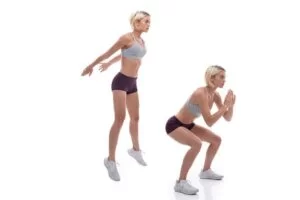
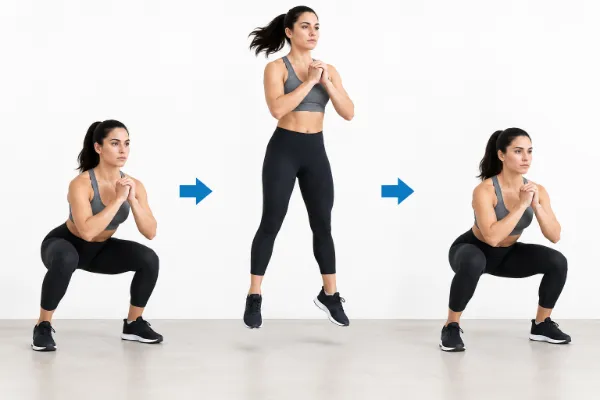
- Begin with feet shoulder-width apart and toes pointing forward or slightly turned out. Keep your back straight, chest high, and core taut.
- Lower yourself into a squat by bending your knees and hips as if sitting back in a chair. Your weight should be evenly distributed over your feet, with a slight focus on the heels. Keep your knees behind your toes as you drop.
- At the bottom of the squat, start the upward movement by pushing through the heels and moving your weight to your toes.
- To jump, stretch your legs, hips, and arms upward and straight in one smooth action, using as much explosive power as possible. Your feet should be elevated and flexed at the top.
- Land on your toes, then instantly shift your weight to your heels. You want to absorb the force of your landing by smoothly returning to a squat stance.
- Repeat the movement.
Common Mistakes To Avoid
No warm-up
Avoid performing squat jumps while your muscles are cold. Warm up your muscles with cardiovascular activity such as running, brisk walking, or light jump roping.
Hard Surface
Think about your surroundings. Instead of concrete, practice these drills on a soft, flat landing surface until you feel comfortable with the activity.
Overdoing It
When you like and benefit from an exercise, you are more likely to do it again. In this case, resist the urge. To avoid overuse or undue strain on your joints, do these drills no more than once each week.
Adding Extra Weight
Strength and Conditioning: Resist the urge to gain excess weight. It turns out that adding weight to squat jumps provides no benefits.
Changes and Variations to Squat Jumps
Do You Need a Change?
Master the squat jump, followed by the tuck. The advanced motion is to tuck your knees up. Bring your knees to your chest to gain height, and do squat jumps.
Determine if height or speed is more important. Determine your goal for squat jumps. If it’s speed, be mindful that your squat jumps will be shorter. Slow down if height is the factor
Squat jumps without the tuck are beneficial to children as young as five. The data suggests that a twice-weekly program beginning with 50 to 60 jumps each session for eight to ten weeks is helpful. A low-intensity program that lasts longer would be an alternative for children who are unable to participate in a twice-weekly session. Squat jumps may also be a family exercise because they are equally beneficial to adults.
Are You Up for a Challenge?
After you’ve mastered stationary squat jumps, you may jump onto a six-inch-high bench or step. Jump up, come to a stop, straighten up, and then take a step down. Try it again.
Squat leaps are an excellent method to integrate high-intensity intervals into your workouts. Perform the needed number of leaps without taking a pause between reps.
To increase lower-body strength, perform an isometric variation. Before completing squat jumps, pause and engage your gluteals (buttock muscles) and quadriceps (front thighs).
Safety and Precautions
If you have any conditions affecting your neck, back, hips, ankles, or knees, see your doctor or physical therapist to see whether you should avoid squat jumps. If you’ve been told to stick to low-impact workouts, you should generally avoid squat jumps. This is especially true during pregnancy, when hormones influence your joints, and the shift in your body’s center of mass affects your balance.
If you are not experiencing any of these concerns, perform squat jumps every 48 to 72 hours. This gives your body ample time to recover and ensures that the training is successful. Make sure there is little dirt and an even area where you will jump. Keep young children and dogs away from the area where you are executing squat jumps to avoid getting underfoot. CrossFit shoes are ideal for squat jumps due to their cushioning properties. Weightlifting shoes give stability.
Conclusion
The jump squat is a dynamic and effective workout for increasing strength and cardiovascular fitness. Including jump squats in your workout routine may have incredible results, whether you’re preparing for sports, weight reduction, or general fitness. Simply maintain proper form, avoid common errors, and proceed at your own pace.
FAQs
What is the Jump Squat Exercise?
Jump squats are an intense plyometric workout that involves performing a standard squat and then pushing off the ground to jump straight up into the air.
What would 100 jump squats per day do?
Doing 100 jump squats a day will quickly create explosive lower-body power, spike your heart rate for higher aerobic fitness, and tone your legs and glutes, but it also has a high risk of joint strain and overuse issues when done every day without recovery.
Do jump squats enhance height?
Jump squats enhance vertical jumping height but not total body stature or bone length.
Is jump squat better than squat?
Neither jump squats nor normal squats are universally “better”; they serve very different training purposes.
Is it possible to do squat jumps every day?
To allow your muscles to recover, take at least one day off between workouts. It’s ideal to do them three or four times every week.
Can squat jumps cause knee problems?
Squat jumps are safe for your knees if done appropriately. If you have knee pain or have previously been injured, try a low-impact variation such as bodyweight squats or step-ups.
References:
- Ms, E. Q. (2024, October 2). How to do squat jumps. Verywell Fit. https://www.verywellfit.com/squat-jumps-build-agility-and-power-3120594
- Schultz, R. (1970, January 1). Squat jumps can build explosive power and energize you in just a few reps. https://www.onepeloton.com/blog/squat-jumps
- Davis, N. (2024, January 25). How to Squat with Proper Form. Healthline. https://www.healthline.com/health/fitness-exercise/proper-squat-form
- Walker, O. (2024, February 29). Squat jump. Science for Sport. https://www.scienceforsport.com/squat-jump/?srsltid=AfmBOoqFxu7SRKgO7tU0NJrYiwDZy2hU9y6dIIF4zqqyItPxbWtKHz_O
- Bhardwaj, N. (2021, February 17). 10 silly mistakes that you might be committing while doing jumping squats. Health Shots. https://www.healthshots.com/fitness/weight-loss/10-silly-mistakes-that-you-might-be-committing-while-doing-jumping-squats/