Serratus anterior weakness test of the shoulder:
- This test is also known as the punch out test.
- This test is applied to the clinic to check the weakness of the Serratus anterior muscle.
- Serratus anterior muscle which is doing the forward flexion of the shoulder above the 90′.
- When this test performs also check the winging of the scapula.
- This clinical test is applied in the clinic by the therapist/doctor.
Purpose of the Serratus anterior weakness test :
- This muscle weakness Test is used to examine the serratus anterior muscle weakness.
- It is also used for winging of the scapula.
- This test is also helpful when checking the strength of the Serratus anterior muscle.
How do you perform the Serratus anterior weakness test?

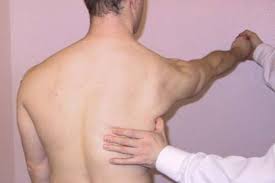
- Starting position of the patient the standing & forward flexes of the arm to 90′.
- The examiner applies a backward force to the arm.
- If the serratus anterior is weak/paralyzed, the medial border of the scapula wings means classic winging.
- The patient also has difficulty abducting/forward flexing the arm above 90′ with weak serratus anterior, but it still may be possible with lower trapezius compensation.
- A similar finding may be accomplished by doing a wall/floor pushup.
- To differentiate long thoracic nerve palsy from posterior instability that causes serratus anterior dysfunction, the examiner should ask the patient to laterally rotate the arm & then forward flex the arm.
- In this case, if scapula winging is eliminated, then the problem is posterior instability due to Serratus anterior weakness.
Scapular winging :
- Winging of Scapula which is a diagnosis by this test.
- Normally the diagnosis of Scapula is easy by visible inspection of the scapula, but the etiology of the Scapula is often too more illusive
- The medial side of winging scapula is due to paralysis of the serratus anterior muscle when asking the patients to do the forward flex of their arms horizontally & push on the wall into a push-up motion.