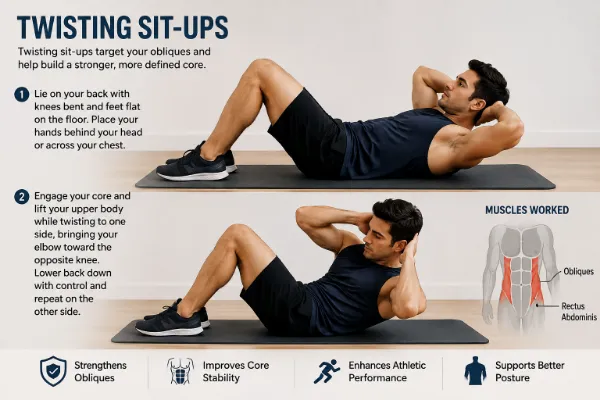
Twisting Sit-Ups
Introduction
Twisting sit-ups are an effective bodyweight exercise that combines a traditional sit-up with controlled torso rotation to target both the abdominals and the obliques. This dynamic movement helps strengthen the core, improve rotational stability, and enhance overall functional fitness. Because it requires no equipment, twisting sit-ups can easily be included in home workouts, gym routines, or sports training programs.
Muscles Involved
Target Muscle
- Obliques Muscles
Synergists
- Iliopsoas Muscles
- Tensor Fasciae Latae
- Rectus Femoris
- Sartorius Muscle
- Rectus Abdominis
Stabilizers
- Tibialis Anterior
Benefits
- Combines oblique rotation with a sit-up
- Builds both the obliques and the abs.
- No equipment is required.
- Standard core exercises
- Complete range of motion
- Easy to use and effective
How To Perform Twisting Sit-Up
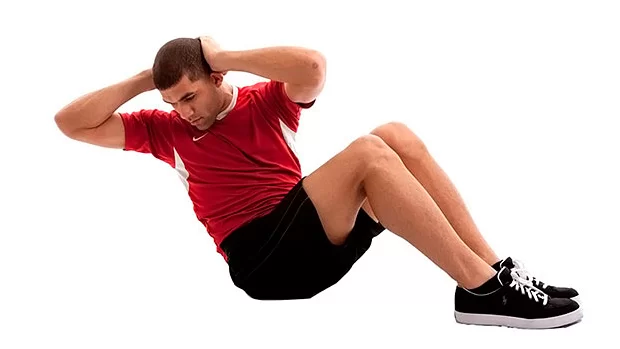
- With your knees bent, lie on the floor (ideally on a mat).
- With your elbows pointing straight out on each side, place your hands behind your head.
- As you sit up, contract your core muscles, lift your body off the ground, and draw a line from your right elbow to your left knee. Your right elbow should be pointed toward your left knee and your body should be twisted as far as you can comfortably do at the top of the sit-up.
- Lay back down gently.
- Twist your left elbow to your right knee for the subsequent repetition.
- Repeat for as many repetitions as needed, switching sides each time.
Common Mistakes To Avoid While Performing Twisting Sit-Ups
Not Engaging Your Core Muscles
- The abdominal muscles should be engaged throughout the activity. When they aren’t, you risk injuring yourself and don’t get the most out of the activity. To activate your abs, just bring your navel in towards your spine and keep it there while performing the sit-up.
Using Momentum Instead of Strength
- Another common error individuals make when doing Twisting sit-ups is depending too much on momentum rather than strength. This means that instead of utilizing their own power to move their upper body, they rely on the momentum generated by their legs swinging up to push them through the exercise.
- While this may appear to accelerate your progress, it really reduces the exercise’s effectiveness. Try to concentrate on calm, controlled motions that rely entirely on your own power.
Going Too Fast or Slow
- Going too fast may damage your form and make it tough to activate your core effectively. Going too slow can also be risky because it does not provide the same cardiovascular advantages as a faster speed. Aim for a moderate pace that you can maintain throughout the activity.
Not Taking Breaks
- Doing too many Twisting sit-ups without a break can cause exhaustion, making it harder to maintain proper technique. Take a pause every few minutes to allow your muscles to rest and heal before continuing.
Focusing on Quantity Over Quality
- While it may be easy to try to do as many sit-ups as you can in a short amount of time, this isn’t necessarily the ideal approach. When it comes to sit-ups, quality is more important than quantity.
- Completing fewer reps with excellent form produces better outcomes than completing more reps with bad form. It’s preferable to complete fewer reps with good form than to do a lot of reps with poor form.
Variations
Bicycle Twisting Sit-Ups
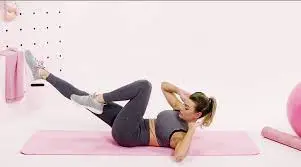
- Lie down on the floor on a yoga mat, rug, or towel, with your lower back on the ground and your knees bent. Your feet should be on the floor, and your hands behind your head.
- Stabilize your spine by contracting your core muscles and pulling in your tummy.
- Hold your head gently with your hands. Pull your shoulder blades back and gradually elevate your knees to a 90-degree angle, elevating your feet off the ground.
- Exhale and gently begin a bicycle pedal motion, pulling one knee up towards your armpit while straightening the other leg, keeping both raised higher than your hips.
- Rotate your torso so you can touch your elbow to the opposite knee as it comes up.
- Twist to the other side, while drawing that knee towards your armpit and the other leg extended until your elbow touches the alternate knee.
Weighted Twisting Sit-Ups
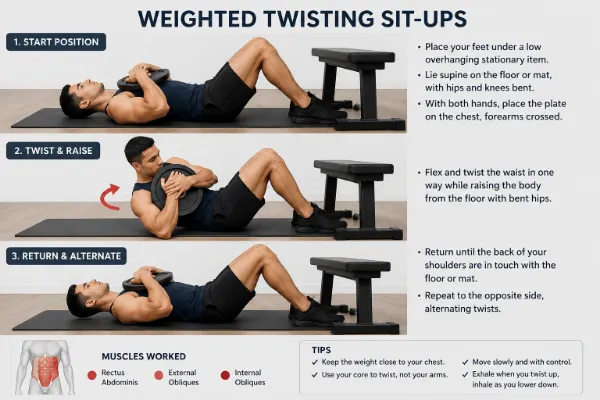
- Place your feet under a low overhanging stationary item. Lie supine on the floor or mat, with hips and knees bent. With both hands, place the plate on the chest, forearms crossed.
- Flex and twist the waist in one way while raising the body from the bench with bent hips. Return until the back of your shoulders are in touch with the floor or mat. Repeat to the opposite side, alternating twists.
Medicine Ball Twisting Sit-Ups
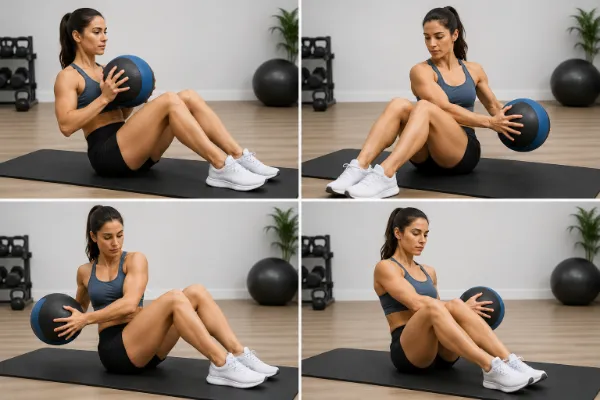
- Sit on the floor, knees bent and heels softly touching the ground, gripping a medicine ball in both hands in front of your chest.
- Lift your chest and maintain a long, neutral spine instead of curving your back.
- Brace your core and move your body to position the ball beside one hip.
- Rotate back through the center to the opposite hip, allowing the ball to move in a smooth and controlled arc.
- Keep the hips looking forward so that the twist originates in the torso rather than the lower back.
- Move at an even pace, breathing out with each movement.
V-Up Twist
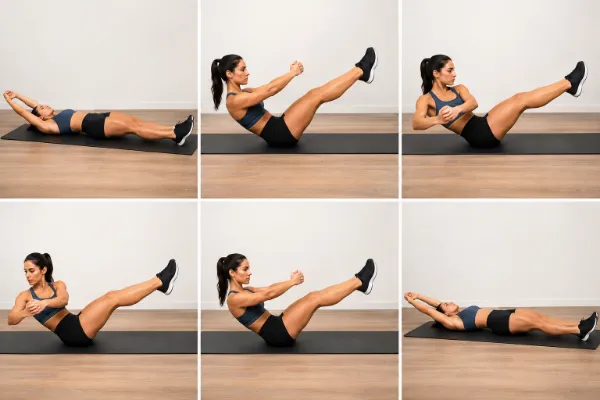
- Lie on your back, arms held. Rotate the body and hands to the right and then left, raise the head and legs off the ground, and contract the core forward. Return to the center, lower the core, and repeat.
Tips
- Make an effort to maintain a neutral, straight neck posture. Don’t try to get up by straining it or throwing your head. Let your abs do the heavy lifting.
- Don’t raise your feet when you sit up; instead, keep them level on the ground. If this is tough for you, tuck your feet under a solid piece of furniture or, if you have some (heavy) dumbbells on hand.
- Try a standard sit-up with a tiny twist at the top instead of twisting through the entire sit-up if you struggle with the twist and sit. Work on creating a larger twist gradually. You’ll succeed!
Conclusion
Twisting Sit-Ups are an effective bodyweight exercise for strengthening the rectus abdominis, obliques, and other core muscles while improving rotational stability. When performed with proper technique, they can help enhance core strength, balance, and functional movement for sports and everyday activities.
Focus on controlled movements rather than speed, avoid pulling on your neck, and maintain proper form throughout each repetition. Whether you’re a beginner or an experienced fitness enthusiast, adding Twisting Sit-Ups to your workout routine can help you build a stronger, more stable, and better-conditioned core.
FAQs
What are the benefits of performing twisted sit-ups?
Twisting Sit-Ups, opposed elbow to knee. This is an excellent workout for exercising both the abdominal and oblique muscles. Twisting V-Sit-Ups will help to increase the intensity of your workout.
What do sit-up twists target?
The twisting sit-up is a variation on the classic exercise that incorporates torso rotation. Instead of rotating your torso up and down, twist it at the waist. This forces your obliques to activate more.
Which is better: crunches or sit-ups?
Crunches and sit-ups both strengthen the core, but crunches isolate the abs with a brief exercise, whereas sit-ups train several muscle groups (including the hip flexors) across a complete range of motion.
What does twisting exercise do?
A twist exercise (such as the Russian twist or Twisting sit-ups) is primarily intended to strengthen the core and obliques. Rotating your torso against resistance increases rotational strength, improves spinal stability, and works your deep abdominal stabilizers.
References:
- Exercise not found – GymStreak. (n.d.). https://www.gymstreak.com/exercises/sit-ups-to-twists
- Medicine Ball Twist (Seated): How to & muscles worked | Zirv. (n.d.). Zirv Fitness. https://zirv.io/exercise-library/medicine-ball-twist-seated