Exercises For Patellofemoral Pain Syndrome
Introduction
Proper exercise is critical for managing Patellofemoral Pain Syndrome (PFPS) and supporting faster recovery. These efficient workouts improve knee muscles while reducing stress on the patellofemoral joint. Managing Chronic Health Conditions.
Patellofemoral Pain Syndrome (PFPS) is a frequent disorder that causes discomfort in the front of the knee, especially where the patella (kneecap) meets the femur (thigh bone). Overuse, muscular strength imbalances, and incorrect patella tracking are common causes.
Patellofemoral pain syndrome can occur in either one or both anterior portions of the knee. It impacts both children and adults. In most situations, there are certain aggravating actions or circumstances that worsen knee pain, such as sitting for an extended period of time with the knee in flexion. Most people can control their symptoms with rest, activity adjustments, or physical therapy.
Why Does Patellofemoral Pain Syndrome Occur?
Patellofemoral pain syndrome develops when nerves detect pain in the soft tissues and bone around the kneecaps. These soft tissues include tendons, the fat pad beneath the patella, and the synovial tissue that borders the knee joint.
In some situations of patellofemoral pain, chondromalacia patella occurs. Chondromalacia patella refers to the softening and degeneration of the articular cartilage on the bottom of the kneecap. Because articular cartilage lacks nerves, injury to it cannot directly produce pain. However, it can cause synovial inflammation and bone pain.
Symptoms of Patellofemoral Pain Syndrome
The most typical symptom of PFPS is a dull, painful ache at the front of the knee. This pain, which normally develops gradually and is commonly activity-related, might affect one or both knees. Other common symptoms are:
- Pain during exercising and activities that frequently bend the knee, such as climbing stairs, jogging, leaping, or squatting.
- Pain at the front of the knee after sitting for a lengthy amount of time with your knees bent, such as in a movie theater, a car, or on an airline.
- Pain due to a change in exercise level or intensity, playing surface, or equipment
- Popping or cracking sounds in your knee when ascending stairs or standing up after a lengthy period of sitting.
Causes of Patellofemoral Pain Syndrome
- Overuse: Running and jumping activities place repetitive stress on the knee joint, which can create inflammation under the kneecap.
- Muscular imbalances or weaknesses: Patellofemoral pain occurs when the muscles around the hip and knee do not maintain the kneecap in place. Squatting with the knee inward has been connected to patellofemoral pain.
- Injury: Patellofemoral pain syndrome has been related to kneecap trauma, such as when the kneecap becomes dislocated or cracks.
- Surgery: Knee surgery may increase the likelihood of patellofemoral pain. This is especially true when repairing the anterior cruciate ligament with one’s own patellar tendon as a graft.
Risk factors
- Age: Patellofemoral pain syndrome primarily affects teenagers and young adults. Arthritis is more commonly to blame for knee difficulties in elderly adults.
- Sex: Women are twice as likely as men to experience patellofemoral pain. This might be because women have broader pelvises. A broader pelvis alters the angle at which the bones of the knee joint contact.
- Certain sports: Running and jumping activities can place additional strain on the knees. This is particularly true when adding extra training.
Diagnosis
- Health History and Physical Examination: Your doctor will review your overall health as well as the symptoms you’re experiencing. They will inquire as to when your knee pain began, the severity and nature of the pain (dull vs. severe), and the activities that aggravate the pain.
- To pinpoint the source of the pain, the doctor may gently touch and pull on the front of your knees and kneecaps.
- During the exam, the doctor may ask you to squat, jump, or lunge to assess your knee and core strength.
- X-rays: X-ray scans clearly reveal bones. X-rays are not as effective for seeing soft tissues.
- CT scans: CT scans reveal bones and soft tissues. However, CT scans expose patients to far more radiation than simple X-rays.
- MRIs use radio waves and a strong magnetic field to produce detailed pictures of bones and soft tissues, such as knee ligaments and cartilage. However, MRI scans are far more expensive than X-rays, CT scans, and ultrasounds.
- Ultrasound: This test employs sound waves to display pictures of muscles and tendons.
Treatment for Patellofemoral Pain Syndrome
Medicines
If necessary, use over-the-counter pain medicines. These include acetaminophen (Tylenol, etc.), ibuprofen (Advil, Motrin IB, etc.), and naproxen sodium (Aleve). Do not take them for more than two or three weeks.
Physical Therapy
A physical therapist may suggest:
- Rehab exercises: Certain exercises strengthen the muscles that support the knees and keep the leg in proper alignment. Keeping the knee from going inward when squatting is a primary objective.
- Supportive braces: Knee braces and arch supports may assist in pain.
- Taping: Your physical therapist may show you how to tape your knee to relieve pain and improve your ability to exercise.
- Icing: Icing your knee after activity may be beneficial.
- Orthotics: Custom or ready-made shoe inserts may assist in relieving stress on the knee.
- Activities that are easy on the knees. During rehabilitation, it may be beneficial to stick to sports that are easier on the knees, such as cycling or swimming.
Surgical and other treatments
If basic therapies fail to relieve pain, a health care professional may recommend:
- Arthroscopy: A surgeon inserts a pencil-thin gadget into the knee via a small incision in the skin. This instrument, known as an arthroscope, has a camera lens and light. Tools for repairing the condition might be placed through further tiny wounds in the skin.
- Realignment: In more difficult situations, a surgeon may have to operate on the knee to correct the angle of the kneecap or relieve pressure on the cartilage.
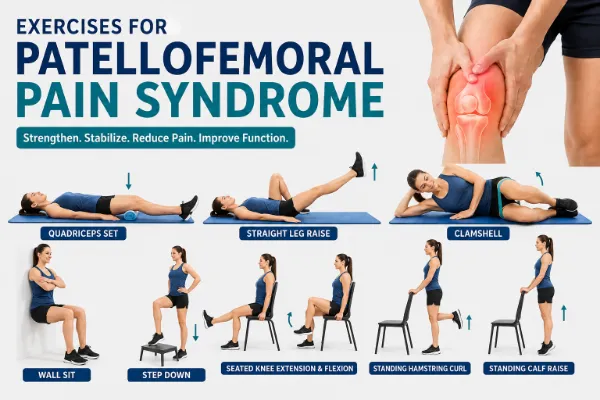
Exercises For Patellofemoral Pain Syndrome
Foam roll hamstring stretch
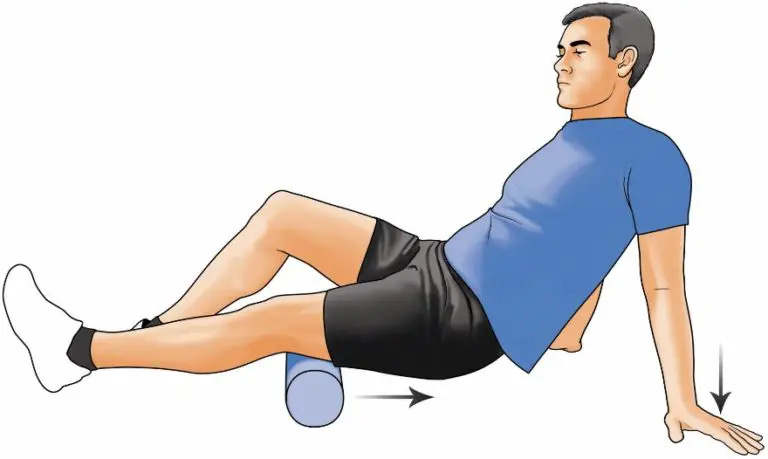
- The foam roll hamstring stretch exercise begins with sitting on the mat or floor, with your hips straight. Place the foam roller equally beneath the thigh of one leg while bending the other leg so that the foot is flat on the floor.
- Lift your glutes off the mat, leaving your hands on the floor for balance.
- Move your body back and forth in long strokes, ending exactly at the back of the knee.
- Gradually twist the thigh to ensure that the roller travels lateral to medial, covering the muscle’s origin to insertion.
The foam roller hamstring stretch can help promote flexibility and hip mobility. Both of these advantages enable people to execute common tasks such as climbing stairs and bending over with ease.
VMO(Vastus medialis obliquus) Exercise
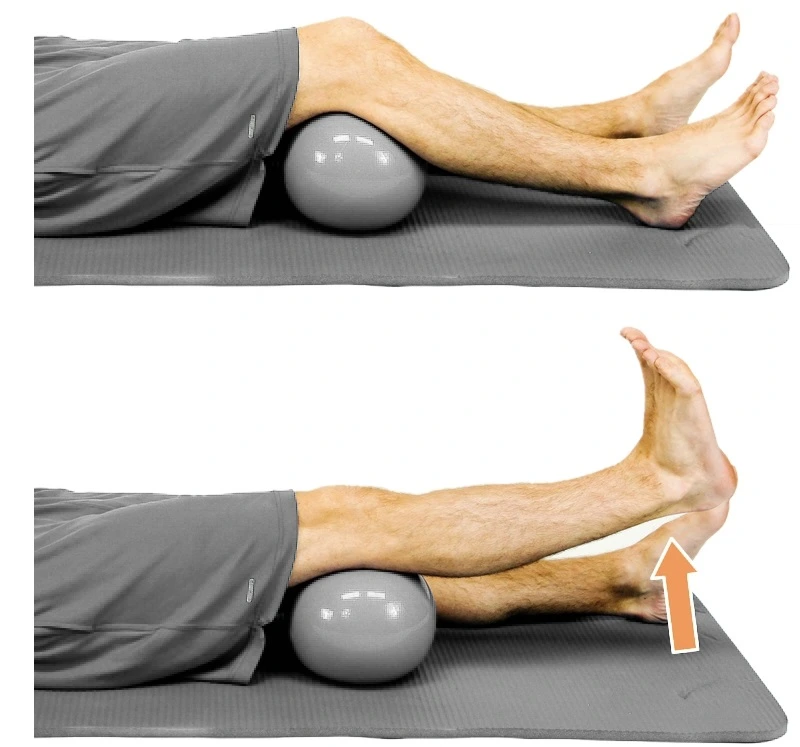
- VMO board training is necessary for both the board and the bolster.
- Begin the exercise by lying down and holding the board beneath your knee, which is under you in a bridge posture.
- Then bend the knee and stretch the ankle, holding the position for 5-10 seconds before returning to the beginning position.
- Perform three sets of 15-20 repetitions per session.
Straight leg raise
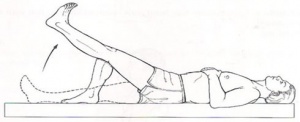
- Take a supine position on the plinth/mat.
- Flex your knees and hips, and place your feet hip-width apart on the floor. Start with the pelvic floor and transabdominal muscles.
- Bring one leg to your chest, then down while maintaining your body straight. During the exercise, focus on activating your core muscles and keeping your abs tight; begin with your legs slightly bent to protect your lower back; keep your arms at your sides with palms down; and raise your legs until you.
- Reach a 90-degree angle at your hips, then slowly drop your legs back to their original position.
This exercise promotes core strength, hip flexor mobility, lower back muscular strength, posture improvement, and abdominal strength.
Side leg raises (hip abduction)
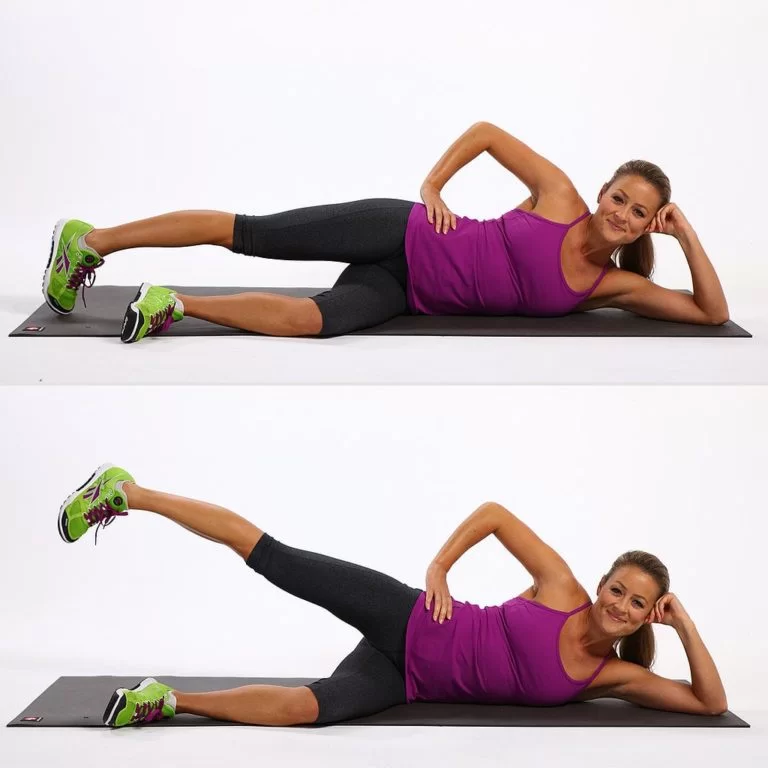
- The side leg lift exercise begins with you lying on your side on an exercise mat, legs outstretched.
- Place your head on an arm that may be bent or stretched. To support the upper body, place the opposite hand on the floor in front of the stomach.
- Raise your upper leg sideways to the ceiling, hold for a bit, then lower it again.
- Repeat this exercise 10 to 20 times. Repeat with the opposite leg. Keep your body stable and move gently and with control. When your leg moves, your upper body should remain still. If you want to try a more difficult workout, wrap an elastic resistance band over your knees.
- Repetitions should be 13-15 per session with three sets per day.
Static quadriceps exercise
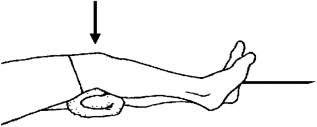
- As you sit, lengthen your legs straight out in front of you.
- Place a rolled towel beneath your kneecap.
- Tighten your quadriceps by squeezing your knee onto the towel.
- Hold for 5-10 seconds and then relax.
- Repeat 10 to 15 times.
- Consider adding a band to your standing workouts to help strengthen your quadriceps even more.
Hip adductor muscle strengthening exercise
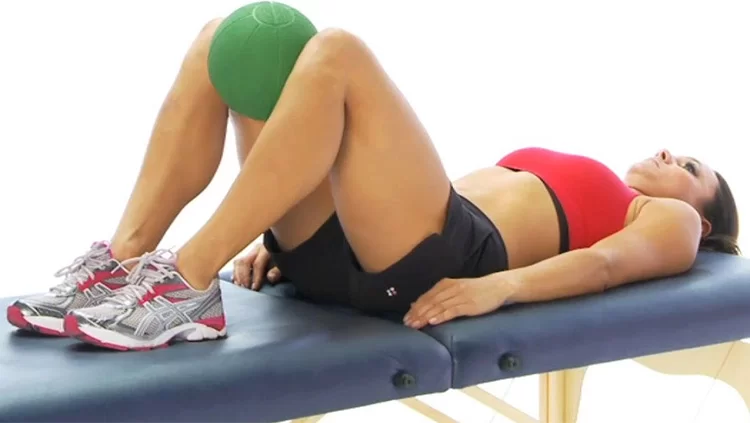
- Start in a supine position. Lying (on a plinth or mat) with your knees flexed and your feet on the floor.
- Put your feet in line with your hips and parallel to each other. Palms down, lay your hands by your sides.
- Relax the neck and shoulders. Put a firm cushion between your knees.
- If you require support, lay a small cushion beneath your head. This is your starting place. Push your knees together, then push the cushion firmly between your knees. Hold for ten seconds.
- Relax and repeat 10 to 20 times.
- Never let your back arch or hold stress in your neck, shoulders, or back. Make sure just your knees move, not the rest of your body.
Heel slide
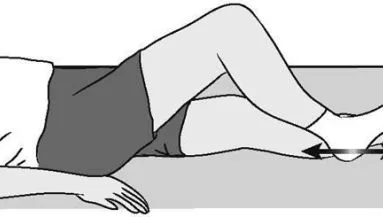
- Start with the supine. Lying on your back, hips straight out in front of you. Pulling the knee with your hip muscles will flex it. Carry as near to the rear as possible. Keep your feet in contact with the surface you’re lying on. Hold for 4-6 seconds, then gently move down and repeat.
- Benefits of These Exercises: Help to increase hip and knee range of motion. Helps to strengthen the hip muscles. Helps to strengthen knee and ankle ligaments.
Seated Knee Flexion & Extension
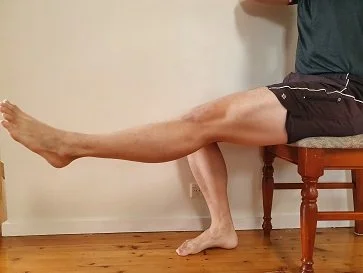
- Start the exercise by sitting with your back straight and your thighs resting on the chair. Flex the damaged knee as far back as possible, then hold that posture for five to ten seconds. Extend the injured knee as far as possible, holding the extension posture for five to ten seconds before relaxing.
- This exercise strengthens the hamstrings and improves knee range of motion. After two weeks of activity, you should be able to completely extend your knee and bend at least 90 degrees. Perform this exercise on both knees.
- Perform the sitting knee flexion and extension exercise 15-20 times each session, three sets per day.
Standing hamstring curl
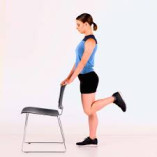
- Stand with your feet widely apart. Begin the workout by placing your hands on your waist or a chair for balance. Shift your body weight to the other leg. Slowly bend your right knee, bringing your heel to your back. Keep your thighs parallel. Gradually lower your legs.
- The repetition rate should be 13-15 each session, three sets per day.
- The standing hamstring curl is an excellent exercise for strengthening the thigh and calf muscles. You may complete this exercise from the convenience of your own home.
Clamshell
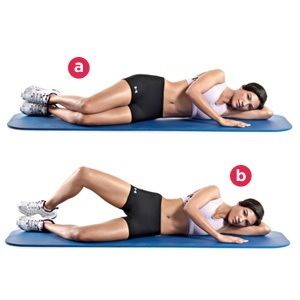
- Lie on your side on a mat, legs stacked and bent 45 degrees.
- Keep your upper leg bent and open, with your knee pointing toward the ceiling.
- Hold for five seconds, then slowly drop your leg back to its original position.
- Repeat 15 times and then swap sides.
Wall Squat
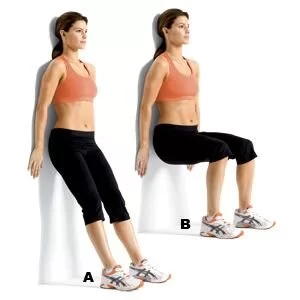
- Place your feet hip-width apart and lean your back against a wall.
- Slowly lower your back down the wall, keeping your thighs parallel to the ground.
- Hold this posture for a few seconds before gently sliding back up.
Single-Leg Romanian Deadlift
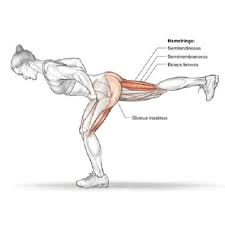
- Bend your knee slightly and stand on one leg.
- Keep your back straight and flex at the hips, lowering your body while elevating the opposing leg behind you.
- Return to your starting position.
- Repeat 10–15 times on each leg.
- Wearing sports shoes might help you keep perfect form during this activity.
Step-ups
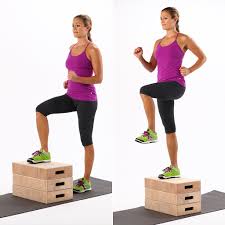
- Step-up exercises require a steady little stool or an aerobic step. Start by standing around 10 cm in front of a step or bench. Place your right foot on it, then walk on it to stretch your right leg. Raise your left leg until your thigh is horizontal (parallel with the ground). Place one foot back on the ground.
- To maintain balance, move your arms in the opposite direction as your legs. Repeat 10-20 repetitions, then swap sides. Complete three sets.
Hip Flexor Stretch
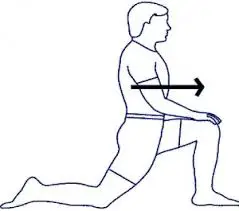
- Stand in a lunge stance, leaving your damaged knee behind.
- Keep your back straight and press your hips forward until you feel a stretch at the front of your hip.
- Hold for 30 seconds, then repeat three times on each side.
Quad Stretch
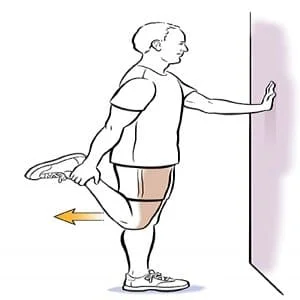
- Standing on one leg, lift the other foot toward your buttock while keeping your knees together and pulling your hips forward.
- Hold the stretch for 30 seconds, then repeat three times on each side.
Calf Stretch
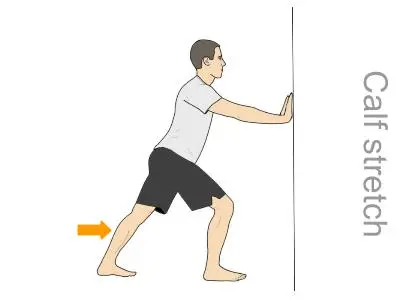
- Position your hands against a wall and one foot behind the other.
- Push the heel of the back foot down and lean against the wall until you feel a stretch in your calf.
- Hold for 30 seconds, then repeat three times on each side.
Iliotibial band stretch
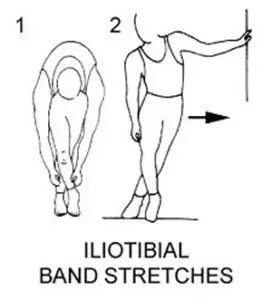
- Bend the left leg on the floor and position the left foot outside the right hip.
- Flex your right hip and position your right foot on the floor, opposite your left thigh.
- Exhale and rotate your lower body to the right.
- Put your left fingers on the floor and move your hips. Wrap your elbow over your knee, or lay it on the other side of your knee, palm front. Look back over your shoulder.
- Hold this posture for up to one minute before repeating on the opposing side.
Aerobic Exercises for Patellofemoral Pain Syndrome:
Aerobic workouts are important for maintaining cardiovascular fitness, which is required for general health and recovery. Individuals healing from patellofemoral pain syndrome (PFPS) should engage in low-impact aerobic exercises. These include joint-friendly exercises such as stationary cycling and walking. Such workouts can assist in maintaining fitness levels without worsening the knee issue.
Precautions while exercising
- Avoid quick or jerky movements when exercising.
- Maintain proper posture by keeping your heart stable and your legs straight; avoid bending your knees in or out.
- Wear comfortable sports clothing that allows you to move freely, as well as robust cushioned sports shoes with nonslip bottoms.
- If the knee joint is inflamed, swollen, and painful even when resting, you should avoid strengthening workouts.
Activities or Exercises to Avoid with Patellofemoral Pain Syndrome
Basketball
Basketball involves frequent jumps and rapid changes in direction, which can put undue strain on the knees. This can lead to the development or worsening of patellofemoral pain syndrome; thus, it is best to avoid this activity if you have knee pain.
Volleyball
Volleyball requires repeated jumping actions like spiking, blocking, and diving, which can place a strain on the knees. These high-impact activities may increase knee soreness and the symptoms of patellofemoral pain syndrome.
Lunges
Lunges can put a lot of strain on the knee joint, especially if they are not executed properly. When performed correctly, lunges may be an effective exercise for strengthening the muscles surrounding the knee. Individuals with patellofemoral pain syndrome should exercise caution since lunges can worsen symptoms and produce additional discomfort.
Deep Squats
Deep squats, in which the hips are lower than the knees, can put more strain on the patellofemoral joint, causing pain and discomfort in people who have patellofemoral pain syndrome. Deep squats should be avoided and substituted with reduced squats or activities that are easier on the knee joint.
Running or Jogging
Running or jogging may increase patellofemoral pain syndrome, often known as runner’s knee. Running’s repetitive impact and stress on the knee joint can exacerbate symptoms, especially when done on hard terrain or with inappropriate footwear.
High-Impact Aerobic Activities
High-impact aerobic exercises like jogging and jumping can aggravate knee pain and should be avoided or minimized. Instead, think about using a bridging program as a low-impact way to protect your knees and relieve pain.
Prevention for patellofemoral pain syndrome
- Maintaining muscle balance: Strengthening the knee and leg muscles can help to eliminate muscular imbalances and improve knee alignment.
- Correcting flat feet: Wearing strong shoes and shoe inserts can help treat flat feet and relieve stress on the knee joints.
- A healthy weight: Being overweight stresses the joints and raises the risk of patellofemoral syndrome. A well-balanced diet can help you maintain a healthy body weight.
- Warming up before exercise: Always stretch and conduct mild movement before beginning a workout. This can improve flexibility and minimize injury risk.
- Gradual modifications to exercise routines: Sudden increases in exercise intensity, duration, or frequency can worsen knee pain.
- Avoid knee strains by engaging in low-impact activities, wearing supportive shoes, and utilizing knee braces during exercise.
When To Seek Medical Help
If your knee pain persists after a few weeks of rest and at-home remedies, see a doctor. If you’ve begun PFPS therapy and your pain returns or worsens, consult your physician or physical therapist. Inform them if any workouts or postures hurt.
Conclusion
Patellofemoral Pain Syndrome can be effectively managed with a consistent, well-designed exercise program that focuses on strengthening the hips, quadriceps, glutes, and core while improving flexibility and knee alignment. Exercises such as quad sets, straight leg raises, clamshells, bridges, wall sits, and step-ups help reduce pain, improve stability, and restore normal movement patterns over time.
Start with low-impact exercises and gradually increase the intensity as your pain decreases and strength improves. Avoid activities that significantly increase knee pain, and always perform exercises with proper form. If your symptoms persist, worsen, or interfere with daily activities, consult a qualified physiotherapist for a personalized rehabilitation plan. With patience and regular practice, most people with Patellofemoral Pain Syndrome can return to their normal activities with less pain and better knee function.
FAQs
Can exercise assist with patellofemoral pain syndrome?
Exercises to relieve patellofemoral knee pain. After experiencing patellofemoral knee pain, it is critical to restore mobility and strength. It promotes tissue repair and allows you to move again. You may not be able to resume your typical level of activity straight away, and recovery may be delayed.
Is cycling beneficial for Patellofemoral Syndrome?
Cycling may be beneficial for patellofemoral syndrome (runner’s knee) since it is a low-impact, non-weight-bearing activity that increases leg strength without the pounding stress of running. However, cycling with an inappropriate seat height, excessive resistance, or on upward slopes could worsen kneecap pain.
Will patellofemoral pain ever go away?
Yes, patellofemoral pain syndrome (runner’s knee) can be entirely resolved, but it rarely does so without active treatment. While early pain is frequently resolved in a few weeks with rest, total healing requires treating underlying muscular deficiencies and regulating activity loads, which can take anywhere from 6 weeks to several months.
Can I still walk with patellofemoral pain syndrome?
Yes, you can typically walk with patellofemoral pain syndrome, but you should do it slowly if it aggravates your front knee pain. Short, steady walks on level ground are usually safe, but steep slopes, stairs, and lengthy distances might stress the kneecap and cause pain.
Is the patellofemoral pain condition permanent?
No, patellofemoral pain syndrome (also known as runner’s knee) is not permanent. It’s a common and curable illness. Most patients recover completely within a few weeks or months by employing focused physical therapy, changing their normal routines, and strengthening weak leg and hip muscles.
References:
- Knee Pain Centers of America. (n.d.). Patellofemoral pain syndrome exercises. https://www.kneepaincentersofamerica.com/blog/patellofemoral-pain-syndrome-exercises.html
- Lakshmanan (Lucky) Sivasundaram M.D. (2026, August 15). Patellofemoral knee pain exercises – Lakshmanan (Lucky) Sivasundaram M.D. https://sivaorthosports.com/patellofemoral-knee-pain-exercises/
- Marek, M. (2026, March 18). Best (Runner’s knee) patellofemoral Pain Syndrome exercises. Peak Endurance Physical Therapy – Peak Endurance Performance & Physical Therapy – Madison, WI. https://peakendurancept.com/best-patellofemoral-pain-syndrome-exercises/
- Patellofemoral Pain Syndrome (PFPS). (n.d.). Cleveland Clinic. https://my.clevelandclinic.org/health/diseases/17914-patellofemoral-pain-syndrome-pfps