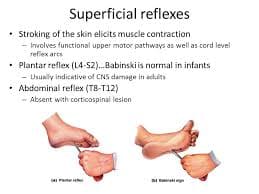
Superficial Reflexes
Superficial reflexes are involuntary muscle contractions that are elicited by stimulating sensory receptors in the skin or mucous membranes. They are polysynaptic, meaning that they involve multiple synapses between the sensory and motor neurons. Superficial reflexes are mediated by the lower motor neurons (LMNs), which are the nerves that connect the spinal cord to the muscles.
Superficial reflexes are important for protecting the body from harm and for maintaining normal muscle tone. For example, the corneal reflex helps to protect the eyes from foreign objects, and the abdominal reflex helps to protect the abdominal contents.
Reflexes are rapid, involuntary, and stereotyped responses to specific stimuli that play a fundamental role in the functioning of the nervous system. These automatic actions are critical for our survival and help protect us from potential harm by allowing the body to react quickly to various sensory inputs
List of Superficial Reflexes
- Corneal Reflex.
- Conjunctival Reflex.
- Nasal reflex
- Abdominal Reflex.
- Cremasteric Reflex.
- Planter Reflex.
- Pupillary Reflex.
- Pharyngeal Reflex.
- Scapular Reflex.
- Anal Reflex
Different Superficial Reflexes
There are a number of different superficial reflexes, but some of the most common include:
- Corneal reflex: This reflex is elicited by touching the cornea with a light wisp of cotton. The response is a blink.
- Conjunctival reflex: This reflex is elicited by touching the conjunctiva (the lining of the eyelid) with a light wisp of cotton. The response is a blink.
- Nasal reflex: This reflex is elicited by irritating the nasal mucosa with a feather or other light object. The response is a sneeze.
- Abdominal reflex: This reflex is elicited by stroking the abdomen in the four quadrants around the umbilicus. The response is a contraction of the abdominal muscles.
- Cremasteric reflex: This reflex is elicited by stroking the inner thigh in males. The response is a contraction of the cremaster muscle, which draws the testicle up into the scrotum.
- Plantar reflex: This reflex is elicited by stroking the sole of the foot from the heel to the toes. The normal response is a downward flexion of the toes.
- Pupillary Light Reflex
- Ask the person to focus on a certain item. A torch from the side shines into his eye, illuminating it. The pupil’s constriction indicates a positive reflex. Consensual light reflexes are known to cause the pupil of the opposing eye to tighten. On the other eye, the same steps are performed.
- Pharyngeal Reflex
- It is also known as the palatal reflex.
- Ask the individual to open his mouth and shut one eye. A tongue depressor is used to flatten the subject’s tongue. When a probe is pressed against the pharynx’s posterior wall, the tonsillar fossi’s pillars contract.
- Scapular Reflex
- Scratching the interscapular skin causes the scapular muscle to contract, which is noticeable. This response receives its neural input from the fifth cervical to first thoracic nerves.
- Anal Reflex
- Anal spincter contracts when the skin near the anus is touched or scratched. The S3 and S2 spinal segments have been linked in the reflex.
Superficial reflexes can be tested as part of a neurological examination. Abnormal reflexes can be a sign of damage to the nervous system. For example, hyperactive superficial reflexes can be a sign of upper motor neuron disease, while absent superficial reflexes can be a sign of lower motor neuron disease.
Superficial reflexes are important for assessing the integrity of specific neurological pathways and can help healthcare professionals diagnose certain neurological conditions or injuries. The presence or absence of these reflexes, as well as abnormal responses, can provide valuable information about the functioning of the nervous system.
Here are some tips for testing superficial reflexes:
- the patient is relaxed and comfortable position.
- Test the reflexes on both sides of the body and compare the results.
- Use a light touch when stimulating the skin or mucous membranes.
- If you are unsure of the results, ask another healthcare professional to test the reflexes.
References
A. (2016, December 3). To Demonstrate Superficial Reflexes on a Subject – All Medical Tests. All Medical Tests. https://allmedtests.com/demonstrate-superficial-reflexes-subject/