Bird Dog with Elbow to Knee Exercise
Introduction
The bird dog exercise targets core stability and spinal control while also engaging the hips and shoulders. Balance, coordination, and postural endurance are tested when performing this exercise in a four-point kneeling stance.
This exercise is commonly used for back pain rehabilitation, sports training, and injury prevention to increase trunk stability during limb movement.
Muscle Worked
Primary Muscle Groups: Upper Abs, Lower Abs, Transverse Abdominis
Secondary Muscle Groups: Side Shoulders , Front Shoulders , Rear Shoulders , Traps (neck) , Lats (back) , Glute Max
Benefits of Bird Dog with Elbow to Knee
- Strengthens core muscles: Many individuals use the bird dog workout to develop their core muscles. As previously said, it works your abdominals, glutes, and lower back’s erector spinae.
- Supports healthy posture: A strong core is essential for proper posture. Including the bird dog exercise in your training program helps enhance your spinal stability and posture.
- May ease lower back pain: Strong core muscles may also assist in alleviating lower back pain. This exercise is an excellent technique to strengthen your core while also stretching your spine. It can be useful in a well-rounded training regimen to prevent or manage low back pain.
- Improves balance and mobility: The bird dog workout strengthens your core and improves your mind-body connection. It can also help with hip and shoulder mobility because the action requires your arms and legs to move in a wide range of motion.
How to Perform Bird Dog with Elbow to Knee?
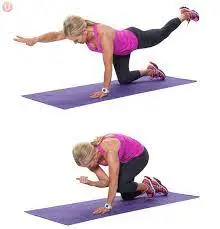
- Begin on your hands and knees on a mat or comfortable surface. To build a tabletop posture, place your hands exactly under your shoulders and your knees under your hips. Engage your core muscles to maintain your spine in a neutral position, with your back flat and no bending or rounding.
- Extend your right arm straight out in front of you, parallel to the ground, while also straightening your left leg behind you, parallel to the ground. Your arm and leg should be completely extended and create a straight line with your torso.
- Bend your right elbow and left knee at the same time from the extended posture, bringing them together under your body. Aim to bring your right elbow to your left knee under your body, or as near as possible without sacrificing form. As you do this action, contract your abdominal muscles and feel a crunch in your core.
- Fully stretch your right arm and left leg back to the beginning position before returning to the tabletop posture.
- Repeat the technique on the opposite side, now extending your left arm and right leg.
- Bring your left elbow to your right knee below your body, then return to the beginning position.
- Exhale while bringing your elbow to your knee and using your core muscles. Inhale as you stretch your arm and leg back to their beginning position.
Common Mistakes to Avoid
- Arching your lower back: Most people arch their lower back excessively when extending their arms or legs. This can stress the spine and limit the efficacy of the exercise.
- Overextending your arms and legs: This might result in a loss of balance and form. As a result, when performing this exercise, you must extend as far as your body allows while keeping your core engaged.
- Sagging hips: When your hips sag when moving, your lower back is put under unnecessary strain. Maintain alignment between your knees, shoulders, and hips.
- Not engaging your core: Failure to engage your core will result in instability as well as reduce the efficacy of the workout. To maintain a steady stance throughout this exercise, draw in your abdominal muscles.
- Moving too quickly: Rushing through repetitions lowers muscular activation and challenges stability. Slow down the movement. Count to three as you stretch, hold for five counts, and then count three times to return to your starting position.
- Bringing the elbow and knee together by overly rounding the spine.
Bird Dog with Elbow to Knee Variations
Basic Bird Dog
How to do:
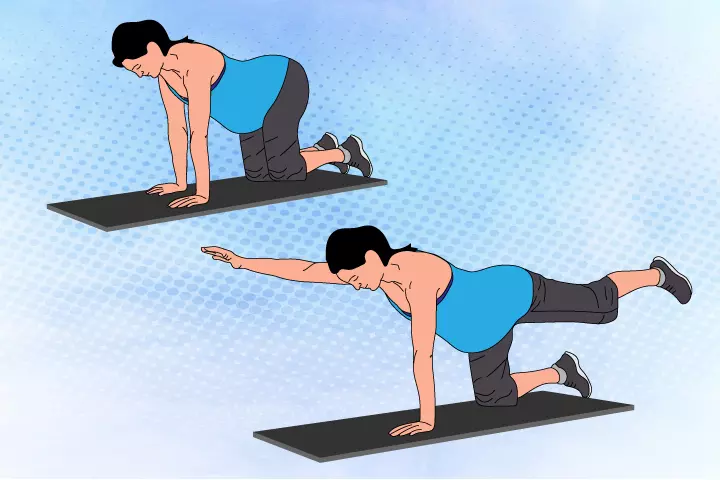
- Begin on your hands and knees, placing your wrists exactly beneath your shoulders. Your knees should be squarely beneath your hips, your spine neutral, and your head level with your back.
- Slowly extend your right arm straight out in front of you, keeping your thumb pointed up. At the same moment, move your left leg behind you, keeping it parallel to the ground.
- Use your body to maintain a straight line from your right hand to your left foot. Square your hips to the ground and utilize your core to maintain stability for a few seconds.
- Gradually return your arm and leg to the initial step without arching your back.
Bird Dog crunch
How to do:
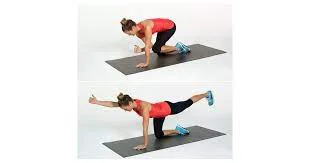
- Kneel on the mat on all fours. Reach one arm long, draw in your abs, and stretch the opposing leg long behind you.
- As you circle your back, bring your elbows and knees closer to your core, keeping your abs tight.
- Repeat for the appropriate number of repetitions, then swap sides.
Resistance-band Bird Dog
How to do:
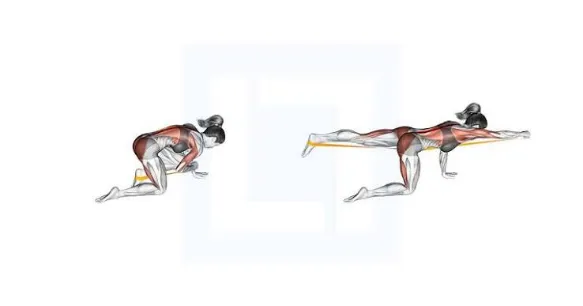
- Get on your hands and knees at a tabletop position.
- Wrap a resistance band around your right hand and left foot.
- Brace your core. Keep your back flat.
- Extend your right arm forward while pulling your left leg back against the band tension.
- Squeeze your glutes and core to maximum extension. Hold for 1–2 seconds.
- Return to the starting point while in control.
- Complete repetitions on this side, then swap the band to the left hand and right foot.
Weighted Bird Dog
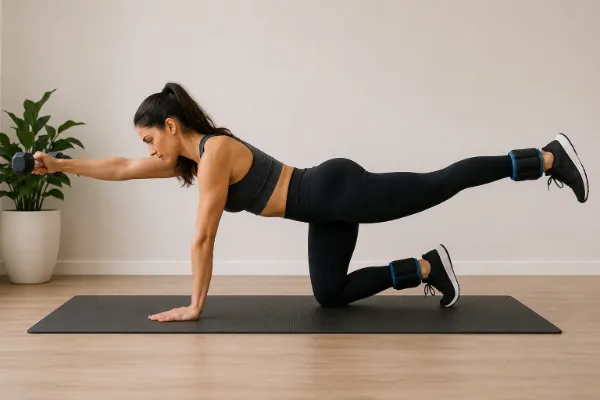
You may execute this exercise with a dumbbell, ankle weights, or a weighted household object like a soup can, book, or full water bottle.
Advanced Bird Dog from a bear-plank position
How to do:
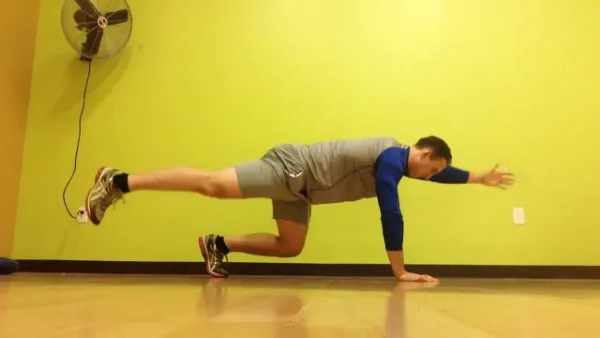
- Begin in a Bear Plank position: arms straight, hands beneath shoulders, feet at hip width, knees lifted, hovering just off the floor.
- Then, keeping your hips low and your pelvis slightly tucked, brace your core as if you were ready to be punched in the stomach.
- Shift your weight evenly between two diagonally opposite points of contact, one palm of your hand and the ball of the diagonally opposite foot, with as little torso movement as possible at the hips and shoulders.
- Then, simultaneously raise the free, unloaded foot from the floor, as well as the diagonally opposite unloaded hand, shifting pressure evenly between the two remaining points of contact (the grounded hand and foot).
- Fully extend your free leg behind you, forcing the heel against the wall, while also stretching out far with your free arm to the wall in front of you.
- Then, return both the arm and leg to the starting position, re-engaging the ball of the foot and palm with the floor as you alternate, extending the opposing leg to the wall behind you and the other arm straight to the wall in front.
- Throughout the exercise, keep your shoulders down and away from your ears, and pinch your armpit to position your arm on the floor.
When to avoid
- Acute back injuries: If you have a recent back injury, herniated disk, or acute pain, speak with a healthcare physician before using bird dogs.
- Shoulder instability: Those with severe shoulder difficulties may need to reduce or avoid the full arm extension.
- Wrist ache or carpal tunnel syndrome: The quadruped pose puts strain on the wrists; use fists or rest your hands on an elevated surface if necessary.
- Advanced Pregnancy: In later stages of pregnancy, reduced or alternative workouts may be more acceptable.
- Balance disorders: If you have trouble with balance, make sure you have support nearby or consider wall-supported adaptations.
- During pain: Stop if you feel pain (not the typical difficulty of the activity).
Safety Tips
- Maintain a level back and prevent sagging or arching.
- Don’t rotate your hips toward the elevated leg.
- Look down to maintain your neck in a comfortable line.
- Move gently, rather than swaying the limbs.
- Stop if you experience intense pain, numbness, or dizziness.
Conclusion
Bird Dog with Elbow to Knee is a great bodyweight exercise for core stability, balance, coordination, and controlled movement. The exercise tests the core’s stability by extending the opposing arm and leg and then bringing the elbow nearer the knee.
Instead of doing a lot of repetitions, concentrate on calm, controlled motions, a neutral spine, and solid hips. Begin with a simple Bird Dog if necessary, and then move to the elbow-to-knee variety as your strength and coordination develop.
FAQs
Is Bird Dog with Elbow to Knee suitable for beginners?
Yes. Beginners can start with the basic Bird Dog and progress to the elbow-to-knee movement provided they have adequate balance and a neutral spine.
How many repetitions should I perform?
A usual beginning point is 8-12 repetitions each side over 2-3 sets. Concentrate on steady movement rather than doing a lot of repetitions fast.
Can Bird Dog With Elbow to Knee Improve Balance?
Yes. Because the exercise challenges you to stabilize your body while moving opposing limbs, it can help you improve your dynamic balance, coordination, and overall body awareness.
References:
- JEFIT Inc. (n.d.). Bird dog elbow to knee – JEFIT. https://www.jefit.com/exercises/1353/bird-dog-elbow-to-knee
- Peak Physio. (2025, August 14). Bird dog Exercise • Peak Physio. https://www.peak-physio.com.au/exercise/bird-dog/
- Elbow to knee bird dog. (n.d.). Total Workout Fitness. https://totalworkout.fitness/en/exercise/10053
- Green, R. (2025, November 26). Bird Dog Exercise: How-To Video Variations, Mistakes to Avoid. PRICE Health. https://www.pricehealth.ca/blog/bird-dog-exercise/
- Cpt, C. F., & Cpt, C. F. (2024, November 8). How to do a bird dog crunch. Get Healthy U | Chris Freytag. https://gethealthyu.com/bird-dog-crunch/
- Heatrick, D. (2025, August 30). Bear Plank bird dog – Evil core exercise. Don Heatrick Muay Thai Performance. https://heatrick.com/2024/11/01/bear-plank-bird-dog-evil-core-exercise/
- Lift Manual. (2026, May 5). Resistance Band Bird Dog: Loaded Core Stability drill. https://liftmanual.com/resistance-band-bird-dog/