Reverse Crunches
Introduction
Reverse crunches are an important core exercise for strengthening the lower abdominal muscles. This activity includes elevating the hips and legs toward the chest, which helps to strengthen the abdominals, enhance stability, and promote good posture.
Unlike traditional crunches, which elevate the shoulders off the floor, reverse crunches focus on bending the hips and knees toward the chest while preserving upper-body stability.
This exercise strengthens the abdominal muscles while also working the obliques and transverse abdominis, which improves pelvic control and core stability. In general, reverse crunches are gentler on the spine and less prone to produce strain since the neck and upper back remain fixed. They are an excellent addition to any at-home training plan for both beginner and expert athletes since they are simple to do and require no extra equipment.
Reverse Crunches: Muscles involved
Understanding the muscles you want to target may have a significant impact on the success of your workout. Before we begin the Reverse Crunch exercise, I’d want to talk about the muscles that are employed.
When you know which stomach muscles you’re using and how they operate, you can focus on using them correctly. This reduces the risk of damage and ensures that you make the most of each rep.
The Reverse Crunch focuses on the following main muscle groups:
- The rectus abdominis is the muscle that gives you the ideal six-pack abs. However, this muscle is critical for core stability and strength, so it’s more than just looks.
- The rectus abdominis muscle joins your hips and ribs, starting at the bottom of your pelvis and running straight up the front of your body to just below your chest.
- The muscle’s major job is to flex the lumbar spine, which is performed by performing a sit-up or crunch.
- This muscle stabilizes your lower back and pelvis and is required for workouts such as the Reverse Crunch and Traditional Abdominal Crunches. This allows you to avoid injuries and maintain an appropriate posture when conducting heavy lifting.
External oblique:
- The external obliques, a critical component of your core muscles, are frequently ignored in favor of the more popular outer, six-pack muscles, such as the rectus abdominis.
- Oblique muscles run down the sides of your abdomen and are essential for effective ab exercises and a strong core.
- Starting with the bottom eight ribs, the external obliques proceed diagonally forward and downward until they meet the iliac crest of your pelvis. Because of their placement, they may make major contributions to a wide range of exercises and workouts.
- The external obliques contribute significantly to the twisting motion during crunches, particularly crossover or bicycle crunches, which help in core stabilization and torso rotation.
- The external obliques are responsible for sideways trunk bending and rotation, which is necessary for workouts such as the Basic Crunch and Reverse Crunch.
- When both sides contract at the same time, as in a standard crunch or abdominal crunch exercise, the spine flexes as well.
- These abdominal muscles also help to maintain proper form during tough, popular workouts and stabilize the pelvis during lower-body activity.
Internal oblique:
- The internal obliques are important for ab workouts and overall body strength because they work with the external obliques to provide stability and strength in your core.
- Your internal obliques originate from your pelvis’s inguinal ligament and iliac crest. They cling to the lower ribs and the linea Alba, a fibrous tissue that runs diagonally up and down the center of your belly.
- Because of their muscle position, the internal obliques can play an important part in a variety of core workouts, including crunches, reverse crunches, and bicycle crunches.
- In terms of function, the internal obliques control sideways bending and trunk rotation.
- Along with the rectus abdominis and external obliques, they aid in the flexion of the spine during classic crunches or abdominal crunch workouts, therefore stabilizing your core.
- This stability is crucial for performing heavy lifts and other difficult workout activities effectively and safely.
Core stabilizer muscles:
- The transverse abdominis is a deep core muscle that is often overlooked yet essential for a strong, stable core.
- This muscle, which wraps around your core and functions as your body’s natural weight belt, is critical for sustaining your daily movements and workouts.
- The transverse abdominis originates at the iliac crest, lower ribs, and thoracolumbar fascia before inserting into the pubic crest and linea alba.
- This muscle is commonly known as the “corset muscle” since it spans the abdomen horizontally. Because of its unique positioning, it is critical for core stabilization, especially while undertaking strenuous activities and heavy lifting.
- The transverse abdominis stabilizes your spine and pelvis while compressing the abdominal cavity.
- Whether you’re doing more dynamic exercises like bicycle crunches or more traditional ones like reverse crunches, this muscle is engaged in almost every core workout.
- It is the muscle that keeps your core stable and powerful by helping you maintain proper form throughout the exercise.
Serratus anterior:
- Many individuals completely ignore—or worse, are unaware of—the serratus anterior, which is an abdominal muscle.
- This muscle has significance for both functional strength and physical appearance, particularly during vigorous exercise.
- This muscle is commonly known as the “boxer’s muscle” because it resembles saw teeth.
- It is necessary for workouts such as push-ups, bench presses, and overhead presses since it plays an important part in pushing activities.
- The serratus anterior controls the scapula’s upward rotation and protraction. In other words, it helps your shoulder blades travel forward and around the rib cage, which is required for a full range of motion while pressing.
Reverse Crunches Video
How to Do Reverse Crunches?
- Posture: The supine resting posture.
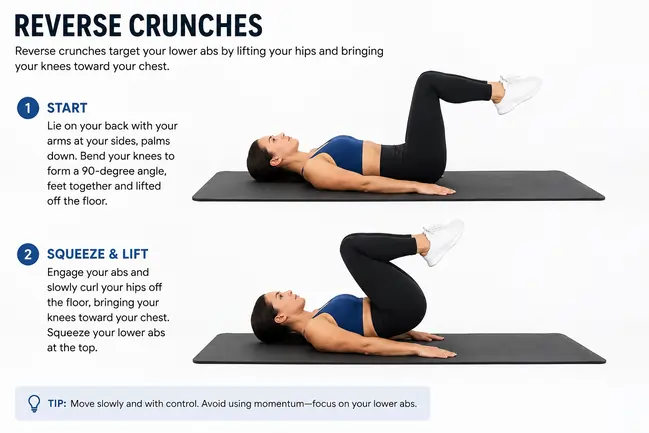
- To begin, lie flat on an exercise mat with your calves parallel to the floor and your knees bent at a 90° angle. Maintain support by keeping your hands at your sides or beneath your hip muscles.
- As you begin, make sure your legs are as straight as possible throughout the workout.
- Concentrate on using your lower abdominal muscles to lift your hips off the ground. This is not about swaying back and forth or swinging your legs, so avoid using momentum.
- Make sure you’re exercising the rectus abdominis and transverse abdominis correctly by pulling your heels back until they’re vertical as you lift your legs.
- Control is important. Curve your pelvis up and steadily raise your hips toward your chest to completely engage your core muscles. Hold for a little period at the top.
- Maintain your equilibrium as you gradually drop your hips back down. Instead of letting your legs drop all the way to the floor, maintain them in that contracted position to keep your abs tense throughout.
- Remember that the goal is quality, not quantity. Try to perform 8–12 crunches (or as many as you can with perfect form) to ensure a strong core and avoid neck strain. Keep your form firm and pay special attention to the contraction.
Additional Reverse Crunch Variations
There are several techniques to execute crunches. Beginners may transition to a format they can do with correct form as they develop strength. As you go, you can raise the level of difficulty.
Reduce Your Range of Motion
- If you don’t have the power to roll up without momentum 4 or manage the return to the starting position, try a smaller range of motion. During the climbing phase, go as far as you can manage. At first, this can only be a little movement that raises your tailbone off the ground.
Getting Ready for a Complete Reverse Crunch
- Another method of building the required strength is to tap your feet. Lower one pointed-toe leg from the starting position until it taps the ground. Put that leg back in the starting position and repeat with the other leg. Keep your lower back, hips, and tailbone on the mat while performing this exercise. Do 15 to 20 toe taps on each side.
Including an Additional Challenge
- The combined or complete crunch is one exercise that combines shoulder and leg/hip action. It may be done with your legs raised and bent at a 90-degree angle, or with your knees bent and your feet resting on the ground.
Cable Reverse Crunch
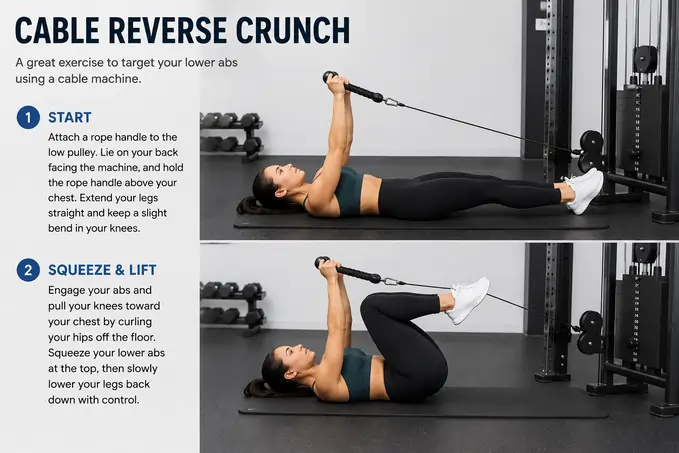
- Connect a cable pulley machine to an ankle strap.
- Lie down on the bench, fasten the wire to your ankles, lift your legs, and bend your knees to create a 90-degree angle between your ankles and your body.
- You will feel some stress in your abs if you draw your knees into your abdominal muscles while keeping your hands behind your head.
- Return to the 90-degree angle position after holding this posture for a short while.
Seated Reverse Crunch
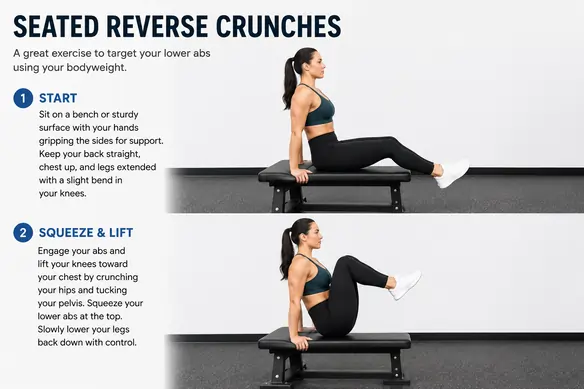
- With arms straight and hands touching the floor, take a seat on the mat.
- Raise the opposite straight leg off the ground while bending one knee.
- Bend your knees fully and contract your abs as you rock back onto your shoulders. Lift your legs over your head and press your hands into the ground.
- Now rock forward and assume the posture with one leg straight and one knee bent.
- Use your hands to raise your hips off the floor, contract your abs, and then go back to your starting position.
Benefits
- Targets lower abs: Reverse crunches focus on the lower region of the rectus abdominis, which is usually under-activated during conventional crunches.
- Engages deep core muscles, including the transverse abdominis and obliques, to enhance core stability and control.
- Improves pelvic control: The curling action trains the muscles that support the pelvis, which is necessary for healthy posture and efficient movement.
- Reduces spinal strain: Reverse crunches, as opposed to standard crunches, reduce lumbar and neck pain by keeping the upper back stable.
- Improves posture: Having a strong core helps to maintain an upright posture, which reduces the pressure on the shoulders and back.
- Improves athletic performance: A strong and stable core helps with power transmission, balance, and agility in daily activities and sports.
- Prevents injuries: By strengthening the core, lower back conditions can be avoided, and the spine can be protected.
- No equipment is required: With just bodyweight and a soft surface, reverse crunches are simple and efficient at-home exercises.
Common Mistakes To Avoid While Performing Reverse Crunches
Strain In The Neck
- Straining your neck while completing the move is a common mistake. Maintain a neutral neck posture during the exercise to avoid neck pain.
- To avoid neck injuries, do not pull on your head or neck with your hands.
- The motion should come from your abdominal muscles, not your upper body, and your neck should remain still.
Limited Range Of Motion
- The Reverse Crunch’s use is restricted since many people don’t use its full range of motion.
- Make sure you manage the downward movement and elevate your hips adequately off the training surface.
- This ensures that both your transverse and rectus abdominis muscles are fully tightened.
Wrong Leg Position
- Keeping with the prior idea, you should complete the Reverse Crunch with your legs as straight as possible.
- When raising your legs, try to restore your heels to the vertical position.
- This posture ensures a wide range of motion and helps to properly target the lower abs.
- Keep your abs tense during the exercise and avoid allowing your legs to drop completely.
Ignoring The Core Involvement
- Another common problem is failing to fully utilize the core muscles. Throughout the workout, focus on tightening and maintaining your abdominal muscles.
- This strengthens your core and more effectively targets your abs.
- To promote muscle activity, draw your belly button forward toward your spine.
Inadequate Breathing
- The majority of people don’t breathe properly during the Reverse Crunch. Breathe in as you go down and exhale as you raise your hips.
- This breathing technique ensures that your core muscles are properly engaged and allows you to maintain a controlled motion.
Inconsistent Form
- Uneven form is one of the most common faults made when doing the Reverse Crunch. To maximize the benefits and minimize errors, changes based on your unique fitness level are required.
- Depending on your fitness level, your Reverse Crunch technique may need to be adjusted.
- It’s okay to start with your knees slightly bent and work your way up to proper form as your strength increases because beginners may find it difficult to maintain straight legs throughout the exercise.
- Maintaining proper form and avoiding unnecessary pressure on your neck and lower back necessitate that your abdominal muscles stay engaged throughout the movement.
- Using an incline or decline bench may increase the variety and intensity of your workouts.
- A decline bench increases resistance, making your lower abs work harder.
- Using an incline bench allows beginners to develop good form and motion with less intensity.
- Maintaining proper form is vital whether utilizing an exercise mat or a bench. Avoid utilizing momentum and keep your motions controlled. To elevate your hips, use your core muscles rather than your legs.
- Maintaining a neutral neck posture can help reduce neck pain. Pull your belly button in toward your spine to stimulate the rectus and transverse abdominis muscles.
Indications
Strengthening the Core
- Ideal for those looking to improve their lower abdominal muscles, namely the rectus and transverse abdominis.
- Advantageous for athletes who want to strengthen their core stability for more dynamic movements and better sports performance.
- People with poor posture due to weak core muscles should improve their posture since reverse crunches help to stabilize the lumbar spine and pelvis.
- Low-impact abdominal training, unlike traditional crunches, is excellent for people who need a core workout that relieves tension on the neck and upper back.
Preventive care and rehabilitation
- If no contraindications exist, such as a spinal disc condition, it can be used in physiotherapy to gently activate the core following an injury. Increases the strength of the muscles that sustain spinal alignment, hence avoiding lower back pain.
Overall, Health and Toning
- Good for those looking to eliminate belly fat and tone their abs as part of a bigger training regimen. Because of its simplicity and lack of equipment needs, it is ideal for at-home training.
Contraindications
- Acute or persistent lower back pain: If the activity is performed incorrectly or with excessive velocity, it may impose strain on the lumbar spine.
- Disc herniation or bulging: When performing reverse crunches, those with spinal disc issues may experience increased strain on their lumbar discs. Exercises that put a lot of strain on the core might slow the healing process after recent abdominal or pelvic surgery (for example, hernia repair or C-section).
- During pregnancy, particularly in the second and third trimesters, later in pregnancy, supine posture and abdominal tension may not be safe.
- Uncontrolled hypertension or cardiac disorders: During crunches, straining might raise intra-abdominal pressure, thereby affecting heart load and blood pressure. Insufficient control can lead to improper form and increased risk of injury. This is particularly true for novices or individuals with weak core muscles.
- Cervical spine issues: Although reverse crunches are less stressful on the neck than traditional crunches, compensatory movements or poor posture can still have an impact.
Conclusion
The reverse crunch exercise, which targets the lower abdominal muscles, is a low-impact, effective technique to strengthen your core and improve your stability. When performed correctly, it can help to stabilize the spine, enhance balance and coordination, and improve posture.
However, while reverse crunches do not immediately remove belly fat, they should be combined with a healthy diet, full-body exercises, and regular exercise routines to achieve the greatest outcomes. To minimize strain or harm, good form and gradual development are essential.
FAQs
How do reverse crunches work?
Reverse crunches primarily work the rectus abdominis (the “six-pack” muscle), with a focus on the lower abdominal area. They also activate your deep core, hips, and obliques, making it a terrific exercise for strengthening stability while being gentler on your back and neck than typical sit-ups.
What are alternatives to reverse crunches?
Lying leg raises, hanging knee raises, and mountain climbers are all effective alternatives to reverse crunches for targeting your lower abdominal and core. These exercises use a similar curling action or a severe isometric hold to increase core strength while minimizing pressure on your lower back.
Why don’t I feel the reverse crunches?
Some frequent mistakes to avoid when practicing reverse crunches might reduce the exercise’s effectiveness. The most common error I notice is swinging the legs, which uses momentum to lift the hips rather than engaging the core muscles. People also frequently lift their hips and legs too high off the ground.
What is the difference between a reverse crunch and a normal crunch?
While a typical crunch targets the upper abs by lifting your upper body towards your knees, a reverse crunch targets the lower abs by lifting your hips towards your chest.
Is it possible to reduce fat in the belly with the reverse crunch exercise?
The reverse crunch exercise does not immediately eliminate belly fat, but it helps to tone and build the lower abdominal muscles. A common fitness myth is spot reduction, which maintains that training a specific region can only burn fat from that location. When you burn more calories than you consume through a mix of regular exercise, a nutritious diet, and general lifestyle changes, you lose fat throughout your body.
However, when combined with full-body strength training, aerobic activities, and a nutritious diet, reverse crunches can help you achieve a more toned and flatter appearance. To summarize, reverse crunches enhance muscle definition and core strength, but a full workout plan is required to lose belly fat.
What are the fundamental concepts of core exercise?
The fundamental concepts of core training center on strengthening the muscles that support the spine, pelvis, and trunk in order to enhance stability, posture, and general bodily function. These concepts include maintaining good alignment and posture throughout movements, activating core muscles (particularly deep stabilizers such as the transverse abdominis) throughout the exercise, and moving with control rather than momentum.
Breathing appropriately is also important—exhaling during exertion and inhaling during rest helps keep the core engaged and eliminates unneeded strain.
Balance, coordination, and a progressive increase in intensity are all essential for safety and efficacy. Building a strong and solid core requires consistency and proper technique.
References:
- Rogers, P. (2023, July 5). How to do a reverse crunch. Verywell Fit. https://www.verywellfit.com/how-to-do-the-crunch-3498607
- The benefits of a reverse crunch and how to do it correctly. (2020b, November 24). Healthline. https://www.healthline.com/health/reverse-crunches#bottom-line
- Cscs, J. C. M., & Cscs, J. C. M. (2025, March 24). How to do reverse crunches | ATHLEAN-X. ATHLEAN-X. https://learn.athleanx.com/articles/abs-for-men/how-to-do-reverse-crunches