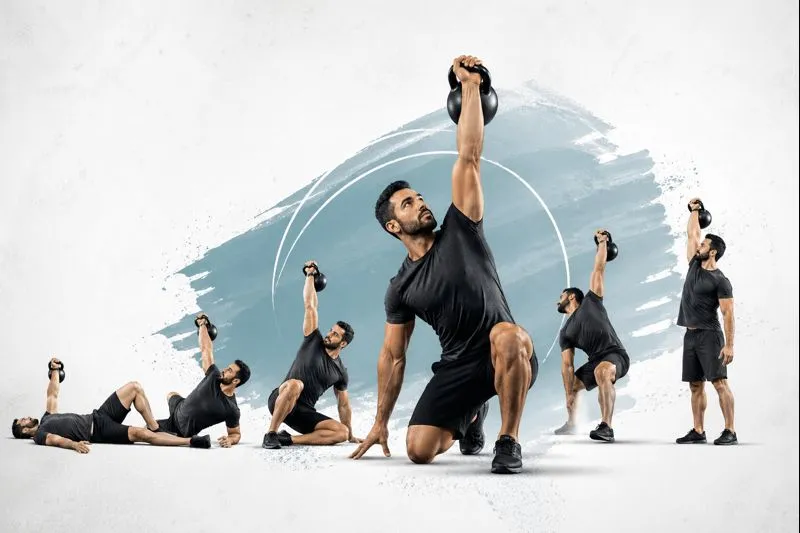
Turkish Get-up
What Is a Turkish Get-Up?
The Turkish Get-Up is a functional exercise created by ancient warrior training. It is now a staple of modern strength training, involving moving from a lying to a standing position while holding a weight, usually a dumbbell or kettlebell, extended overhead.
It’s a compound exercise that consists of several small movements and requires flexibility, stability, and strength.
A Turkish get-up is a functional exercise that takes you through all of the planes of motion and movement patterns your body requires to maintain strength, mobility, and stability. This move improves not only your physical strength but also your confidence and cognitive performance.
What Muscles Does a Turkish Get-Up Work?
What separates the Turkish Get-Up exercise is its ability to activate multiple muscle groups at the same time. As you progress through the different phases of the exercise, you’ll engage:
Shoulders: The deltoids, rotator cuff muscles, and scapular stabilisers are all actively working to keep you stable and in control as you stand up.
Legs: The quadriceps, hamstrings, and calves are activated to stabilize the knees and hips while maintaining proper form and posture.
Core: As you move from supine to standing, you work the rectus abdominis, obliques, and erector spinae muscles.
Glutes: This exercise involves the gluteus maximus, medius, and minimus muscles, all of which help you propel your body from the floor while maintaining hip stability.
How to Do a Turkish Get-Up
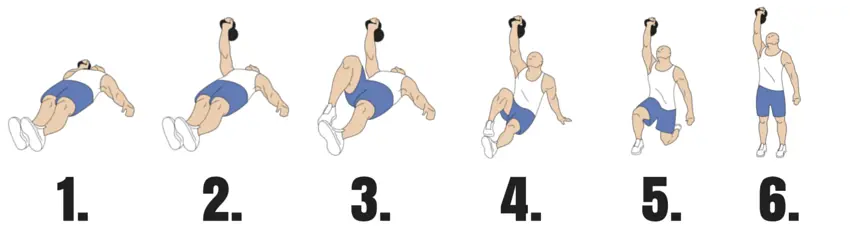
- Lie on your back, left knee bent, right leg straight. Keep your left foot flat on the ground. Maintain some distance between your left and right legs.
- Raise your left arm towards the ceiling. It should be externally rotated. Keep your left shoulder down and away from your ears. Hold a weight or keep your hand in a fist.
- Keep your right arm flat on the floor. Your right palm should be facing the floor. Maintain some space between your hip and your arm for balance.
- Drop your left knee towards your right. Transfer to your right forearm. Keep your left arm fully locked. Pay attention to the weight of your fist.
- Brace your core muscles. Push up with your right hand while keeping your left shoulder away from your ear. Do not fall into your own traps.
- Lift your hips into a bridge position. Your right leg should extend straight out.
- Place your right leg under your body into a half-kneeling position (also known as a half-kneeling windmill). Maintain visual contact with the weight. Rotate your hips and square them forward.
- Gradually stand up. You’ve completed the first half of the movement.
- Take your time reversing these steps back to the starting point.
The Phases of a Turkish Get-Up
From a Supine Position
- Roll to your elbow
- Supported seated
- High bridge
- Half-kneeling windmill
- Half-kneeling position
- Stand up
From Standing
- Half-kneeling position
- Half-kneeling windmill
- Kick to the high bridge
- Supported seat
- Lower down to the elbow
- Roll down to a supine position
How to Program the Turkish Get Up
Movement Integrity – Reps and Sets
To ensure that the lifter can carry out a stable and controlled positioning at every stage, this should be done with bodyweight or light loads (see how to perform a proper Turkish get-up above).
3-4 sets of 3-5 repetitions, resting 2-3 minutes
Strength – Reps and Sets
Lower repetitions with more sets can be used for more strength and stability-focused work, giving the athlete enough time to rest between sets.
3-4 sets of 1-3 repetitions, resting 2-3 minutes
Variations
Double Kettlebell Turkish Get Up
This Turkish get-up variation is done by having two kettlebells being used, one in each hand. This is an extremely challenging get-up variation that stresses higher amounts of core stability, shoulder strength, and mobility. This is not a variation for beginners.
Tempo Turkish Get Up
To gain more control and awareness when learning the Turkish get-up, it can be beneficial to have an athlete perform each step above. The athlete will then pause at each step for a few seconds. This can also lengthen the athlete’s time under stress, improving their control and coordination.
Barbell, Dumbbell, and Other Odd Object Turkish Get Up
Although kettlebells are frequently used for Turkish get-ups, dumbbells, barbells, and even people have been used as loads. The athlete can increase wrist strength and stability, improve shoulder stability, and increase the Turkish get-up’s programmatic versatility by using alternative loading techniques.
The Benefits of the Turkish Get-Up
- Teaches you how to stabilize both your upper and lower body.
- Promotes spatial awareness, also known as proprioception.
- Improves mobility in your hips, shoulders, and spine.
- Boosts your overall strength.
- Encourages cross-laterality (cross-crawl patterns that make both sides of your brain and body work together).
- Teaches you how to shift your weight from front to back.
- Develops strong posture.
- Promotes stability in your trunk
- Boosts confidence.
- Improves your self-awareness
Common Mistakes
- Trying the exercise for the first time with a weight.
- Rushing through the exercise—or moving too quickly.
- Not practicing the movement.
- Not paying attention to your body’s positioning throughout the sequence.
- Not breathing during the exercise.
- Not focusing on the weight or your first.
- Bending your raised arm or not packing your shoulder.
Who Should Do Turkish Get-Ups?
The Turkish get-up is beneficial to almost every athlete and individual because it tests core stability, upper-body strength, and overall body movement. The following are the primary groups of people who can benefit from including these in a training program.
Turkish Get Ups for Strength and Power Athletes
The Turkish get-up can be an effective warm-up, functional strength, and/or corrective exercise for strength and power athletes. The ability to maintain overhead stability during movement is essential in most lifts in these sports, and it can help prevent shoulder injuries. In addition, the Turkish get-up can be a useful exercise for athletes who want to vary their fitness by moving in non-sagittal patterns.
Turkish Get Ups for CrossFit/Competitive Fitness Athletes
The Turkish get-up, like the strength, power, and general fitness athletes, can be used to improve shoulder and core stability, as well as overall hip function and movement.
Turkish Get Ups for General Fitness
Turkish get-ups are useful for almost everyone, with or without loading. The Turkish get-up can help improve movement, core strength, and shoulder stability. This movement should be taught slowly and with light loads before adding weight to avoid injury.
Conclusion
Turkish Get Ups are one of the most effective full-body exercises for building strength, stability, and coordination. By combining controlled movement with core engagement and shoulder stability, they help improve functional fitness that carries over into everyday activities and other workouts. While the movement may seem complex at first, consistent practice with proper form can lead to significant gains in mobility, balance, and overall body control.
Whether you’re a beginner starting with bodyweight or an advanced lifter using a kettlebell, incorporating Turkish Get Ups into your routine can elevate your training. Focus on technique, progress gradually, and you’ll unlock a powerful exercise that delivers long-term strength.
FAQs
Why are they known as Turkish get-ups?
Some believe that ancient wrestlers in what is now Turkey invented the get-up to prepare for their tough competitions. Furthermore, it demonstrated their immense strength to one another.
Can Turkish get-ups help prevent injuries?
The Turkish get-up exercise helps you identify asymmetries between your left and right sides of the body. For runners, this is a significant injury-prevention benefit.
How long should a Turkish get-up take?
The time required to complete the TGU is approximately 20 seconds to get up and 18 seconds to get down. If you include the safety roll, chest press, and preparation, you can count one minute for each rep.
Are Turkish get-ups good for the back?
Turkish kettlebell get-ups improve your overall physical mobility. This stretches the upper back and hips, making you more flexible. This reduces lower back injuries and aches while keeping you healthy and pain-free. Furthermore, this exercise strengthens your core.
References:
- Sayer, A. (1970, January 1). Don’t be intimidated by the Turkish Get-Up. Here’s how to do it properly. https://www.onepeloton.com/blog/turkish-get-up
- The Spartan Editors. (n.d.). 9 Benefits of the Turkish get up: How to master the exercise. https://www.spartan.com/en/blog/turkish-get-up
- The Turkish Get-Up: What is it and How to Do it. (n.d.). https://www.thegymgroup.com/exercises/total-body-exercises/turkish-get-up/
- Dewar, M., & Dewar, M. (2025, June 18). Turkish Get Up Exercise Guide. BarBend. https://barbend.comget-upsh-get-up/