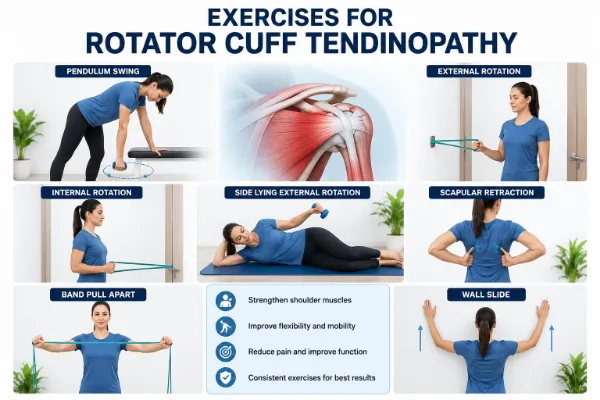
Physiotherapy Exercises For Rotator Cuff Tendinopathy
Introduction
Tendinopathies come in many forms, but rotator cuff tendinopathy is among the most common and severe. Rotator cuff tendinopathy occurs when one or more of the muscles and tendons that support the shoulder become inflamed. The rotator cuff is a collection of four tiny muscles that surround the shoulder joint in your upper arm.
Rotator cuff tendinopathy usually develops gradually, so you may feel aching or stiffness before you experience pain. Rotator cuff tendinopathy results from overuse or inflammation of the rotator cuff tendons. It may be triggered by a novel or recurring activity that puts greater strain on your shoulder muscles than they are used to. The symptoms include shoulder pain and stiffness, difficulty extending your arm above chest height, and weakness while lifting weights and moving objects with your arm.
What are the Four Rotator Cuff Muscles?
- The supraspinatus muscle is the most often damaged. It aids in lifting the arm sideways in the early stages of movement. Its tendon travels via a tiny region beneath the acromion, making it susceptible to repetitive contact.
- The infraspinatus muscle permits external rotation of the arm. This is the movement required to open a door or toss a ball. This muscle is critical to the posterior stability of the shoulder.
- The teres minor is a tiny, strong muscle that interacts with the infraspinatus to rotate the arm externally. It helps to maintain the overall stability of the joint.
- The subscapularis is the only rotator cuff muscle found on the front of the shoulder blade. It enables internal rotation of the arm, which is utilized to position your hand behind your back. This muscle is responsible for maintaining the head of the humerus centered in the joint.
These four muscles must work together correctly to provide for smooth and secure shoulder movement. When one of them is weakened or inflamed, the entire system may be impacted, resulting in compensations and sometimes pain.
Stages of rotator cuff tendinopathy:
- Acute (reactive) tendonitis– It is the initial stage and can persist up to two weeks. This stage is caused by either an acute injury, overuse, or an original stimulus that places greater stress on your rotator cuff than you are used to. During this stage, you may have pain, inflammation, edema, and warmth in your shoulder. When you move your shoulder, you may feel clicking or popping sensations.
- Subacute tendonitis – After two weeks, symptoms will begin to fade. Although the pain will be reduced, the tendinopathy will remain. This is an essential period to manage since it is when you can keep it from worsening and having a long-term impact on your shoulder.
- Chronic (dysrepair) tendinopathy – Failure to treat your rotator cuff at this point may result in irreversible injury. The inflammation will intensify, and the tissues will deteriorate. You will feel pain and weakness while lifting weights or pushing objects with your arm (such as a shopping cart), shoulder stiffness, and a reduced range of motion. People who reach this stage are frequently on a rollercoaster of symptoms, with periods of pain that decrease but are never addressed, causing it to return and the cycle to repeat.
- Rotator Cuff Tear – If you do not address rotator cuff tendinopathy, the tissues will shred and tear your rotator cuff. This normally causes serious pain and makes it difficult to move your arm; therefore, it is critical to have it treated.
Symptoms of Rotator Cuff Tendinopathy
- Pain that gets worse at nighttime or after exercise. This is related to chemical changes caused by the activity that irritates the tissues, as well as the accumulation of these chemicals at night. The pain is typically felt around the top of the shoulder, where the tendons attach, and can spread down the arm.
- Swelling and warmth around the shoulder joint.
- Weakness in moving shoulder muscles, such as twisting your arm outwards or lifting it over your head.
- Shoulder stiffness, including clicking and popping sensations.
- Numbness or pins and needles. Some patients get tingling sensations down their arms and fingers as a result of this condition.
- Pain that wakes you up from sleep, especially if your movements throughout the night aggravate it further, such as lying on your side or turning over onto it while sleeping. You may be unable to sleep at night due to pain or numbness caused by sleeping on the injured shoulder for an extended period of time.
- When you first wake up in the morning, your shoulder may feel tight and painful. This stiffness improves slightly after exercise or movement, but it worsens again at rest, particularly if you rest with your impacted arm lying down straight beside you.
Causes
Extrinsic causes
- Anatomical variations: Variables in your body’s structure, such as bone form or musculature, can produce friction or crowding; one typical reason is an irregularity in the shape of the acromion bone (located at the top of the shoulder joint). A protrusion may cause a tendon to rub against the bone over time.
- Bone spurs: Excess calcium deposits—bony growths known as bone spurs or osteophytes—on the shoulders’ bones can also cause friction and crowding, irritating or tearing the tendon.
- Other mechanical or postural difficulties with the back or shoulders: In certain persons, for example, the scapula (shoulder blade) may be positioned abnormally when moving or at rest. This disorder is known as scapular dyskinesis. Repetitive strain frequently causes the deviation from the usual, resulting in an imbalance that can cause the scapula to “slide off track.” (Similarly, knees can be out of alignment, resulting in knee damage.) As with so many mechanical injuries caused by movement-related stress or strain, a single deviation sets off a chain reaction that causes issues elsewhere. Instability or asymmetry in the scapula can impair the mechanical function of the whole shoulder.
Intrinsic causes
- As we age, our collagen weakens.
- Blood supply. Anything that reduces proper blood flow to the shoulder joint, especially the tendons, may impair the tendons’ capacity to self-heal from microtears and other injuries. Swelling or microvascular illness, for example, might reduce blood flow to the shoulder.
- Gradual degradation at the cellular level erodes the collagen in the tendon, speeding up its breakdown and preventing self-repair. Genetics and sickness are among the possible reasons for degeneration.
- Repeatedly pushing a shoulder tendon to greater stress than it can tolerate can cause micro-tears, thicker scar tissue, weakening, nerve irritation, and inflammation.
- Repetitive strain from overhand motions—throwing a baseball, serving in tennis, swimming, or painting a house—can all result in trauma.
Risk Factors
- Athletes who consistently practice or engage in an overhand throwing or serving sport are at risk, such as those who play baseball, football, softball, squash, tennis, track and field (javelin, shot put), or volleyball. Baseball pitchers are especially vulnerable to rotator cuff problems owing to the repetitive overhand action of pitching and the rotation of the shoulder. Load-bearing exercises that require you to raise big weights above shoulder level can also induce rotator cuff tendon damage.
- Workers who extend their arms above shoulder level face an increased danger. House painters (interior and exterior), construction workers, and some types of industry workers commonly suffer shoulder injuries. If your job requires you to lift anything heavy above your head on a regular basis, you are at an even higher risk. (For instance, kitchen staff who frequently collect and store bulky items on high shelves.)
- If you’re over 40 (man or woman), the normal wear and tear of aging might make you more prone to shoulder issues. Women who have gone through menopause are more vulnerable to tendon problems, which may be caused by an estrogen deficit.
- Being overweight, obese, or having a higher-than-average BMI might increase your risk of tendonopathy, particularly if you are a man.
- Diabetes and other metabolic diseases: Experts think that inadequate glycemic management might result in the accumulation of advanced glycation end-products (AGEs) in the circulation. These can cause inflammation and damage tendons.
Diagnosis
Your healthcare expert will do a complete health history and physical examination. You may also need diagnostic tests such as:
- X-ray. Invisible electromagnetic energy beams produce images on film of inside tissues, bones, and organs.
- Ultrasonography. High-frequency sound waves create an image of some part of your body’s interior.
- An MRI uses large magnets and a computer to take detailed pictures of your body’s organs and systems.
Treatment
- Over-the-counter medications. Anti-inflammatory pain medications such as aspirin, ibuprofen, and naproxen can help reduce shoulder discomfort.
- Rest. Stop any physical activity that causes or worsens your shoulder ache.
- Ice. A cold pack might help relieve swelling and pain. Use 15 to 20 minutes every few hours.
- Heat. Once the pain subsides, you can use a heating pad to relieve any stiffness in your shoulder.
- Steroids. An injection put into your shoulder joint may reduce the ache.
- Physical therapy. Your trainer can walk you through exercises to help you rebuild strength and mobility in your shoulder.
- Surgery. This is rare. Unless you are young and have had an acute, serious shoulder injury, surgery is a last choice for rotator cuff injuries.
Best Exercises For Rotator Cuff Tendinopathy
Doorway stretch
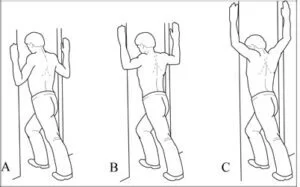
- Warm up your muscles by spreading your arms to the sides while standing in an open doorway.
- Lean forward into the doorway until you feel a small strain, then use both hands to grab the sides at or near shoulder height.
- Maintain a straight back while reclining and shifting your weight to your toes.
- A stretch at the front of your shoulder should be felt.
- Avoid going too far.
- Hold this position for a short period.
- Return to a neutral stance after that.
- Then relax.
- Repeat the exercises five to 10 times.
Side-lying external rotation
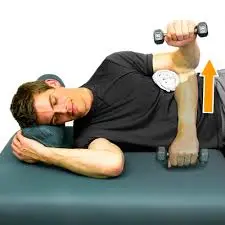
- Place yourself on the side that has not been harmed.
- Your wounded arm’s elbow should be bent 90 degrees and resting on your side.
- Position your forearm over your abdomen.
- Hold a light dumbbell with the affected hand and gently raise it toward the ceiling while keeping your elbow firmly against your side.
- If you begin to feel anxious, stop rotating your arm.
- After a short period, remove the dumbbell and drop your arm to return to the beginning position.
- Then relax.
- Repeat the exercises five to 10 times.
Pulling a lawnmower
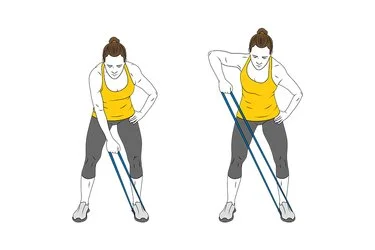
- As you stand, extend your feet shoulder-width apart.
- Place a resistance band beneath the foot on the opposite side of the injured arm.
- Hold the opposite end of the band vertically across your torso while the injured arm is facing you.
- Maintain your other hand on your hip and avoid locking your knees while flexing your waist slightly to put the hand holding the band parallel to the opposing knee.
- Stand up straight and bring your elbow across your body to your outer ribs, just like a slow-motion lawnmower would be started.
- Press your shoulder blades together while standing in a comfortable stance.
- Return to a neutral stance after that.
- Then relax.
- Repeat the exercises five to 10 times.
Pendulum
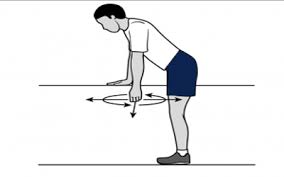
- To do the pendulum exercise, lean forward while standing and leave your left arm free.
- Hold yourself up against a table with your other arm for support.
- Swing the dangling arm in a smooth forward, backward, and circular motion from lateral to medial.
- Return to your starting position cautiously.
- Then relax.
- Continue to the opposite side.
- Repeat the exercises five to 10 times.
Cross-body reach shoulder stretch exercise

- Raise one arm straight up and parallel to the floor, without locking it in place.
- Grab the extended, elevated arm at the wrist with your other hand.
- Try to wrap the chest with the arm while gently pulling it across the front of the body.
- Hold the stretch for five seconds, then gradually release it.
- Return to your starting position cautiously.
- Then relax.
- Continue to the opposite side.
- Repeat the exercises five to 10 times.
Reverse Flys
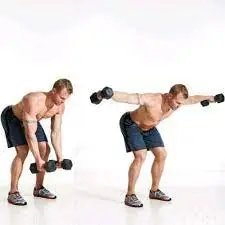
- To complete a reverse fly, you must hold dumbbells.
- Step out, keeping your feet shoulder-width apart and your knees slightly bent.
- Maintain a straight back with a minor hip flexion.
- Extend your arms away from your body while holding a dumbbell in each hand; do not bend your elbows.
- Try not to elevate your arms over shoulder level while squeezing your scapulae together.
- Return to your starting position cautiously.
- Then relax.
- Continue to the opposite side.
- Repeat the exercises five to 10 times.
Posterior Stretch
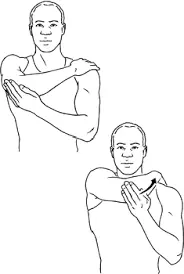
- Raise your shoulders and stand up.
- The hand of the intact arm supports the damaged elbow portion in place.
- After crossing the body, the wounded arm’s hand is resting on the shoulder across from it.
- Stretching occurs when the unaffected arm gently pushes the affected arm up and over the body.
- Return to your starting position carefully.
- Then relax.
- Repeat the exercise with the opposite arm.
- Repeat the exercises five to 10 times.
Dumbbell Lateral Raise
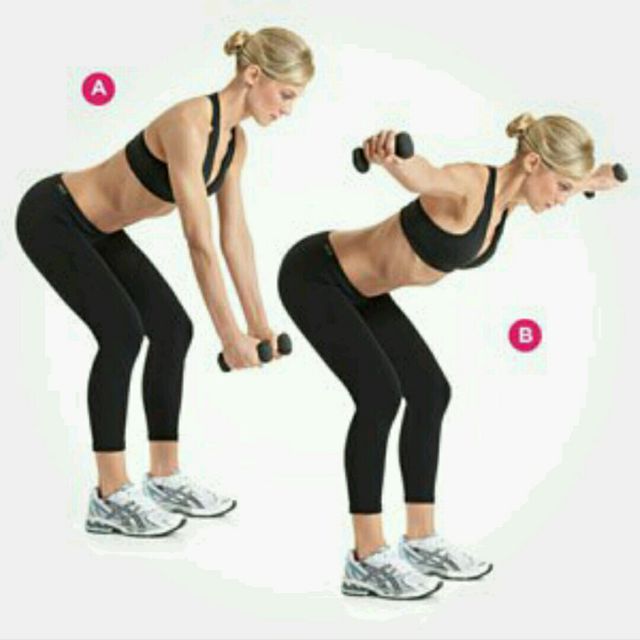
- Bend forward and grip a dumbbell in each hand.
- Place your arms at your sides, palms facing in.
- Make the space between your feet equal to the length of your hips.
- Check your body’s optimal posture.
- Pull your shoulders back, tension your abdominals, and look straight ahead.
- At the same moment, elevate your arms two inches on each side.
- As you raise and stretch the weight to either side, keep your arms nearly completely extended.
- Stop when your body forms a “T” shape.
- Lifting your arm leads you to inhale.
- Hold your position at the top of the movement for two seconds.
- Easily lower the dumbbell and return your hands to your sides.
- Breathe out as you lower the weight.
- Return to your starting position carefully.
- Then relax.
- Repeat the exercises five to 10 times.
Wall push-ups
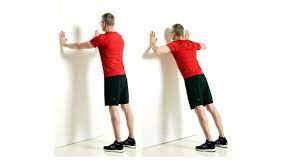
- To do this exercise, you must stand facing a wall ten to fifteen inches away.
- Place both of your palms at shoulder height against the wall.
- Turn your face to the wall and slowly bend your elbows.
- You should maintain a straight lower body.
- Return to your starting position carefully.
- Then relax.
- Repeat the exercises five to 10 times.
Scapular retraction
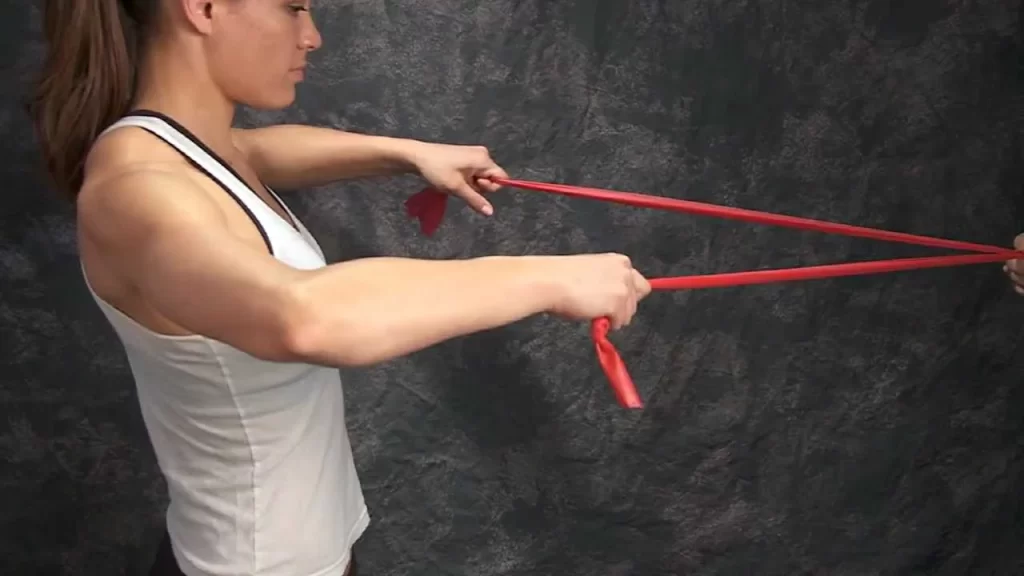
- This scapular retraction exercise may be performed using an elastic exercise band, such as a Thera-Band or therapeutic cable.
- Wrap the band around an object of strength at around trunk level.
- Using both hands, hold one end of the elastic band.
- Pull the elastic band back while maintaining a 90-degree flexion and elbows by your sides.
- Move your scapulae in the direction of each other.
- After that, stretch your arms back to where you were previously.
- Return to your starting position carefully.
- Then relax.
- Repeat the exercises five to 10 times.
Wall Slides
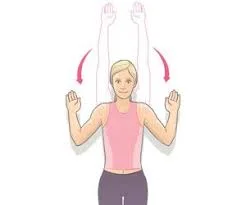
- Take a position with your injured shoulder about an arm’s length away from the wall.
- As far as the pain allows, elevate your affected arm to the wall at a 30-degree angle in front of you.
- Instead of shrugging, have relaxed and low shoulders.
- Stay upright and avoid tilting to one side.
- Maintain your position for at least a few seconds.
- Slowly move your fingers back to where you started.
- Return to where you began.
- Then relax.
- Repeat the exercises five to 10 times.
External Rotation with Resistance Band
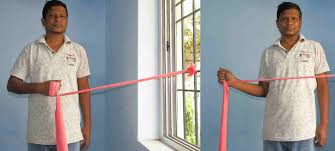
- Stand sideways, near a door.
- Place the hand that is nearest to the door across your abdomen.
- Using that hand, grip the waist-level resistance band connected to a doorknob.
- Keep your elbow at your side and extend your arm outside and away from your waist.
- Maintain a 90-degree bending elbow and forearm in line with the ground.
- Return to your starting position cautiously.
- Then relax.
- Repeat this exercise 5-10 times.
Internal Rotation with Resistance Band
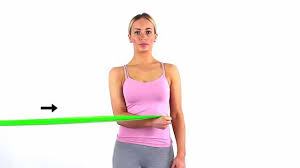
- Stand upright with a resistance band linked to the side of your weakest arm.
- Make a 90-degree bend with your weak elbow.
- Use an adjustable resistance band on your weakest arm.
- Rotate your forearm into your body, keeping your elbow at your side.
- Hold this position, then move your forearm away from you, allowing the band to slowly recover.
- During the workout, keep your back straight and avoid turning your body.
- Return to your starting position cautiously.
- Then relax.
- Repeat this exercise 5-10 times.
Prone Y Raise
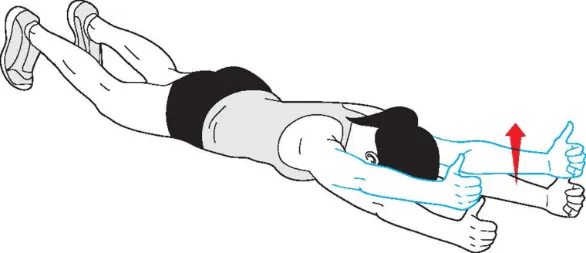
- To perform the prone Y raise, the exerciser must lie flat on their stomach, legs straight and near together.
- The arms should be lifted parallel to the shoulders at a 45-degree angle, palms facing each other, to form a letter “Y” shape with the upper body.
- From this posture, the exerciser pulls their scapulae together and squeezes their posterior deltoids, raising their arms off the floor while keeping the same “Y” shape until a full range of motion is reached.
- At the conclusion of their range of motion, the exerciser gradually releases the tension in their scapulae and returns their arms to the floor, keeping the same posture.
- At this point, the repetition is thought to be complete.
Prone T Raise
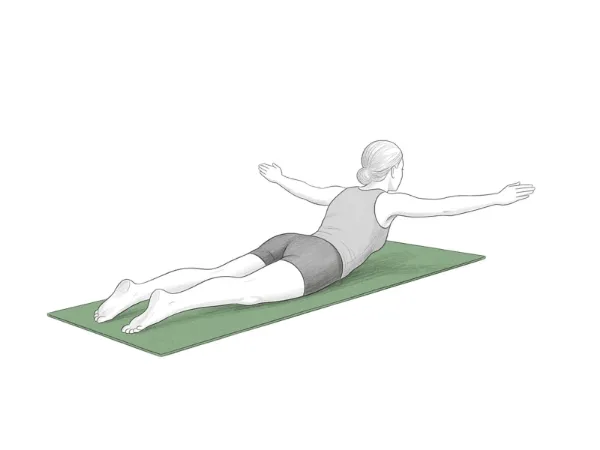
- Lie face down on a mat, arms stretched to the sides to make a T shape, palms down, and forehead resting on a towel for a neutral neck.
- Inhale to prepare.
- Exhale and squeeze shoulder blades together, lifting arms 3-6 inches off the ground while keeping elbows straight.
- Hold the top position for around 1-2 seconds.
- Inhale and carefully drop your arms back to their starting position.
- Repeat for the desired number of repetitions.
Benefits of doing Exercises for Rotator Cuff Tendinopathy
- This exercise will help strengthen the muscles in your shoulder joint.
- Reduces pain in the shoulder joints. This exercise will strengthen your muscles, allowing them to give better support for your joints.
- Maintains normal activities such as pushing and pulling objects to assist with performance maintenance.
- Keeps the cartilage healthy. To keep joint cartilage healthy, it must be nourished and treated with care. Synovial fluid collects in cartilage in the same way as water does in sponges.
- Improves the shoulder joint’s range of motion and functionality.
- Exercise improves posture.
- This activity reduces pain by strengthening muscles and reducing bone dislocation and inflammation.
Advice for a Strong Rotator Cuff
- Strengthen the rotator cuff.
- Increase the strength of your lower limbs and core muscles.
- Resume throwing with good technique.
- Apply as much ice and pain relievers as required.
- Stretch before working out.
Exercises to Avoid with Rotator Cuff Tendinopathy
- Dead Lifts: When you use these heavy weights, your arm is being pulled out of its socket. The rotator cuff has been under too much strain.
- Shrugs are another example of weight bearing down on the shoulder.
- Squatting causes rotator cuff tension when you place the bar across your shoulders and stretch your arms.
Conclusion
Rotator cuff tendinopathy is frequently successfully treated with a mix of focused exercises, progressive strengthening, and appropriate shoulder mobility. Exercising regularly to increase rotator cuff strength, shoulder stability, flexibility, and posture can help decrease pain, restore function, and avoid future injuries.
Begin with modest mobility and isometric exercises, then move to resistance and functional strength as your pain improves. Avoid pushing through acute pain, and gradually increase exercise intensity to enable the tendon to adjust.
If your shoulder pain persists, worsens, or limits your daily activities despite frequent exercise, see a physiotherapist for a specific examination and treatment plan. Most people may return to regular activities with stronger, healthier shoulders if they are patient and follow a planned exercise regimen.
FAQS
Does rotator cuff tendinopathy resolve on its own?
Rotator cuff tendinopathy rarely resolves entirely without altering the activities that produced it or actively treating the shoulder.
What is the difference between a rotator cuff injury and tendinopathy?
A rotator cuff strain is a sudden stretch or damage to a muscle or tendon. Tendinopathy is a long-term deterioration of the tendon caused by continuous usage.
How long will it take to heal from rotator cuff tendinopathy?
Rotator cuff tendinopathy (inflammation or irritation of the shoulder tendons) typically heals in 2 to 4 weeks for moderate cases, but persistent or chronic cases might take 6 to 12 weeks or several months to fully recover.
What is the most common cause of rotator cuff tendinopathy?
The most prevalent causes of rotator cuff tendinopathy are recurrent overuse and gradual, age-associated degeneration of the tendon.
References:
- Rosi, J. (2023, March 16). Rotator Cuff Tendinopathy: A complete guide of causes, symptoms and how to fix tendonitis – Location: Cincinnati Physical Therapy. Alinea Performance Cincinnati Physical Therapy. https://alineaperformance.com/cincinnati/rotator-cuff-tendinopathy/
- Williams, R. S., MD, & Williams, R. S., MD. (n.d.). Rotator cuff tendinopathy: causes, risk factors, and symptoms. https://www.coastalorthoteam.com/blog/rotator-cuff-tendinopathy-causes-risk-factors-and-symptoms
- Rotator cuff tendinopathy. (2024, September 15). WebMD. https://www.webmd.com/pain-management/rotator-cuff-tendinopathy
- Rotator cuff tendinopathy: symptoms and treatment. (n.d.). https://www.physioactif.com/en/comprehensive-guide/tendinopathy-or-tendinitis-of-the-shoulder