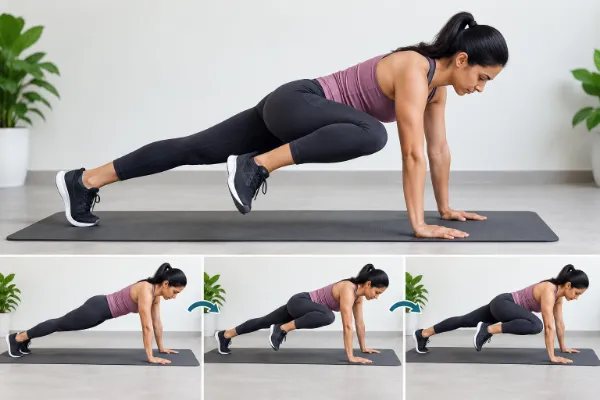
Spider-Man Plank Exercise
Introduction
The Spider-Man plank Exercise is a full-body workout that does not require any equipment. It turns the standard plank into an intense core workout. It is more sophisticated and moves beyond the standard prone conventional plank posture, making it a challenging yet effective dynamic exercise. If you’re trying to obtain that famous six-pack, the Spiderman plank belongs in your core exercise program.
A Spiderman plank is a bodyweight exercise that works numerous major muscle groups. It may also be used as a warm-up activity before your main workout. The Spiderman plank can help your body prepare for aerobic exercises and vigorous exercise like strength training.
Muscles Worked
- The rectus abdominis is a pair of muscles on the front of your abdomen that runs from your ribs to the front of your pelvis. The rectus abdominis is also known as the abs for short. Working out these muscles and keeping a slim physique causes them to create bumps and lines, giving your abs a six-pack look.
- The rectus abdominis’ principal job is to support and flex the trunk and spine. It allows you to raise your hips and bend forward while also stabilizing a wide range of movements throughout your body.
Obliques
- You have two sets of oblique muscles that run diagonally across your waist. They attach to the top of the hip bone, ribs, lower back, and abdominal fascia.
- The external obliques extend diagonally downward between the lower ribs and pelvis, wrapping around the sides of the waist. The external obliques are the most superficial. The internal obliques lie beneath them, flowing diagonally in the opposite direction between the pelvis and the lower ribs.
- They assist movements such as lateral spine flexion, side bending, and torso rotation.
- When you perform Spiderman planks, the obliques keep your hips from rotating while stabilizing your spine.
Transversus abdominis
- The Transversus abdominis (TrA) muscle is a large sheet of muscle fiber that makes up the deepest layer of the abdominal muscles. It attaches to the ribs and the top of the pubic bone. The TrA covers the trunk from front to back, with its fibers flowing horizontally, much like a back support belt does.
- A strong, correctly functioning Transversus abdominis serves to support the spine, maintain appropriate posture, and reduce back pain.
Quadriceps, glutes, and hip flexors
- Although the Spiderman plank exercise works all of the core muscles, maintaining the hips and knees extended demands activation of the quadriceps, glutes, and hip flexors. When doing Spiderman planks, the strain on these lower-body muscles is rather minimal, so you may not see them functioning.
Upper-body Muscles
- It’s no surprise that Spiderman planks are considered full-body workouts. Because they are executed in the push-up posture, strong triceps, shoulder, and chest muscles are required. Whether you perform Spiderman planks on your forearms or with straight arms, your upper-body muscles must support and maintain proper posture.
Benefits of the Spiderman Plank
- Improves core strength
- Spiderman planks increase core strength, flexibility, and mobility, which is essential for most exercises and daily tasks.
- Enhances range of motion
- The core promotes movement, power, strength, and endurance. Superman planks improve range of motion by stabilizing the spinal and pelvic muscles and strengthening the abs, obliques, rectus abdominis, and transversus abdominis.
- Improves posture
- The long hours most individuals spend at their workstations have a negative influence on their posture and gait. The Spider-Man plank is an effective dynamic workout that can lessen the likelihood of your lifestyle negatively impacting your posture.
- Improves body alignment
- Spider-Man planks not only improve body alignment, but also identify and address asymmetries or weak regions by alternating the activation of muscles on both sides of the body.
How to do a Spider-Man Plank
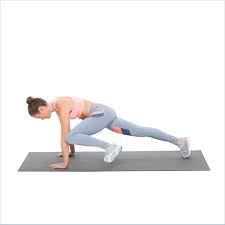
- Get down on all fours and stretch your body into an elbow plank posture.
- Place your forearms flat on the floor to support your upper body, and your legs extended with your toes balancing your lower body (low plank posture).
- Maintain slightly lifted buttocks, a neutral back, and engaged abs for support. When viewed from the side, your body should form a straight line.
- Take a breath in and tuck your right knee to your right elbow while supporting yourself with your left foot.
- Tuck your knee as far as you can in one continuous motion, then return it to the starting position as you exhale.
- Take another breath, then tuck your left knee to your left elbow in the same way.
- Continue alternating between left and right until you’ve completed the set.
Common Mistakes To Avoid
- Dipping the hips and arching the back: It’s vital to keep the body straight since arching the back won’t train the muscles that Spiderman planks are designed to target. With an arched back, you won’t be able to adequately work the core and glutes, compromising your lower back.
- Rounding the back: It causes unneeded effort on the upper back and shoulders, taking attention away from the core. A rounded back makes it hard to keep the torso, hips, and legs in appropriate alignment.
- Lifting or lowering the head: Again, maintaining your back straight is critical. The spine links to the skull; therefore, any head movement affects the spinal column. Lifting or lowering the head transfers the attention away from the targeted core muscles and toward the lower back.
- Forgetting to maintain smooth movements: Bringing your knee to your elbow should never be a jerky motion. Slow, smooth movement will put more strain on your core muscles, giving you a higher chance of getting the results you want.
- Holding Your Breath: Breathing while bracing your core is never easy. However, adequate breathing is required while performing Superman planks to ensure that your muscles receive enough oxygen to execute the workout.
Spiderman Plank vs. Traditional Plank
The standard plank posture is more common and suitable for beginners since it requires less core strength and expertise. All you have to do is take the position, breathe steadily, and go as long as you can. As a result, the risk of bad technique or harm is virtually non-existent.
Standard planks are also good since you may change the difficulty level by adjusting your body posture. For example, you can begin with knee planks, graduate to elbow planks, and finally to high planks.
Spiderman planks, on the other hand, are significantly more advanced because of the leg actions involved. Aside from making it more difficult to maintain balance, your core muscles must work harder to generate the motions.
Spider-man planks are more demanding, but they are also more entertaining and create a sense of growth. As long as you can do more reps, you’re on the correct road.
Spider Plank Variations: Regressions and Progressions
Kneeling Spider Plank
- Begin with a modified high plank with both knees on the floor. Drive one knee out to the same-side elbow, then return and swap sides. This shortens the lever, allowing you to learn the knee technique without resisting the whole plank load.
Standard Spider Plank
- This is the whole exercise: high plank, alternating lateral knee drives, moderate pace, and level hips. Master this variant before attempting quicker reps or including a push-up.
Paused Spider Plank
- Pause for two seconds at the peak of each knee drive. The delay decreases momentum, allowing the obliques to remain in the anti-rotation posture for extended periods of time.
Spider-man Push-Up
- Combine the knee drive and push-up. As you drop, push the knee toward the same-side elbow, then press back up as the leg returns. This increases chest, triceps, and shoulder effort; therefore, use only after normal spider planks have been thoroughly cleaned.
Alternative Exercises For Spider-Man Plank
Mountain Climber
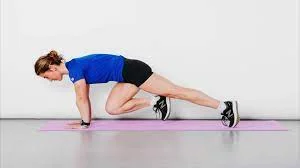
Many individuals are unaware that mountain climbers mimic Spider-Man’s plank. You must continually take a plank posture and tuck your knees to your upper body, which will build your stomach.
The basic difference is that mountain climbers are more active. Your knees also pass through your core to your chest, rather than from your side to your elbows.
Bicycle Crunches
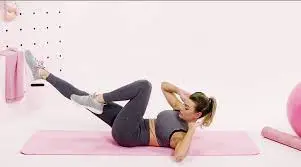
Develop an oblique knee-to-elbow pattern from your back, which requires less shoulder and plank work.
When to Avoid or Modify Spider Planks
- Acute lower back pain or disc pathology: The movement of the leg might cause the pelvis to tilt or rotate anteriorly. Begin with deadbugs, bird dogs, or short forearm planks instead.
- Active diastasis recti or the first 6-8 weeks postpartum: If the deep core is unable to control the bracing during dynamic plank exercises, intra-abdominal pressure increases. Begin by rebuilding with breathing exercises, dead bugs, and bird dogs.
- Recent abdominal surgery or hernia repair: Consult your surgeon before loading the abdominal wall with plank variants. Before performing dynamic knee drives, gradually progress from modest bracing to brief holds.
- Wrist, elbow, and shoulder pain: High planks provide pressure on the upper body via extended arms. Use forearm planks or raised hand planks until your joint is comfortable.
- Pregnancy, pelvic floor dysfunction, and pelvic organ prolapse: The brace and knee drive may increase pressure in the trunk and pelvis. Consult with a skilled doctor about lower-pressure core choices.
Add the Spiderman Plank to Your Workouts
Include the Spiderman plank in your training regimen a few times each week as a warm-up or core exercise, in which you switch legs for 30 seconds at a time or execute 10 to 15 reps on each side.
Once you can achieve that, try a more difficult variation.
Conclusion
Incorporating Spiderman plank exercises into your core workouts is a great challenge that will take your fitness to the next level. Along with other exercises such as crunches, aerobic HIIT, climbers, side planks, sit-ups, and squats, these motions can help you develop a strong core that will support your balance and posture.
As a bonus, you’ll burn more calories and increase your endurance for daily tasks, resulting in considerable physical changes in no time. Keep in mind that your body needs more than simply physical activity to be healthy.
FAQs
What muscles do spider planks activate?
Spider planks primarily target the internal and external obliques, hip flexors, rectus abdominis, and transverse abdominis muscles. The shoulders, serratus anterior, chest, glutes, quads, and spinal stabilizers all aid in maintaining the high-plank posture.
How many Spider Planks should I do?
If you’re new to the activity, start with two to three sets of six to eight reps each side. Build up to three sets of 10 to 20 reps each side, halting each time your hips twist, droop, or pike.
Are spider planks helpful for your obliques?
Yes. The lateral knee drive causes the working-side obliques to shorten, whereas the opposite-side obliques prevent hip rotation. This combo exercises flexion, anti-rotation, and plank endurance all in one bodyweight drill.
What is the difference between spider planks and mountain climbers?
Mountain climbers typically force the knee forward below the body, making them quicker and more conditioning-focused. Spider planks force the leg out into the same-side elbow at a slower cadence, putting greater strain on the obliques and hip control.
Can I perform spider planks if I have lower back pain?
If bracing, twisting, or hip flexion causes lower-back pain, modify or skip spider planks. Use deadbugs, bird-dogs, or brief forearm plank holds initially, and then seek advice from a skilled healthcare physician or physical therapist if the pain continues.
References:
- Stefanov, P. (2025c, May 29). Spiderman Plank: How-to, tips, variations & Mistakes. Hevy – #1 Workout Tracker & Planner Gym Log App. https://www.hevyapp.com/exercises/spiderman-plank/
- Colletta, M. (2026c, February 24). How to do Spiderman Planks (Form & Muscles worked). Steel Supplements. https://steelsupplements.com/blogs/steel-blog/how-to-do-spiderman-planks-form-muscles-worked?srsltid=AfmBOoq360caQHXDUlQSh22pfuNbWz-5gA3Xz_ICAMBBvQJb2nxjvWh4
- Schuler, M. (2023, September 15). How to do the Spider-Man plank for superheroic strength. BODi. https://www.bodi.com/blog/spiderman-plank
- Kuzey. (2021, August 7). How to do Spider Plank – Benefits, muscles worked. FitnessProgramer.com. https://fitnessprogramer.com/exercise/spider-plank/
- Cpt, D. A. M. M. C. (2026, May 20). How to do Spider Planks: Form, mistakes & progressions. https://getfitcraft.com/exercises/spider-planks