
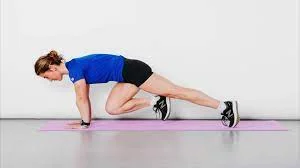
Mountain Climbers
Introduction
Mountain Climbers are a dynamic full-body exercise that combines cardio and strength training by engaging the core, arms, shoulders, and legs while improving endurance, balance, and coordination.
- The bodyweight exercise known as the “mountain climber” may appear straightforward, but it works every muscle in the body. The name of the workout comes from the fact that it feels like climbing a mountain on the floor.
- The exercise involves maintaining a plank posture while rapidly raising each knee to your chest one at a time, much like you would when jogging side to side.
This exercise is popular in the fields of physiotherapy and fitness because:
- Complete bodily participation. Your arms, shoulders, chest, core, hips, and legs all get equally developed at the same time. Mountain climbers are effective and time-saving, since other exercises just work one muscle area.
- Strength + cardio combination. It strengthens your muscles and raises your heart rate like an aerobic workout. For this reason, many trainers incorporate it into circuit training and HIIT (High-Intensity Interval Training) to combine strength with cardio.
- Stability of the core. Your lower back and abdominal muscles must be constantly engaged in order to maintain a plank position. This exercise is suggested by physiotherapists because it strengthens the core and stabilizes the spine, both of which can lower the risk of injury.
- No equipment is required. All you need is your body and a small amount of space, no machines or weights. It’s simple to incorporate mountain climbers into both at-home and gym workouts.
- Functional fitness and rehabilitation. Controlled versions of mountain climbers are used in physiotherapy to help patients improve their endurance, flexibility, and coordination. Mountain climbers are used by sportsmen to increase their stamina, speed, and agility.
What is the Mountain Climber exercise?
- A type of dynamic, bodyweight action that mimics mountain climbing, but on a floor, is the Mountain Climber workout. It is a strength and cardiovascular exercise that combines the plank posture with a rapid knee drive.
Mountain climbers move their bodies more fully, using the following main muscles:
- Core: obliques, transverse abdominis for stability, and rectus abdominis (often known as the “six-pack”).
- Your upper body is supported in the plank posture by your shoulders and chest.
- Strength and balance are maintained by the arms and triceps.
- Legs and glutes: pushing your knees forward activates your quadriceps, hip flexors, and glute muscles.
- Back: aids in alignment and postural stabilization.
Mountain Climbers Video
How to perform Mountain Climbers?
- The high plank position (PUSH-UP) is the starting position.
- Make sure your hands are beneath your shoulders exactly. From head to heel, the body should be in a straight line.
- Engage your glutes and legs for stability, and keep your core muscles tight.
- Your right knee should be driven to your chest.
- Pull your left knee forward and pull your right leg back.
- Continue switching between your left and right legs to mimic running.
- Take your time; beginners can go more slowly or faster for cardio.
- To maintain your endurance, breathe steadily and consciously; do not hold your breath.
Benefits of Mountain Climber
Boosts Cardiovascular Stamina
- Mountain climbers are a dynamic, fast-paced exercise that will raise your heart rate right away. Without the space or equipment needed to jog or ride a bike, this improves cardiovascular endurance, stamina, and general heart health.
Enhances Core Strength
- While holding the plank posture, driving your knees forward keeps your lower back, obliques, and abdominals fully engaged. This will improve posture, lower the chance of back injuries, and strengthen the core.
Full-body Exercise
- Mountain climbers concurrently engage several significant muscle groups:
- Arms and shoulders: support body weight.
- Back and chest: maintain alignment.
- Core: provides stability.
- Legs, hips, glutes: power the running motion.
Boosts Speed and Coordination
- In addition to testing your timing, balance, and coordination, the alternating knee motion will improve your agility, functional mobility, and overall athletic performance, all of which are advantageous in both sports and daily life.
Support for Fat Loss and Calorie Burning
- Mountain climbers can burn a lot of calories in a short amount of time because of their strength and cardio characteristics. They boost your metabolism and aid in fat loss, particularly around the thighs and abdomen, when used in circuit training or high-intensity interval training.
Common Mistakes to Avoid in Mountain Climbers
Arched Back or Dropped Hips
- Your lower spine may experience unneeded pressure if you arch your back or let your hips drop too far.
Excessive Bouncing
- Some people will bounce their entire body up and down instead of stabilizing it. As a result, the exercises are less effective.
Going Too Quickly Without Control
- Sloppy form and joint discomfort might result from moving too fast. Control is more important than speed alone.
Avoiding the Core
- If your core is relaxed, your hips may lift too high or sag too low, reducing stability and effectiveness.
Variations of Mountain Climbers
Slow Mountain Climbers
- Perform the movement at a slower pace to focus on control and stability
- Ideal for beginners or physiotherapy patients looking to improve their form and stability.
Cross-Body Mountain Climbers
- Push your knee to the elbow on the other side.
- Strengthens the rotating core and targets the obliques.
Spider Mountain Climbers
- Bring your knee to the outside.
- Increases mobility by activating the side core and hip flexor muscles.
Elevated Mountain Climbers
- Instead of placing your hands on the floor, place them on a seat or step.
- Relieves wrist strain and facilitates movement for beginners.
Resistance Band Mountain Climbers
- Wrap a small resistance band around your thighs or feet.
- Increased hip and glute toning and intensity.
FAQs
How many mountain climbers should I do each day?
For beginners (1-3 months of regular exercise), 2-3 sets of 15-20 reps on a slower speed.
Does using mountain climbers cause damage to the knees and hands/wrists?
If not done correctly, they could strain the hands and wrists as well as the knees. Before performing, someone with lower back problems, wrist injuries, or knee pain should start with reduced or elevated versions or speak with a physiotherapist.
Is performing mountain climbers every day suitable?
As long as you include them in circuit workouts and interval variants and regulate the dosage, it can be. Every day, you might warm up with mountain climbers before working out with weights or aerobic exercises. Remember to give your muscles enough time to heal. Remember to include rest days to allow muscle recovery.
Do mountain climbers burn belly fat?
Mountain climbers help reduce overall body fat, which may gradually reduce belly fat as part of a balanced workout routine. Although you cannot directly eliminate belly fat, mountain climbers build muscle and burn calories, which will eventually result in a more defined stomach.
Do mountain climbers burn fat or do they gain muscle?
The primary purpose of mountain climbers is to strengthen the core and increase cardiovascular capacity. They aid in muscle endurance, toning, and stability, but they don’t help you gain big muscles as weightlifting does.
References
- Cpt, P. W. (2024, May 19). Learn to master mountain climbers. Verywell Fit. https://www.verywellfit.com/mountain-climbers-exercise-3966947
- Sparacino, A. (1970, January 1). How to Master Mountain Climbers—Plus 3 challenging variations. https://www.onepeloton.com/blog/mountain-climbers
- Ba, G. R. (2022, March 10). What muscles do mountain climbers work? Healthline. https://www.healthline.com/health/fitness/what-do-mountain-climbers-work#bottom-line

4 Comments