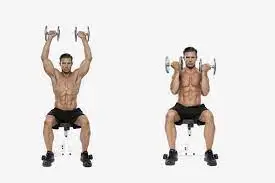
Arnold Press
Introduction
The Arnold Press is a powerful shoulder exercise named after Arnold Schwarzenegger. It targets all three heads of the deltoid muscles, improving shoulder strength, size, and mobility through a unique rotational movement.
- The twisting motion combined with an overhead press is what makes this exercise unique.
- Compared to a typical overhead shoulder press, the Arnold Press engages the anterior, medial, and posterior deltoid muscles more thoroughly. It also requires core stability and controlled rotation, which is why it is a good fit for bodybuilding and functional training regimens.
- The movement is named after the well-known actor and bodybuilder Arnold Schwarzenegger. In the 1970s, when he was a bodybuilder competing,
Muscles Involved in the Arnold Press
- The anterior, lateral, and posterior fibres of the deltoid muscles are involved in the Arnold Press.
- Deeply involved in the lifting (pressing) phase is the anterior deltoid (front). Lifting the arm upward and forward is beneficial.
- The medial deltoid muscle (side) is responsible for elevating the arm out to the side and supporting the shoulder during pushing and rotating.
- The posterior deltoid muscle (back) aids in stabilizing the shoulder during rotation and regulating downward motion. The deltoid’s three components work together to give the shoulder its stability and rounded form.
The upper back muscle, or trapezius
- As the arms raise upward, the upper trapezius helps to elevate and rotate the shoulder blades upward.
Brachial Triceps (Arm back)
- When you push the weights upwards, your triceps expand your elbows.
- In order to complete the arm extension in the last stage of the Arnold Press, the triceps are also crucial.
Serratus Anterior
- Located on the sides of the rib cage, this muscle helps rotate and stabilize the shoulder blades as you lift your arms.
Equipments
- All you need to raise and build your shoulder muscles is a pair of dumbbells for the Arnold Press. You may perform the exercise standing if you want to strengthen your shoulders and core muscles, or you can use a bench if you want to sit.
How To Perform Arnold Press
- Position at Start:
- You can stand with your feet shoulder-width apart or sit up straight on a bench with a back support.
- With your hands and palms facing inward, hold a dumbbell at shoulder height in each hand.
- Your elbows are drawn in close to your torso and bent.
- Please keep your back straight and contract your core.
- Press the dumbbells up and above and slowly spin your palms outward.
- Your palms should be facing front, and your arms should be straight at the top position.
- Pause for a moment in the top position.
- As you raise the dumbbells overhead, release your breath.
- As you return the dumbbells to their initial position, take a breath.
- Go Back to the Beginning Position: Rotate your wrists until your hands are shoulder-height and facing your body once more while you slowly descend your dumbbells. Throughout the movement, keep your attention on control, and repeat as many times as you like.
Benefits of the Arnold Press
- Builds the shoulder’s three areas: Your shoulder muscles‘ front, centre, and back are all worked throughout this workout, which results in full growth.
- Strengthens and increases shoulder mobility: This workout increases shoulder strength and improves shoulder mobility.
- Improves shoulder shape: Doing the Arnold Press on a regular basis will make the shoulders appear toned and rounder.
- Enhances general upper body fitness: It also works in concert to increase the strength of your arms, chest, upper back, and entire upper body.
Contraindications
- Shoulder impingement or cuff damage: Avoid doing this exercise if you have shoulder discomfort or injury, since it may make it worse.
- Any upper back or neck discomfort: Avoid doing this exercise if you have upper back or neck pain, since it may put additional strain on those regions.
- Shoulder post-operative conditions: Unless your physiotherapist explicitly authorizes it, avoid performing the Arnold Press while you are recovering from shoulder surgery.
Common Mistakes in the Arnold Press
- Lifting excessively heavy dumbbells can cause shoulder injuries and impair appropriate mobility.
- Excessive momentum rather than muscle control: The exercise will be less effective if you rock the weights or use any other body movement outside of shoulder strength.
- Incorrect wrist and elbow posture puts strain on your joints and increases your risk of injury if your wrist is bent or your elbow is positioned too far out.
- Not stretching or warming up your shoulder muscles: If you don’t warm up your shoulder muscles beforehand, you run a higher chance of experiencing pain or damage.
Variations of The Arnold Press
- Seated Arnold Press: To improve control and support your back, perform this exercise on a bench.
- Standing Arnold Press: As the name suggests, do the Arnold press while standing. If standing, you may do this variation of the Arnold press, which targets your core muscles as well.
- One arm at a time, do the Single-arm Arnold Press using a dumbbell. By doing this, you will improve your ability to use your shoulder to gain balance rather than using both arms.
- Resistance Band Arnold Press: This exercise substitutes a resistance band for dumbbells. It is the ideal option for beginners or those looking to do at-home workouts, as it helps ease joint strain.
Precautions
- Before you begin, always warm up your arms and shoulders a little bit to get your muscles and joints ready for the workout.
- Avoid using large weights immediately away: Before increasing the weight you are lifting, start with small weights to be sure you are learning the proper technique.
- Throughout the exercise, maintain control by avoiding rushing or jerking the dumbbells. Throughout the whole exercise, pull the dumbbells gently and consciously.
- Stop right away if you experience discomfort: Stop the exercise, take a break, and/or get in touch with a physiotherapist if you have any sudden, intense pain or strange changes in your typical mobility.
Conclusion
- An excellent exercise for developing well-defined shoulders and general upper body strength is the Arnold Press. It strengthens every part of the shoulder and enhances posture and mobility.
- Always use proper form, begin with modest weights, then increase gradually for the best results. Always practice cautiously to prevent injuries, and pay attention to your body to make sure you’re training and recovering properly for consistent improvement.
FAQs
How many sets and repetitions are ideal?
Beginners: use light weights for three sets of 8–12 repetitions.
Intermediate/advanced: progressively increasing weight in 4–5 sets of 6–12 repetitions.
Advice: To prevent shoulder injuries, concentrate on form rather than using large weights.
Can I perform the Arnold Press while sitting or standing?
Yes.
Sitting: Less tension on the lower back and more stability.
Standing: Increases the use of the stabilizers and core.
Can shoulder size be increased using the Arnold Press?
Indeed, it’s great for hypertrophy, particularly for the lateral and front delts. For well-rounded shoulder development, combine with lateral lifts and rear delt workouts.
Can I do additional shoulder workouts in addition to the Arnold Press?
Indeed! Typical combinations:
Lateral rises → Arnold Press → Rear delt fly
Arnold Press → Front lifts → Shrugs
Is it possible for Arnold Press to exacerbate shoulder injuries?
Yes, if done incorrectly, too quickly, or with too much weight.
Avoid if you have:
tear in the rotator cuff
Impingement of the shoulder
How can I safely advance the Arnold Press?
Increase weight gradually.
Prior to using heavier weights, add more repetitions or sets.
Add changes in speed (lower eccentric/lowering phase).
References
- Thwaini, H. (2025, August 26). The Arnold Press: What It Is, Benefits & How To Do It Safely. Gymshark. https://row.gymshark.com/blog/article/what-is-the-arnold-press
- Catlett, T. (2025, July 11). How to do an Arnold Press. Healthline. https://www.healthline.com/health/arnold-press#how-to
- Dewar, M., & Dewar, M. (2023, December 15). How to do the Arnold Press: proper form & variations. BarBend. https://barbend.com/arnold-press/
- Brown, K. (2024, June 9). How to do a dumbbell Arnold Press. WebMD. https://www.webmd.com/fitness-exercise/how-to-do-dumbbell-arnold-press