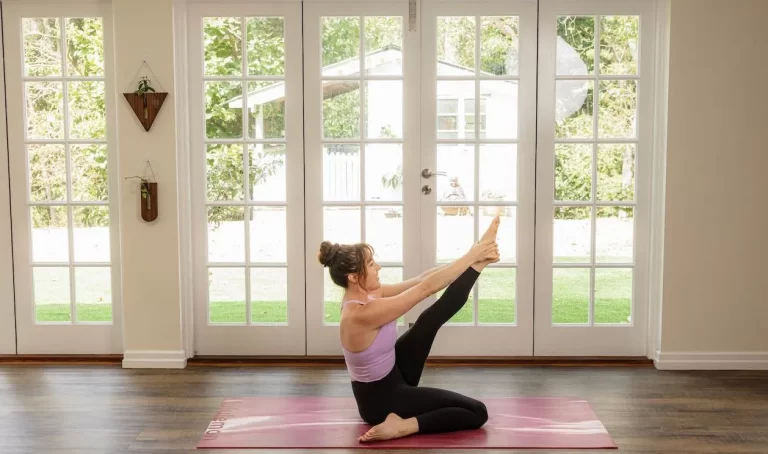
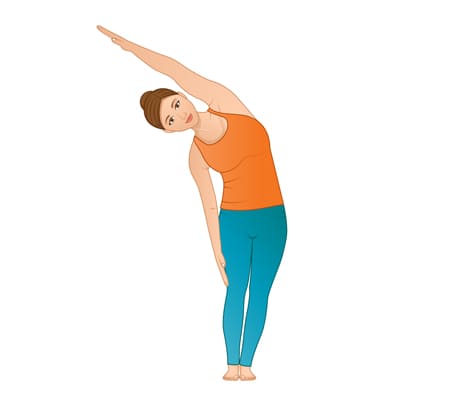
Side Bend Exercise
Introduction
Classic stretch for good reason, the standing side bend helps release tension in your chest, hips, and back muscles, improves your side-to-side mobility, and keeps you more stable when standing. Besides, it feels amazing, really.
As the name suggests, this exercise consists of bending your upper body sideways until your back, hips, and waist all feel somewhat stretched.
Muscles involved
- Internal and exterior obliques. These abdominal muscle groups go down either side of your torso. They assist you twist your body throughout daily activity.
- Rectus abdominis. The rectus abdominis (often known as the “six-pack” muscle) is a lengthy muscle that runs vertically along the front of the abdomen. The standing side bend exercise gives it a wonderful stretch.
- Erector Spinae. This collection of muscles runs down the spine and can become tight as a result of daily activities, jobs that require a lot of desk time, other pressures, and our fast-paced lifestyles. This stretch helps to relieve that tightness.
- Intercostal muscle. These are tiny muscles located between your ribs. They aren’t the simplest muscles to target, but the standing side bend is a great technique to stretch them, especially if you take deep breaths while in the posture.
- Quadratus Lumborum. This is a deep lower back muscle that joins the pelvis, spine, and bottom rib. It is essential for maintaining pelvic stability when standing.
Benefits
Standing side bends improve the flexibility and strength of the muscles on the sides of your waist and back, making a variety of daily activities easier and more pleasant. It may also improve your balance and lower your chance of falling and injury. Perform this technique on a regular basis as part of your general movement program, and you may see benefits in:
- Muscle tightness, particularly after prolonged sitting or standing.
- Backache. The quadratus lumborum muscle is a leading cause of back discomfort. Stretching this muscle on a regular basis will help to relieve tension and increase back mobility, which can alleviate pain.
- We’ve always said that there is no such thing as perfect posture. However, maintaining the same posture for an extended period might strain your torso. Standing side bends assist in alleviating the tension.
- Sit at your workstation. Less back discomfort and a greater emphasis on taking breaks mean that if you must stay hooked to your computer screen for most of the day, your body will be more resistant to the strain and agony it may bring.
- Reaching for objects, such as leaning to the side to pick something up off the floor or reaching into an airplane’s overhead compartment.
- Twisting actions include rolling over in bed or turning to see behind you.
- Changing positions. Consider getting out of a chair or turning to get out of the shower.
- Carrying unequal loads forces your obliques to kick in to keep you balanced.
- Household chores such as vacuuming, washing, putting away dishes, and mopping.
Side Bend Exercise Video
How to perform the side bend exercise?
- Begin by standing with your feet a comfortable distance apart and your hands at your sides, palms facing your thighs.
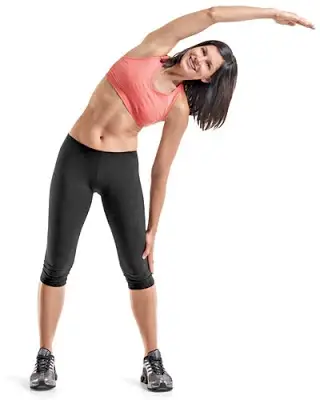
- Slowly bend to one side, moving your arm down your thigh toward your knee, causing your shoulder to tilt down and to the side.
- As you bend, your other hand will automatically move up your leg and toward your hip.
- Hold the stretch and concentrate on taking deep breaths in and out.
- Return to your starting position.
- Repeat the stretch, bending to the opposing side.
- As you complete each rep, you may feel a stretch in your low back, hips, and sides.
To make the side bend exercise easier
Stand a few feet from a wall, one side facing it. Place your forearm on the wall so that your upper arm is around shoulder height. Now, carefully move your hip toward the wall while pressing firmly against your forearm. Hold for a few deep breaths before returning to the beginning position and repeating on the opposite side.
You may also attempt the sitting side bend variant. In which everystep is the same except sitting on a chair comfortably.
To make the side bend exercise harder
As you slide one hand down your thigh, extend the other arm straight up by your ear and over your head in the direction you’re leaning.
You can also add a pair of dumbbells at your side.
Tips
- Move carefully and with control; do not rush the curve or return.
- Do not lean forward or backward. The movement should be exclusively side to side.
- To better activate your obliques, exhale as you return to the standing position.
- Avoid overextending. Go only far enough to feel a stretch, not a strain.
FAQs
What advantages can side bends offer?
They increase the flexibility of the spine and stretch the muscles in the hips, thighs, and abdomen. The intercostal muscles, which are located between the ribs, are similarly stretched by side bends. Because of the amount of time spent sitting and slouching, these muscles can become short and tight in daily life.
Which muscles are targeted by side bends?
A straightforward yet efficient exercise for strengthening the obliques and other muscles along the sides of your torso is the side bend.
Can a side bend make your waist smaller?
You can immediately tone your waist by working the oblique muscles. Nonetheless, a lot of individuals perform side bends while holding a weight in each hand. To thin the sides, they swing from side to side. This bending motion is pointless and may even make your waist appear bigger.
Can I perform side bends on a daily basis?
Yes, we can and do spinal bending, but since we don’t separate spinal side bending in everyday tasks, continuously bending the body to the side is unhelpful for strengthening core function. The main purpose of the core is to limit the excessive range of motion, which puts the spine at greater risk of damage.
For what duration should I maintain a side bend?
Slowly ease yourself into the stretch, stopping when you sense a feeling and utilizing slow breathing to help your body and mind relax. Hold the stretch for 2 to 5 minutes after that. Again, with thicker tissue, the hips and back take longer than the shoulders or wrists.
How many side-bend repetitions should I do?
A straightforward yet powerful technique for strengthening the lateral trunk is the side bend. You can perform sets of ten to fifteen repetitions on each side for the side bend. Make use of a weight that permits a complete range of motion at a regulated speed.
What is the function of a side bend?
A great exercise to promote flexibility, strength, and mobility is the side bend. They boost energy and immunity, increase stamina and endurance, and improve memory and focus.
References
- Standing side bend. (n.d.). [Video]. Hingehealth. https://www.hingehealth.com/resources/articles/side-bend