
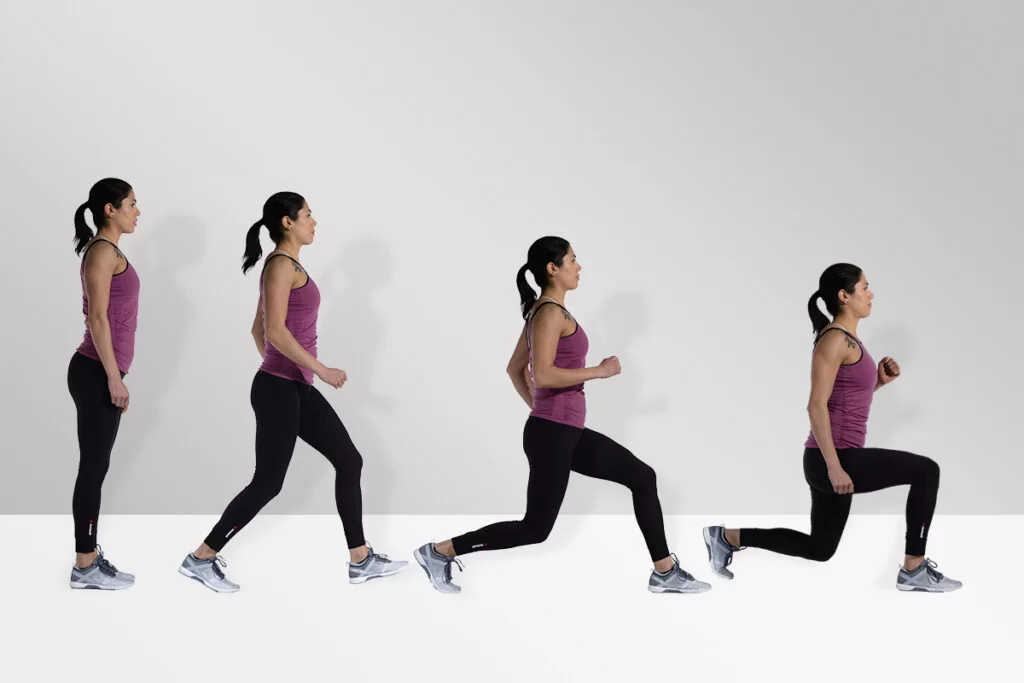
Walking Lunge
Introduction
Walking lunges are a dynamic lower-body workout that enhances balance and coordination, develops your quadriceps, hamstrings, and glutes, and encourages functional mobility.
Walking lunges are a version of the static lunge exercise. Instead of standing back straight as you would in a static bodyweight lunge, you “walk” ahead by lunging out with the other leg after finishing a lunge on one leg. The exercise continues for a predetermined number of repetitions.
Walking lunges engage not just the leg muscles but also the hips, core, and glutes. Walking lunges may also be made more challenging by adding weights or by twisting your torso while completing the exercise.
The walking lunge is a practical weight-bearing exercise that may improve lower-body strength and range of motion and make daily chores easier. Even though the strong muscles in the lower body are the primary movers during the walking lunge, you will use the core muscles to help with stability and balance.
Muscles involved during the walking lunges
- Glutes
- Hamstring Muscle
- Quadricep Muscle
- Calves
- Hip Muscles
Benefits
- Increase your range of motion
- Walking lunges can help you increase your range of motion by increasing flexibility and relaxing your hips and hamstrings. Enhancing posture and balance, this can benefit fitness beginners, athletes, and casual exercisers equally.
- Better results
- The walking lunge is one kind of functional exercise. They mimic commonplace movements, such as rising, sitting, and advancing to pick up an object off the floor. Regular practice of walking lunges may make them easier in real life.
- Enhances Core Stability and Balance
- Because it is performed unilaterally while standing and integrates your lower body and core muscles, the walking lunge is especially dynamic.
- Promotes One-Stop Instruction
- The walking lunge allows you to train unilaterally or equally with both sides. Unilateral exercises can be used to identify and correct any muscle imbalance between the left and right legs.
- It can be done anywhere
- Anywhere—at home, the gym, on a business call, in a hotel, or pretty much anywhere else—walking lunges are the ideal portable workout.
Walking Lunge Video
How to perform walking lunges?
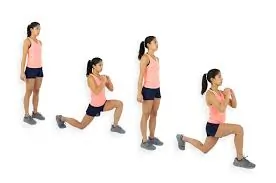
- Start by placing your feet hip-width apart. Keep your core engaged and your shoulders back. You can keep your arms at your sides or clasp them behind your head.
- Breathe in as you lower your body to the ground and step forward with your right foot. Take a long enough stride to ensure that both knees are bent at a 90-degree angle as you lower your body.
- Allow your left back knee to approach and make contact with the floor. Do not push your front knee too far forward; instead, maintain it slightly above your ankle. Look straight ahead while keeping an erect posture or slowly lowering your body.
- Maintain the bottom lunge position for a count.
- Exhale as you step into the next lunge with your left foot, then push off with your right foot to carry it forward.
- With each stride, switch legs and keep walking. Prioritize quality over quantity, and aim for smooth, controlled movement.
Variations
Walking lunge with torso twist
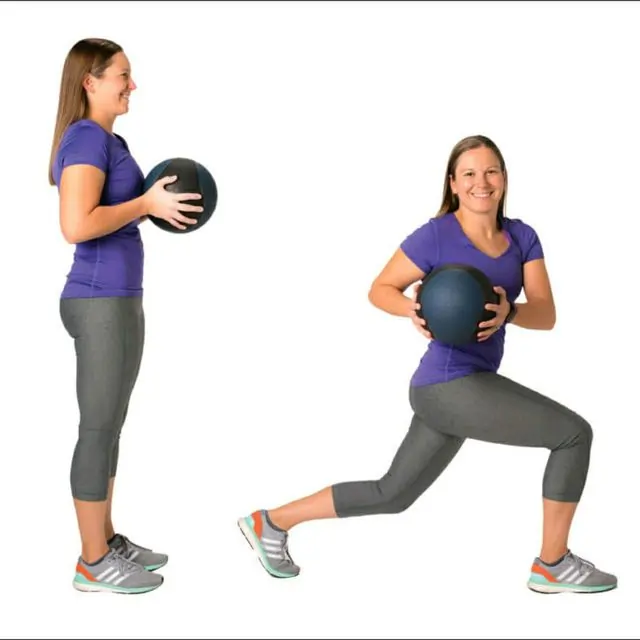
- Stand up straight, with your feet hip-width apart. Hold a weight or medicine ball in front of your midsection with both hands, elbows bent at a 90-degree angle, and tense your abdominal muscles.
- Place your weight on your heel as you take a stride forward with your right leg.
- Bend your right knee and lower it until it is parallel to the floor in a lunge posture, while your right foot contacts the ground and stabilises. Hold on.
- Once you’re comfortable in the lunge position, spin your upper body to the right while holding the weight with both hands. Your torso should be the source of movement.
Walking lunge with weights
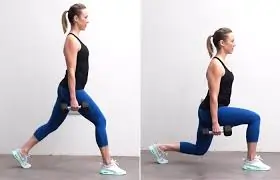
- Take a straight posture while keeping your shoulders back. Maintain an upright posture while holding one dumbbell in each hand and keeping your arms at your sides.
- Throughout the exercise, keep your arms at your sides and relaxed. Place your weight on your heel as you take a stride forward with your right leg.
- Lower yourself into a lunge stance by bending your right knee as your right foot lands and stabilises.
- Repeat the action with the left leg, bringing your left foot forward without moving your right leg. Pause in a lunge posture, keeping your left leg parallel to the floor.
- Repeat the action, swapping legs and “walking” forward as you lunge.
Overhead walking lunges
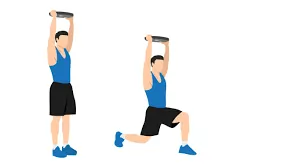
As you lunge, raise a medicine ball or weight plate above your head.
Hill walking lunges
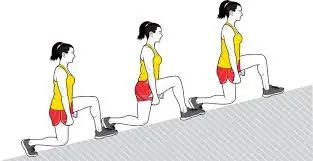
Do walking lunges while you climb a hill.
Sideway walking lunges
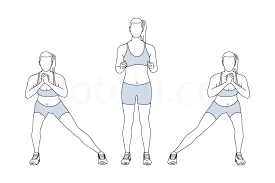
- Breathe through your nose into your stomach while keeping your feet shoulder-width apart.
- First, take a step to your side with your weak leg.
- Hold your shoulders back and your chest high.
- You should have a perfectly straight lead leg.
- If you want to dig deeper, you can turn your toes up or maintain your trail foot flat.
- Using the leg you lunged at, raise yourself. Exhale as you push yourself up and finish the rep.
Precautions
- If you are a total beginner, you may want to start with a static lunge to develop appropriate form.
- Throughout the exercise, try to keep a straight posture rather than sinking forward.
- As you go forward, contract your muscles.
- You risk arching your back if you take too long a stride.
Common mistakes
The foundation of doing a walking lunge is appropriate form. It may take some trial and error to master this practice, from alignment and posture to focusing on the right muscles. Knowing the common mistakes ahead of time will help you get off to a good start and avoid injury.
Adjust your footing
The walking lunge is usually performed improperly, particularly at the feet. A safe walking lunge requires you to maintain a hip-width spacing between your feet throughout the set. Now is not the time to put one foot in front of the other; you may wind up appearing silly.
Take the Right Step.
Overstriding or taking too lengthy steps may cause pain in your hips and groin. Begin with tiny steps and gradually increase your strength and agility.
Avoid resting your back knee on the ground.
Another common technique mistake is allowing the hind leg to touch the floor. When taking a step, maintain your back knee hovering above the floor, despite the inclination to lower the leg to the ground.
Conclusion
Walking lunges are a dynamic and effective method for working many muscle groups while increasing flexibility and balance. Walking lunges are an adaptable exercise for all fitness levels, whether performed as a stand-alone exercise, as part of a leg day workout, as part of your existing full-body routine, or as part of a dynamic warm-up.
FAQS
Who should avoid lunges?
People with major knee, hip, or back issues should see their doctor, physical therapist, or personal trainer before beginning a lunge-based fitness program. Don’t let a lack of leg strength prevent you from performing the lunge.
What are walking lunges useful for?
Walking lunges enhance lower body strength, stability, and total functional fitness by activating several muscular groups such as the quadriceps, hamstrings, glutes, and core. The dynamic nature of the activity improves flexibility and joint mobility.
What are the risks of performing lunges?
“You shouldn’t strain when doing a lunge.” Straining can cause muscular or tendon damage that can take many weeks to recover. People with substantial knee, hip, or back issues should see their doctor, physical therapist, or personal trainer before beginning a lunge-based fitness program.
Which is better: squats or walking lunges?
Squats promote strength, power, longevity, and joint-friendly movement. Lunges improve balance, coordination, performance, and real-world agility.
What happens if I practice walking lunges every day?
Daily lunges are a simple yet effective technique to tone your legs, improve your balance, and strengthen your core. Daily lunges may shape your lower body, boost flexibility, and improve stability, whether you’re an athlete, attend the gym, or work out at home.
How long should I perform walking lunges?
Pause with your left leg parallel to the floor in a lunge stance. Repeat this exercise, “walking” forward while you lunge with alternate legs. Perform 10-12 repetitions on each leg. Perform 2–3 sets.
Which is preferable: walking lunges or static lunges?
Walking lunges may be better for building balance, stability, and core strength since they challenge these areas more, but static lunges allow most individuals to lift more, making them superior for strength and hypertrophy. Choose the lunge that best matches your goals, or include both in your regimen.
References
- Lindberg, S. (2024, November 25). Walking lunges are a staple Functional Fitness Move—Here’s How to Master them. https://www.onepeloton.com/blog/how-to-do-walking-lunge
- Chertoff, J. (2019, June 24). How to Step Up Your Workout with Walking Lunges. Healthline. https://www.healthline.com/health/exercise-fitness/walking-lunges
- Fit, C. (2022, August 8). Walking Lunges: How-To, Variations, Benefits, Precautions & More. blog.cult.fit. https://blog.cult.fit/articles/walking-lunges-variations-benefits-precaution-and-more
- Bodyweight lateral walking lunge – Simple Solutions fitness. (n.d.). https://www.simplesolutionsfitness.com/exercise-library/bodyweight-lateral-walking-lunge



2 Comments