Reverse Lunge Exercise
What Is a Reverse Lunge?
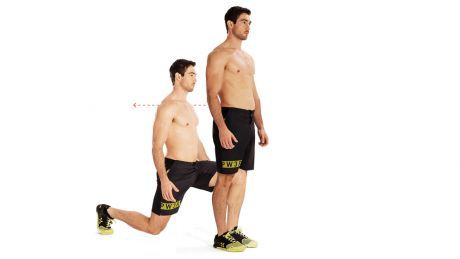
A reverse lunge is a variation in which, instead of stepping forward, you step the working leg backwards, landing with both knees bent—the same position you would reach at the base of a split squat or forward lunge. Then you stand back up, bringing your back leg under you. It may appear simple, but you’ll feel it once the reps start adding up.
Muscles Worked By the Reverse Lunge
The quadriceps are the primary muscles that work during a reverse lunge. They are located in front of our thighs and produce knee extension (straightening of the leg). Our quadriceps start working as soon as we lunge, and they get more active as we get back to the top position. The muscle group is also responsible for knee stability and hip flexion, which occur when we lunge back.
During reverse lunges, the second muscle group that works actively is our glutes. The muscle accounts for a significant portion of the buttocks and is primarily responsible for hip extension, which occurs when we begin to move up after lunging. Our glutes also extend each leg back and improve hip stability.
Similarly, our hamstrings help the glutes with hip extension and promote knee and hip stability during lunges.
As previously stated, the movement also promotes better midsection activation due to its increased stability demands. The abs, obliques, and other muscles are flexed isometrically, contributing to torso stiffness. Our back muscles contract similarly to maintain spine stability, and our shoulder blades retract.
How to Do Reverse Lunges Correctly
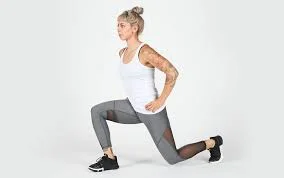
- Take the starting position by standing tall with your shoulders back, abs tight, gaze forward, and hands on your hips.
- Position your feet in a comfortable stance (roughly shoulder-width apart) with your toes pointing slightly out.
- Take a breath and bring your right leg back, landing on the ball of your right foot. Bend your front leg to go into a lunge right away.
- Descend until your front thigh is nearly parallel to the floor and your back knee is an inch or two off the ground. The stride length varies from person to person, but you should avoid taking short and long steps. A good stance is one in which your front shin remains relatively vertical (knee above ankle) as you descend.
- Pause at the bottom and use your front leg to lift yourself back to the top.
- Return to the starting position with your right leg, maintaining a shoulder-width apart stance, and exhale as you reach the top.
- Take another breath, then lunge back with your left leg, landing on the ball of your left foot.
- Continue alternating throughout the set, performing equal reps on both legs.
Variations and Modifications
Bodyweight Split Squats
If reverse lunges are too difficult to try, Jess recommends split squats first—instead of moving your back foot out and in, your feet stay in the same position on the floor the entire time, and you simply squat down and lift back up.
Limited Reverse Lunge
If you don’t have the strength or mobility to go all the way down until your knees are at 90-degree angles, work within your limitations.
Lunges from a Box
Reverse lunges from a box provide an extra challenge. Begin by standing on a low box and performing a reverse lunge to deepen the lunge. With this variation, your front knee bends even more.
Loaded Reverse Lunges
Adding weight is one way to progress with reverse lunges. Dumbbells can be held in either hand, down by your sides, lifted overhead, or simply in the hand on the same side as the working leg. Alternatively, you can hold a kettlebell or weight plate at your chest with both hands, or keep the kettlebell in one hand, racked at the shoulder.
Held Reverse Lunge
Spending more time at the bottom is an easy way to improve your reverse lunges. Begin by adding one or two seconds, then gradually increase to around five seconds.
Walking Reverse Lunges
To test your coordination and balance, try walking backwards with reverse lunges. So, instead of bringing your back leg in to stand up when you reach the bottom of the position, bring your front leg back to meet it.
Rear Foot Elevated Split Squat
If you place your back leg on a box or bench behind you and perform split squats, you’ll work many of the same muscles as a reverse lunge, but it’ll feel more difficult because your weight is concentrated in your front foot.
Benefits
Reverse Lunges Can Be Easier On Your Knees
Compared to the typical forward lunge, reverse lunges are less burdening on the knee joint. You can maintain the shin bone perpendicular to the ground in a reverse lunge, giving you more control and less strain on the knee joint. Additionally, reverse lunges can strengthen your glutes and hamstrings to protect your knees during other activities.
Reverse Lunges Work One Leg At a Time
Any kind of lunge is a unilateral exercise, which can help you spot unevenness in your body and strengthen each side equally.
Reverse Lunges Can Work Your Mobility
You’re stretching your hip flexors in particular and testing your ankle and hip range of motion when you perform a reverse lunge.
Your Posterior Chain Fires Up
Fitness experts refer to the muscles in the back of the body as the “posterior chain,” but many of us are quad dominant, meaning we focus primarily on the muscles in the front of our thighs. However, reverse lunges activate the hamstrings, glutes, and calves—muscles that we all too frequently overlook.
Your Balance Gets a Challenge
You have to balance on one leg for a brief period of time when you’re stepping backwards. Additionally, because your legs are staggered, the position can test your stability even when that back foot touches the ground.
You Get Moving In New Ways
We spend the majority of our lives moving forward, such as by walking or climbing stairs. However, reverse lunges compel us to act in the opposite way.
Common Mistakes to Avoid When Doing Reverse Lunges
- First of all, a lot of people have an overly limited perspective. Start with your feet hip-width apart, then take a straight step back. Instead of using a balance beam, imagine walking on railroad tracks.
- Don’t make your ribs stand out. Make sure to tuck your pelvis under when you take a step back to protect your lower back. The spine’s neutral alignment will be preserved as a result.
- Some people take a step back that is either too big or too small. Keep in mind that you should be just far enough so that both of your knees can reach 90-degree angles.
- Performing reverse lunges too quickly is another frequent mistake. If you control the motion, your muscles are actually working much harder. Thus, you should descend gradually before accelerating a bit on the ascent.
Which Is Better: Reverse Lunge or Standard Lunge?
Your glutes and legs will be tested whether you lunge forward or backward. Which lunge is best will depend on your objectives. A forward lunge might be more appropriate for your sport if you don’t have any knee problems and you play sports where you must jump forward and stop quickly.
Reverse, however, is the best option if you want to protect your knees. Both work the quadriceps and glutes, but because they use the hamstrings a little more than forward lunges, reverse lunges are typically more knee-friendly.
Conclusion
Any fitness regimen would benefit from the addition of reverse lunges. There are many variations to choose from that can all provide you with significant advantages, whether you need to change this move to make it more accessible for your body or need to mix things up to keep pushing the challenge.
FAQs
Are reverse lunges challenging?
Compared to forward lunges, this movement is typically easier to execute and less taxing on the body. However, they work wonders for strengthening the lower body.
Is reverse lunge better for knees?
Improving these side-to-side imbalances is one of the reverse lunge’s main advantages. One-leg exercises include the reverse lunge. This improves these imbalances for less impact at the knee by making your weaker leg work as hard as your stronger leg.
What do reverse lunges work most?
Instead of pushing the front knee forward over the toes, this exercise keeps the front knee behind or directly over the toes, which puts less strain on the knee joint. The reverse lunge is usually the best way to emphasize glute activation, even though all lunge variations target the glutes to some degree.
What do reverse lunges aim to achieve?
Lunges generally work the hips, core, hamstrings, glutes, and quadriceps. Compared to front lunges, reverse lunges are more hamstring and glute-dominant.
Why is performing reverse lunges so difficult for me?
Keep in mind that the back knee shouldn’t come into contact with the floor. It ought to be a few inches away. Stepping too narrowly is another frequent error. When performing the reverse lunge, people attempt to step their back leg precisely behind their front leg, which causes them to lose their balance.
References
- Heimlich, J. (1970, January 1). This lunge variation is easy on your knees, but still effective. Here’s how to do it. https://www.onepeloton.com/blog/reverse-lunge
- Stefanov, P. (2025, May 29). Reverse lunge: how-to, tips, variations, mistakes. Hevy – #1 Workout Tracker & Planner Gym Log App. https://www.hevyapp.com/exercises/reverse-lunge/