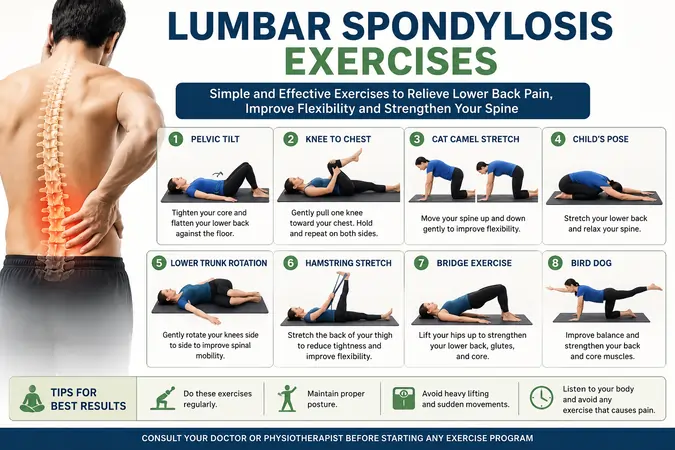
Best Home Exercises for Lumbar Spondylosis
Introduction
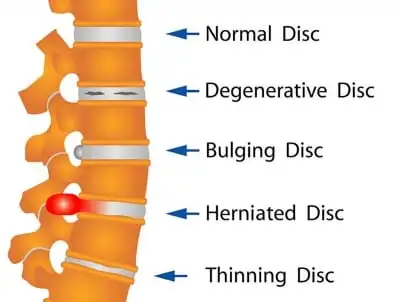
Lumbar spondylosis refers to a group of conditions that include all age-related degenerative diseases of the spine. Lumbar spondylosis is a kind of arthritis of the spine. It happens when the lumbar discs and joints deteriorate, causing aches, pains, and decreased flexibility. Symptoms may range from minor discomfort to severe pain that interferes with regular activities.
Lumbar spondylosis affects a large number of people globally. It is believed that 60-70% of adults over 60 suffer from some kind of lumbar spondylosis.
The reason for its high occurrence is the natural aging process, which causes wear and strain on the vertebral joints and discs in the lower back. Other risk factors include heredity, bad posture, obesity, and a sedentary lifestyle.
Risk factors and causes:
- Multifactorial
- Growing older—being over 60 is the largest risk factor.
- Twisting, lifting, bending, and long-term driving may increase the risk and severity of spondylosis.
- Prior lumbar spine surgery
- Genetic and environmental factors, smoking, and obesity
- Trauma to the spine
Symptoms:
- On and off back ache – Isolated back pain is quite unusual – Back pain that improves with rest or exercise
- Your low back’s limited range of motion makes it difficult to walk or bend.
- Lower-back stiffness
- Leg pain: Muscle spasms and cramps.
- Numbness and tingling in lower limbs.
Benefits of Lumbar Spondylosis Exercises
- Reduced Back Pain: Movement promotes joint health and relieves pain caused by stiffness.
- Stretching increases flexibility in the lumbar spine and associated muscles.
- Improved Posture: Strong core muscles promote good spinal alignment.
- Reduced lower back stiffness. Gentle mobility prevents joints from getting too stiff.
- Enhanced rehabilitation: Exercise treatment speeds up healing and improves long-term results.
- Improved daily function. Regular exercise frequently makes it simpler for patients to walk, stand, and sit.
Best Exercises for Lumbar Spondylosis
Stretching Exercises
Stretching activities help to decrease stiffness and increase flexibility. Here are some of the most effective stretches for lumbar spondylosis:
Cat-Cow Stretch
- Start on your hands and knees, placing your knees below your hips and your wrists beneath your shoulders.
- Inhale, arch your back (Cow Pose), raising your head and tailbone.
- Exhale and circle your spine (Cat Pose), placing your chin into your chest.
- Repeat 10 to 15 times.
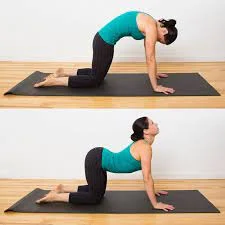
Cat Cow Stretch Benefits:
Improves flexibility.
Promotes spinal movement.
Helps decrease stiffness.
Pelvic Tilts
- Bend your legs and place your feet flat on the ground while lying on your back.
- Tighten your abdominal muscles and push your lower back on the floor.
- Hold for a few seconds and then relax.
- Repeat 10 to 15 times.
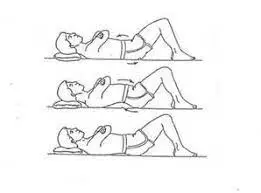
Benefits:
Increases core strength.
Supports lumbar spine alignment.
Reduces lower back pain.
Knee-to-Chest Stretch
- Lie on your back, knees straight.
- Bring one knee to your chest.
- Hold for 5 to 10 seconds.
- Repeat on the opposite knee.
- Repeat ten repetitions on each knee.
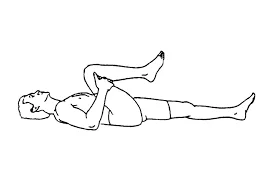
Benefits:
- Relieves stress
- Improves mobility.
- Reduces stiffness.
Child pose
- Kneel on your mat, then sit back on your heels with your knees hip-width apart.
- Exhale, then gently drop your torso between your thighs, extending your arms in front of you.
- Hold this posture for up to a minute, inhaling deeply.
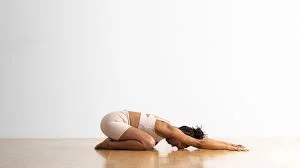
Benefits :
- Helps to stretch your back muscles and the surrounding muscles in your hips
Hamstring stretch
- Lie on your back, left leg flat on the ground, right leg bent.
- Tighten your core muscles and carefully elevate your right leg.
- Wrap a towel or a yoga strap around the ball of your right foot. Hold the strap’s two ends in each hand.
- Gently press your right heel toward the ceiling while straightening your right leg. Keep your left leg on the ground.
- Once you feel a stretch, hold this position for 15 to 30 seconds.
- Return your right leg to its previous position. Switch legs and repeat at least three times each.
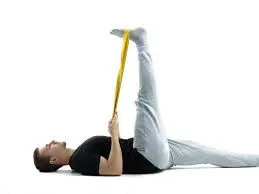
Benefits:
- Improved Lumbopelvic Rhythm
- Reduced Vertebral Shearing
Strengthening Exercises
Strengthening exercises target the muscles that support the spine, which can assist in relieving pain and preventing further damage.
Bridge
- Bend your legs and place your feet flat on the ground while lying on your back.
- Lift your hips to the ceiling, clenching your glutes and activating your core.
- After a few seconds of holding, drop your hips once again.
- Repeat 10 to 15 times.
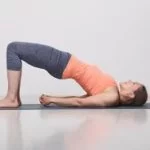
Benefits:
- Strengthens the posterior chain muscles.
- Enhances lumbar spine support.
- Relieves mechanical back pain
Bird-Dog Exercise
- Start on your hands and knees, placing your knees below your hips and your wrists beneath your shoulders.
- Extend your right arm forward and your left leg backward while maintaining your back straight.
- Return to the starting position after 5- 10 seconds of holding.
- Repeat on the opposite side.
- Do 10-15 repetitions on each side.
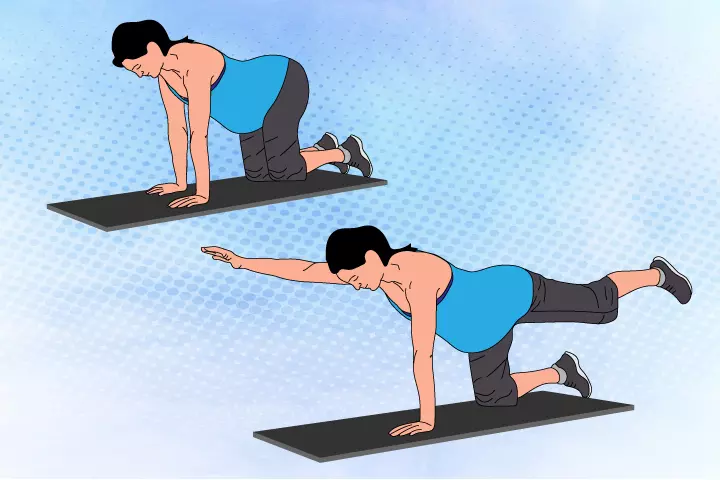
Benefits:
- Improves balance.
- Promotes spinal stability.
- Strengthens the supporting muscles.
Plank
- After lying face down on the ground, lift your body to your toes and forearms.
- Keep your body in a straight line from head to heel.
- Hold for 20-30 seconds, progressively increasing the time as you gain strength.
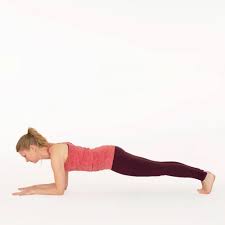
Benefits:
- Improves balance
- Builds core strength
- Supports posture
Partial Curl-Ups
- Lie on your back.
- Bend your knees.
- Place your arms behind your head.
- Lift the shoulders slightly.
- Repeat 10 to 15 times.
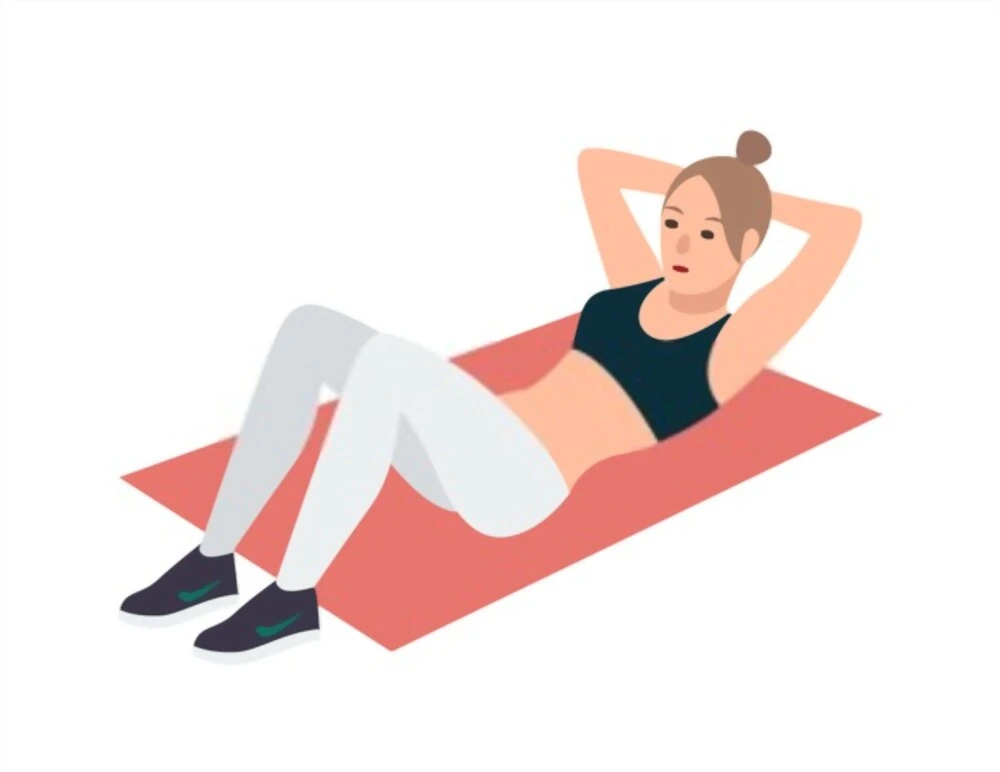
Benefits:
- Core strengthening
- Better spinal support
- Improved posture
Low-Impact Aerobic Exercises
Low-impact aerobic activities are mild on the joints and can assist in improving cardiovascular fitness while not increasing lumbar spondylosis symptoms.
Walking
- Walking is a basic, low-impact workout that can be performed anywhere.
- Most days of the week, set aside 20-30 minutes for moderate-paced walking.
Swimming
- Swimming gives a full-body workout without placing strain on the spine.
- Try swimming laps or joining a water aerobics class.
Cycling
- Stationary cycling is another great low-impact activity.
- Adjust the seat height and intensity level for a pleasant exercise.
How Often Should You Perform Lumbar Spondylosis Exercises?
- Stretching: Daily
- Strengthening Exercises: 3–5 times weekly
- Walking: Most days of the week
Exercises and Movements to Avoid
- High-impact activities.
- Running, jumping, and strenuous aerobic activities place excessive strain on the spine. These can cause additional wear and strain, causing pain.
- Heavy weightlifting.
- Lifting big weights, particularly with poor technique, puts additional strain on the discs and joints. Avoid deadlifts, squats, and overhead presses unless under the supervision of a physical therapist.
- Extreme Forward Bending or Twisting
- Rapid twisting motions and deep forward yoga bends put stress on the spine and may aggravate disc-related issues.
- Jerky, fast movements.
- Spondylosis requires gradual, controlled movements. Jerky or rapid motions could trigger muscle spasms and aggravate pain.
Tips for Exercising with Lumbar Spondylosis
- Start slowly. If you’re new to fitness or haven’t been active in a while, begin cautiously and gradually increase the intensity and duration of your exercises.
- Warm up and cool down: Always prepare your muscles before exercising and stretch afterwards to minimize stiffness.
- Listen to your body. If a movement produces extreme pain, stop it right away. Discomfort is natural, but pain is abnormal.
- Consistency is key. Regular exercise is vital for treating lumbar spondylosis. Aim to do at least 150 minutes of moderate-intensity aerobic activity and two strength-training sessions each week.
- Consider physical therapy. A physical therapist may create a personalized workout program based on your individual needs and teach you correct methods to avoid injury.
Lifestyle Tips That Enhance Results
- Keep Your Weight in Check: Being overweight strains your lumbar spine.
- Improve Your Sitting Posture: Use ergonomic seats and lumbar support.
- Stay Active: Avoid lengthy bed rest.
- Lift Correctly: Instead of bending at the waist, use your legs.
- Sleep comfortably: Select a supportive mattress and sleeping posture.
Conclusion
Exercise is an effective way to manage lumbar spondylosis. Stretching, strengthening, and low-impact aerobic workouts can help you reduce pain, increase flexibility, and improve your overall quality of life.
Remember to start carefully, listen to your body, and speak with a healthcare expert if you have any questions. With hard work and determination, you may get relief and keep your spine healthy.
FAQs
Is walking beneficial for lumbar spondylosis?
Walking is great for lumbar spondylosis. It is a low-impact workout that improves blood circulation, nourishes the spinal discs, and strengthens the muscles that support the spine. Consistent, mild walking also helps with flexibility and weight management, which immediately relieves strain on your lower back.
Can physiotherapy treat lumbar spondylosis?
Lumbar spondylosis is a kind of lower-back arthritis that most typically affects adults over 60. Physiotherapy assists in relieving the symptoms of lumbar spondylosis.
How long does spondylosis take to heal?
The recovery period for spondylosis (spinal degeneration) or spondylolysis (a spinal stress fracture) is mostly determined by the severity of your disease and the therapy you choose. Within 6 to 12 weeks of continued conservative treatment, most people notice considerable improvement and are able to resume normal activities.
At what age does lumbar spondylosis begin?
Lumbar spondylosis—age-related wear and tear on the lower back—usually begins in a person’s 30s, with obvious symptoms appearing between the ages of 20 and 50.
What are the best exercises for lumbar spondylosis?
The Pelvic Tilt is the most effective exercise for lumbar spondylosis. It safely stabilizes the spine by activating your core and flattening your lower back, reducing strain on your spinal discs while avoiding jarring hits.
References:
- CB Physiotherapy. (n.d.). Cbphysiotherapy. https://cbphysiotherapy.in/exercise/top-5-exercises-for-lumbar-spondylosis
- Effective exercises for lumbar spondylosis. (n.d.). https://www.medicoverhospitals.in/articles/lumbar-spondylosis-exercises
- [email protected]. (2026, June 25). Best Lumbar Spondylosis Exercises for Back Pain Relief. https://wearespine.in/lumbar-spondylosis-exercises/
- Ortho, P. N. J. |. M. D. (2026, May 17). Exercises for spondylosis relief: What to do and what to avoid. ANSSI Wellness. https://www.anssiwellness.com/proper-exercises-spondylosis-relief/
- Srikantha, U. (2026, February 24). Lumbar Spondylosis Treatment: Exercises & Relief. Spine 360 | Dr.Umesh Srikantha. https://www.spine360.in/spine-knowledge-lumbar-spondylosis/