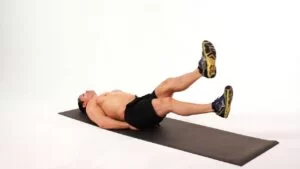
Scissor Kicks Exercise
Introduction
Scissor kicks are a dynamic core exercise that works the lower back’s stabilizers and hip flexors in addition to the lower abs. Because it requires no equipment, can be performed anywhere, and produces good benefits when done regularly and correctly, it is an essential component of any successful exercise regimen.
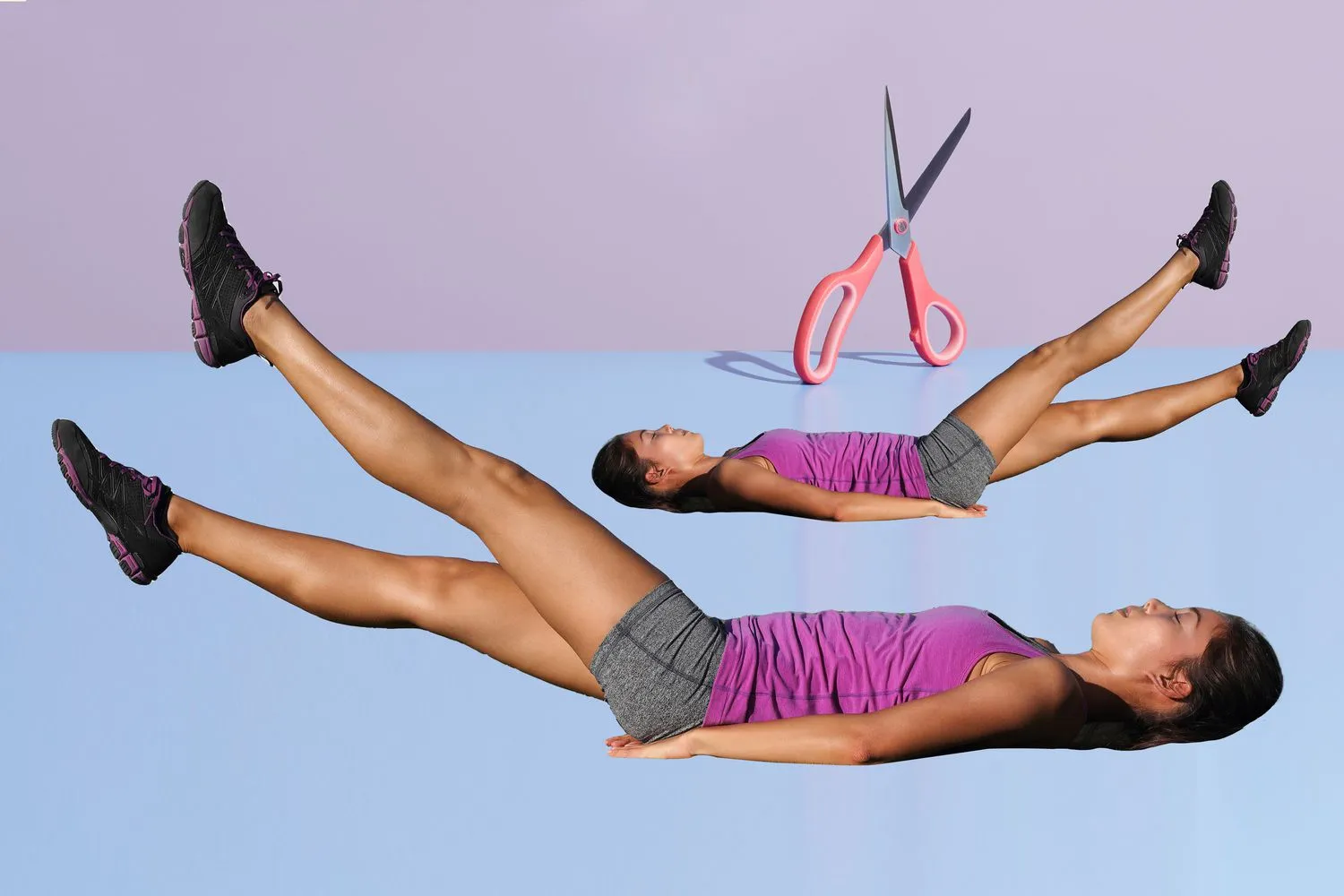
Scissor kicks, also known as flutter kicks, are a bodyweight exercise in which you lie on your back and raise and lower your legs in a slow, controlled fluttering motion. The workout is called “scissor kicks” because the movement resembles cutting with scissors.
Muscles Worked
- Rectus Abdominis – The “six-pack” muscle
- Transversus Abdominis – Deep core stabilizer muscle
- Hip flexors (iliopsoas) – Raising the legs
- Obliques – Aid in stabilizing
- Quadriceps – Used to keep legs straight
- Lower Back Muscles – Maintain good posture and help to stabilize the spine.
Scissor Kicks Exercise Video
How to perform a scissor kick?
Steps:
- Look for a comfortable exercise mat. You’ll want a solid mat with some thickness.
- Stretch your legs out in front of you while you lie on your back on the mat. Place your arms at your sides, palms facing downward. You can also push your palms into the floor while placing your hands behind your buttocks, beneath the small of your back.
- Tuck your pelvis in and press your lower back on the mat to activate your core. Maintain this position throughout the movement.
- Raise both legs at a 45-degree angle, or 6 to 12 inches from the starting position (in this case, the floor).
- Lift one leg and lower the other to the floor while keeping a tight core and a relaxed neck. The “scissoring” action starts at this point.
- To repeat the scissoring motion, carefully shift your legs up and down for the recommended number of repetitions.
- Perform two sets of 12–20 reps. Each leg scissoring counts as one rep. Add a third set as your strength increases. You may incorporate scissor kicks into a two-to-three-day-a-week core workout.
Variations and Modifications
Beginners Modification:
- Maintain your lower leg position on the mat. Your lower back may feel less stretched as a result. If your lower back is arching away from the mat, begin this exercise with your feet just hanging over the floor. As you develop strength, increase the distance between your legs and the floor. Check that you’re not arching your back.
- Replace the scissor kick with the bicycle crunch. The scissor kick and bicycle crunch share similar movement characteristics.
- To improve your strength and stamina before performing the scissor kick exercise, perform a supine bicycle crunch.
Advanced variation:
- Increase the size of the scissoring motion and lift your legs.
- Before switching legs, slow down your kicking motion and hold the higher leg for two to three seconds.
- Light ankle weights should be included.
Benefits
- Enhances Core Strength: Scissor kicks target the muscles in your abdomen, especially the lower abdomen. The core region is also strengthened and stabilized by oblique workouts.
- Enhances lower abdominal definition: The exercise helps tone and define the lower abdomen, an area that is sometimes difficult to target.
- Activates Hip Flexors: This exercise improves strength and stretches the hip flexors. This is essential for everyday mobility and sports activity.
- Increases Endurance: Longer scissor kick sessions increase your legs’ and core’s muscle endurance, which makes it simpler to maintain physical exercise.
- Promotes Better Posture: You may have better posture and a lower chance of developing back pain if you have a strong core that stabilizes your spine.
- Beginner-Friendly & Low-Equipment: Scissor kicks are one of the best exercises for beginners and at-home exercises because they don’t need any equipment and can be done anywhere.
- Encourages burning and fat loss. Calories: Although scissor kicks don’t burn a lot of calories by themselves, they can help with total fat loss when paired with a healthy diet and regular exercise.
Common Mistakes To Avoid
- Avoid Lower Back Arching:
- Keep your lower back in contact with the mat at all times to reduce the risk of discomfort or injury. Perform the exercise in a slow and controlled manner to effectively target your core muscles.
- Focus on Core Engagement:
- Make sure your abdominal muscles remain active throughout the movement. Without proper engagement, the exercise will not deliver the desired results.
- Don’t Raise Your Legs Too High:
- Holding your legs closer to the ground increases core activation. Lifting them too high decreases the intensity and reduces the effectiveness of the exercise.
Tips to do a better scissor kick
- Throughout the workout, maintain your arms motionless. Your arms give stability. It is not proper to use them for momentum.
- Throughout the workout, keep your core tight and active. Consider the spine to the abdominal button.
- Instead of moving rapidly and randomly, maintain your movements consistently and rhythmically.
- Because the scissor kick is an independent exercise, it typically performs better when combined with a bigger fitness routine. A mix of Pilates exercises, abdominal and core workouts, and aerobic boot camp-style routines, including the scissor kick.
- Before executing scissor kicks, be sure to thoroughly warm up because you’re asking the core muscles to work at high speeds.
Precautions and safety tips
- The scissor kick is an intermediate-level workout that requires both lower-body and core power. If you experience neck problems, tight hip flexors, or low back pain, consider modifying your workout routine.
- If you’re new to exercise and don’t know how to engage your abdominal muscles, you may consider working with a personal trainer or physical therapist.
- If you’re pregnant, consider doing a different workout to improve your core muscles.
Conclusion
Scissor kicks, a useful and demanding workout, may help tone a powerful and well-defined core. Including scissor kicks in your program can improve your general conditioning and core strength, regardless of your level of experience. You will undoubtedly gain from maintaining control, using your core muscles, and practicing on a regular basis.
FAQs
Does the scissor kick work?
Compared to flutter kicks, scissor kicks are often more difficult because they need more muscle control and core stability through intricate horizontal movement patterns. Although they focus on separate muscle areas for complete abdominal growth, both workouts successfully increase core strength without the need for equipment.
Can belly fat be burned with scissor kicks?
Scissor kicks are a great way to develop your hip flexors and core, but they won’t make your abs stand out on their own. It takes a mix of activity, a good diet, and total body fat reduction to achieve different abs.
How many scissor kicks should I perform each day?
Start with two or three sets of ten to fifteen repetitions. To make it more difficult, alternate between horizontal and vertical scissor kicks.
Why is my lower back hurting when I practice scissor kicks?
Your back arching off the floor is typically the cause of pain in the lower back. To avoid tension, keep your core active and drive your lower back into the floor.
Are leg lifts superior to scissor kicks?
Both workouts are beneficial. Leg lifts concentrate more on strength, while scissor kicks enhance endurance and coordination. It’s best to include both in your regimen.
Reference:
- Lindberg, S. (2019, May 1). How to do scissor kicks. Healthline. https://www.healthline.com/health/scissor-kicks#variations
- Nitesh, D. (2025, November 3). Scissor Kicks Exercise – Benefits, How to do Video? Physiotherapy Treatment and Exercises at Home. https://homephysiotherapyexercises.com/scissor-kicks-exercise/