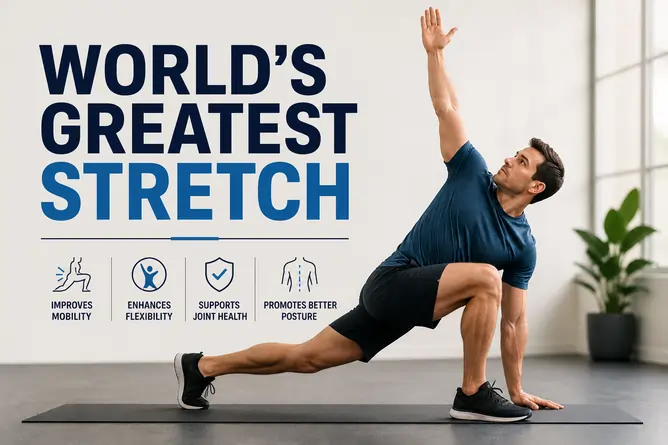
World’s Greatest Stretch
Introduction
A dynamic full-body stretch, The World’s Greatest Stretch enhances muscle activation, flexibility, and mobility. It is perfect for warming up before exercises or sports since it works the hips, hamstrings, spine, and shoulders.
The “World’s Greatest Stretch” is a well-liked mobility exercise among athletes, fitness enthusiasts, and physiotherapists. It is regarded as one of the best full-body stretches for increasing flexibility, mobility, and body readiness for physical activity.
People’s range of motion, flexibility, and endurance can weaken with age, which raises the possibility of tightness, difficulties, and accidents. Both long-term pain management and general well-being depend on movement.
It takes less than five minutes to complete and works all of the body’s major muscles, especially the ones we frequently ignore from spending all day at a desk or computer. This is why it is so popular. Because it is a dynamic stretch with static components, you may do it as part of your dynamic warm-up, at the conclusion of a session, or to get your body ready for action.
World’s Greatest Stretch Video
The World’s Greatest Stretch involves which muscles?
You may include this stretch into a stand-alone mobility exercise, execute it dynamically during your warm-up, or hold it still during your cool-down to enhance circulation and prepare your muscles for the task ahead.
When you are in a deep lunge position, your hamstrings, calves, and back foot should all feel pleasantly stretched. Additionally, the front of your extended rear leg’s quadriceps should feel stretched. Your hips should expand up, and your glutes should softly pull when you reach into that region with your front foot flat on the ground.
With one hand on the ground and the other reaching straight up toward the ceiling, your upper body then joins in. Twisting your body will help your shoulders and back because one hand will support your weight while the other extends up into the air to stretch your abdominal muscles and open up your chest.
During your cool-down, switch sides for a static stretch after a few seconds of maintaining this posture. For a more dynamic stretch during your warm-up, gently twist your arm by slowly rotating it up and back down to the floor. This is a great method to warm up and work your spine, core, and upper body.
Benefits of the stretch:
- Prepares the Body for Athletic Performance
- This dynamic stretch improves neuromuscular preparation before physical activity.
- Perfect as a warm-up to get the body ready for HIIT, deadlifts, squats, and running.
- Promotes Healing and Mobility
- To avoid post-workout stiffness and restore normal joint ranges, use it during cool-downs.
- Particularly helpful for those who need hip and spine decompression because of heavy lifting or sedentary occupations.
- Enhances Blood Flow and Reduces the Chance of Injury
- Increased blood flow and oxygen delivery to the muscles are facilitated by this dynamic movement.
- Sprains, strains, and other soft-tissue injuries are less likely when muscles and joints are prepared.
- The Hip Flexors’ Range of Motion and Stretch
- The hip flexors, particularly the iliopsoas, which can be strained by extended sitting, are tightened by the deep lunge posture.
- Frequent exercise increases hip flexion and extension, which enhances performance in lifting, cycling, and running.
- Increases Core Activation
- keeps the trunk stable throughout the exercise by using the core vigorously, especially when bending and reaching.
- enhances neuromuscular control and total core strength.
- Encourages the use of functional movement
- The greatest stretch in the world promotes functional flexibility that can be applied to daily work by including real-world actions like lunges and twists.
- Improves Posture
- opens up the shoulders and chest and activates the posterior chain, which is made up of the glutes, hamstrings, and spinal extensors.
- aids in correcting bad posture brought on by extended sitting or screen time.
- Helps in improving body coordination
- The complexity of the motions requires mental and physical coordination and concentration, which might enhance overall body awareness.
- Increased Mobility of the Thoracic Spine
- Because it effectively mobilizes the thoracic spine (mid-back), rotating the upper body is a crucial part of the World’s Greatest Stretch.
- Maintaining good posture, moving above, and reducing tension on the lower back and shoulders all depend on this.
- Corrects Unbalanced Muscles
- Autonomous training is encouraged by stretching and using one side of the body at a time.
- Excellent for determining and addressing variations in strength or flexibility between the left and right sides.
- Improved Adductor and Groin Flexibility
- The lunge posture, especially when paired with the elbow-to-instep component, increases groin flexibility and reduces the risk of injury by efficiently extending the adductor muscles of the inner thigh.
Before starting a stretching regimen, consider the following precautions:
Before starting a program, a few safety precautions should be taken to optimize the advantages of stretching. See your doctor or a physiotherapist for guidance on the ideal stretch for your particular issue.
Instead of battling misery, you should focus on your body. Stretching can cause discomfort, but if it lasts or worsens, it can indicate that you’re overexerting yourself.
If you are unsure about your ability to dedicate yourself to a fitness regimen, speak with a doctor. Before beginning any exercise, make sure your muscles and joints are ready by warming up.
When the Greatest Stretch in the World Should Be Included:
- Warm-up Before Exercise
- It’s a great dynamic warm-up that prepares your body for any type of exercise, including
sports, running, and strength training.
- It’s a great dynamic warm-up that prepares your body for any type of exercise, including
- Morning Routine for Flexibility
- Start your day with the World’s Greatest Stretch to get your body moving and expand your range of motion.
- Cool-down After Workout
- Despite being mostly active, it may also be a helpful cool-down stretch that emphasizes muscle lengthening following an activity.
- Sitting Breaks
- If your profession demands a lot of sitting, performing the World’s Greatest Stretch a few times during the day might help counteract the negative consequences of extended sitting.
- Rehabilitation
- When performed under the guidance of a physiotherapist, the World’s Greatest Stretch can be a helpful technique for treating certain mobility problems and healing from certain injuries.
How should the World’s Greatest Stretch be performed?
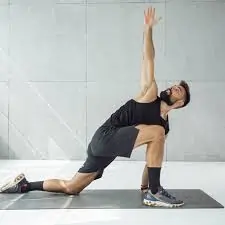
- Start by standing on the floor in a wide plank position.
- Contract your core before proceeding to the next stage.
- Your right foot should be outside your right hand when you go forward.
- Make sure your knee is just above your right foot at a 90-degree angle.
- In a plank position, keep your left leg straight or, if you’re changing, put that knee on the ground.
- Don’t round your upper back.
- Raise your right hand and extend it toward the sky as you inhale to expand your chest to the right.
- Keep your neck extended, keep your core tight, and avoid letting your left hip rotate.
- Put your right hand back on the ground.
- There is just one repeat.
- After that, go back to your neutral stance.
- Then loosen up.
- Do these exercises five to ten times.
- Perform the same number of repetitions on each side.
World’s Greatest Stretch Variations:
Reverse World’s Greatest Stretch
How to perform it?
- Start by taking a position on the ground.
- For a reverse lunge, utilize your right foot.
- Ensure that both hands are inside your left foot.
- Let go of your hand and perform a hamstring stretch.
- Breathe deeply during the stretch transitions.
- For a few seconds, maintain this posture.
- To stand once more, take a stride forward.
- After that, go back to your neutral stance.
- Then unwind.
- Do these exercises five to ten times.
- After exchanging legs, repeat the stretch.
World’s Greatest Stretch With Resistance Band-Assisted
How to perform it?
- Loop a solid pull-up support band over the back of your upper thigh and secure it to a solid item in front of you.
- Stretch the hip flexor of the kneeling leg by starting in a split squat stance, bending forward with your torso.
- Put one hand on the ground across from the front foot.
- Starting with your shoulders and upper back, turn toward the ceiling.
- For a few seconds, maintain this posture.
- After that, go back to your neutral stance.
- Then unwind.
- Do these exercises five to ten times.
Side Lunge Worlds Greatest Stretch
How to perform it?
- Stand on the ground to start.
- Use your right foot to take a large step.
- As you lower your right knee, your left leg should stay straight.
- Keep your chest up and distribute your weight over your heel or midfoot.
- Your inner thigh on the left should feel stretched.
- With your hands on the ground close to your right foot, slightly lower your body.
- Expanding your hips, this helps you become ready for the following phase.
- Use your left hand to touch the ground.
- Rotate your chest while raising your right arm toward the ceiling.
- Holding for a few seconds will cause your hip, shoulder, and thoracic spine to lengthen.
- After that, go back to your neutral stance.
- Then relax.
- Do these exercises five to ten times.
World’s Greatest Stretch the World, Loaded (With Kettlebells or Dumbbells)
How to perform it?
- Hold a kettlebell or dumbbell in each hand at your sides.
- Step your right leg forward to initiate a deep lunge.
- Be sure to keep your left leg straight behind you.
- You may either keep both weights at your sides or position one inside the front foot.
- If needed, drop the back knee gently.
- Bring your right elbow down to the instep of your right foot.
- Stretch your hips deeply.
- Maintaining the dumbbell or kettlebell in your right hand, raise your right arm toward the sky while maintaining your torso wide.
- People follow your hand.
- To prevent spinal instability, keep your core engaged.
- This improves anti-rotation stability and shoulder strength.
- As you lower or hold the weights, straighten your front leg and push your hips back.
- By leaving the weights hanging, you can increase the posterior chain loading.
- You should feel a deep stretch in your hamstrings.
- After that, go back to your neutral stance.
- Then relax.
- Do these exercises five to ten times.
- Repeat with the opposite leg.
Curtsy Lunge Worlds Greatest Stretch
How to perform it?
- Get down on the ground and start to stand.
- Step your right foot laterally behind your left leg so that its heel rests outside the left heel, like a deep curtsy.
- Then you go into a lunge.
- so that your torso stays straight and your front knee is above your foot.
- This should be felt in your left glute and outer hip.
- You are now in a twisted kneeling lunge, which opens up the hip and glute of the front leg and begins to stretch the back hip flexor.
- Place both hands inside your left foot and touch the ground.
- Drop your left elbow toward the floor after positioning it close to the inner of your left foot.
- Keep your back leg outstretched if you can; if not, gently rest your knee.
- To keep your balance, put your right hand down.
- Next, raise your left arm to a higher position.
- As you follow your hand with your eyes, maintain a firm hip position and an expanded spine.
- Put your left hand back down.
- Start to straighten your left leg by moving your hips.
- Your hamstrings and calves will be stretched by this.
- Keep both hands on the ground while you bend over the leg that is straightening.
- Flex your front foot to achieve a deeper stretch.
- After that, go back to your neutral stance.
- Then relax.
- Do these exercises five to ten times.
When Should You Stop?
- Excessive or Weak Muscle Use
- The muscles, particularly the shoulders, hip flexors, glutes, and core, may feel weak or shaky.
- Stretching while fatigued can result in bad form, which lowers performance and raises the risk of injury.
- Dizziness, nausea, or lightheadedness
- Experiencing lightheadedness, nausea, or vertigo during or after the stretch.
- Low blood sugar, dehydration, or poor breathing might be the cause of this.
- Experiencing Pain When Stretching
- Muscular cramps or radiating, acute, or stabbing pain in the knees, hips, shoulders, or spine.
- Pain is a sign that tissues are overworked and may be damaged.
- Poor Techniques or Weak Self-Control
- In addition to reducing the benefits,
- it can cause pain, particularly in the lower back and shoulders.
- Physical or Mental Tiredness
- Being passive, uninterested, or terrified of the stretch when working out.
- Although forced repetition without involvement might result in a lack of commitment or even a dislike for the mobility activity, consistency is essential.
- Continual Clicking Sounds or Joint Pain
- You can feel popping or crunching in your hips, shoulders, or knees with each repetition.
- This might be the result of overuse or displaced joints, which can get worse with repeated use.
Common mistakes to avoid when performing the World’s Greatest Stretch
Incorrectly placing the hands or feet.
- The hand placement is either too broad or too short, while the front foot is either too far forward or too near.
- altering posture and balance.
Extending too much during the twist
- When finishing the twist part, try not to overrotate since this might lead to back pain.
- The thoracic spine (upper and mid-back) should be the main source of the twist rather than the lower back.
Rapidly Getting Through the Motion
- Completing the stretch too rapidly without maintaining each posture.
- decreases the stretch’s flexibility.
- raises the possibility of muscular strains caused by a lack of control.
Ignoring your breathing
- Inappropriate breathing might cause your muscles to become stiff, which will limit their capacity to stretch.
- In order to deepen the stretch and encourage relaxation, take slow, deep breaths.
Unable to engage the core
- If your core is not worked throughout, the stretch’s twist and reach components in particular may create lower back pain.
- A powerful and dynamic core supports the spine in addition to offering stability.
Lunge in Poor Quality
- The front knee may bend inward or extend past the toes, or one leg may drop with the knee touching the ground.
- Balance and stability are impacted by improper placement.
Going too far
- Above all, pay attention to your body, especially if it’s hurting.
- Pain that is more than simply little pain is a sign that something may be wrong, and pushing through pain can lead to harm.
- If anything doesn’t feel right, adjust the stretch or see an expert.
Tips
- Before the stretch, warm up.
- Make changes if you are injured or have restricted mobility.
- Spend some time performing the Motions
- Don’t push yourself too far.
- Gradually Increase Repetitions Over Time
- Inhale deeply and naturally.
- A smooth or uneven surface should never be used for a performance.
- Make sure your head and eyes follow your hand as you turn and reach toward the ceiling.
- Make sure you step forward far enough so the front shin is upright.
Conclusion
This exercise improves flexibility and mobility by using the entire body. It is strongly suggested that anyone interested in fitness perform this activity. Remember that, while this stretch is fantastic for most individuals, it is not appropriate for everyone.
If you have any diseases or health issues, please see your doctor first.
The dynamic stretching workout “The World’s Greatest Stretch” targets the hips, hamstrings, quadriceps, and core, among other muscle groups. To increase flexibility and mobility, a lunge stance is supplemented with extra twists and stretching. Incorporating the World’s Greatest Stretch into your routine will benefit anybody looking to move more smoothly and suffer fewer everyday aches and pains, as well as elite athletes looking for excellence.
When completing the World’s Greatest Stretch, you should keep a few things in mind. Take your time when doing the movement to begin. Since achieving each step is not a race, control your breathing and gently stretch until you feel a bit tight. Additionally, keep a square hip stance throughout the workout. Make sure your core is engaged during the stretch, as your hips should not bend or fall.
FAQs
Why is it referred to as the greatest stretch in the world?
Although the title may sound like a marketing scam, it is well-deserved. The World’s Greatest Stretch got its name because it simultaneously works several main joints and muscle groups, preparing your body for almost any type of physical exercise.
Is the Greatest Stretch in the World suitable for beginners?
However, beginners should indeed begin with blocks or supports if they are unable to make contact with the ground.
Form should take preference over depth.
Which muscles does the world’s greatest stretch target?
Along with the hamstrings, hip flexors, glutes, and core, it also targets the shoulders and lower back muscles.
How does the world’s greatest stretch improve flexibility?
By allowing the muscles to move through their entire range of motion, the World’s Greatest Stretch increases flexibility and mobility in a number of joints and muscle groups.
How many sets of the world’s greatest stretch should you perform?
Raise your inner hand and turn your back toward the ceiling. Maintain a straight knee and hip position. Return to the beginning by rotating. Ten to fifteen times, repeat.
Why does the world’s greatest stretch feel so good?
Targeting the hips, hamstrings, glutes, spine, and shoulders, the World’s Greatest Stretch is a dynamic, full-body exercise that enhances flexibility, joint mobility, and muscular strength. It corrects muscle imbalances caused by sitting, increases blood flow, and serves as an efficient warm-up to prevent injuries.
Does the world’s greatest stretch relieve lower back pain?
Yes, particularly if the pain is caused by limited hip or spinal mobility. However, stop and see a doctor or a physiotherapist if you have chronic back pain and it becomes worse as you stretch.
References:
- (January 2, 2025b) Ringe, D., the largest span in the world. https://dieringe.com/exercises/worlds-greatest-stretch DIE RINGE
- Mazzo, L. (January 1, 1970b). Why we adore the longest stretch in the world (and how to achieve it). A Peloton blog article describing the longest length on the globe
- Equinox | The longest stretch on the planet. (n.d.-b). The longest stretch on Earth: As of April 2013, https://www.equinox.com/articles
- E. Millard. April 3, 2025. Find Out How to Do the Best Stretch in the World. BOD. The greatest stretch in the world: https://www.bodi.com/blog/worlds-greatest-stretch?srsltid=AfmBOop9NES-xbD2jDv9JeAqpim4aTQG9xrvgAQriLhKsbDl47y_K_Nm
- June 28, 2025: Bariya, D. Benefits of the Greatest Stretch in the World: How to Do It? Physical therapy, exercise, and treatment. The greatest stretch in the world: https://physical-therapy.us/
- The world’s greatest stretch uses how many muscles? (undated). perspiratPerspiration/sweat.com/blogs/fitness/Best Stretch in the World
- Fata-Chan, A. February 14, 2025b. According to a fitness guru, this stretch is considered the “best for longevity,” so it’s recommended to do it daily to keep your body looking fresh. CNBC. The fitness trainer shamefully claims that the best stretch for longevity and ageing is https://www.cnbc.com/2025/02/14/the-best-stretch-for-longevity.html.