Deep Breathing Exercises
What is a deep breathing exercise?
Deep breathing exercises are a stress-relieving and relaxing method that is typically used for anxiety, depression, and other conditions. This breathing technique, also known as diaphragmatic and abdominal breathing, lowers blood pressure and releases muscular tension.
The diaphragm, which is situated at the bottom of the lung parallel to the intercostal muscle and the abdominal muscle to assist the diaphragm in emptying the lung during expiration, is the muscle utilized for deep breathing.
All of the air that is driven out is distributed to the bottom of every part of the lung. Breathing via the diaphragm. Another name for exercise is relaxation exercise.
How to Do It?
- Start by placing one hand on your stomach and the other on your coffin.
- Make yourself comfy, as you may lie on your back in bed or on your face with a cushion between your legs and head.
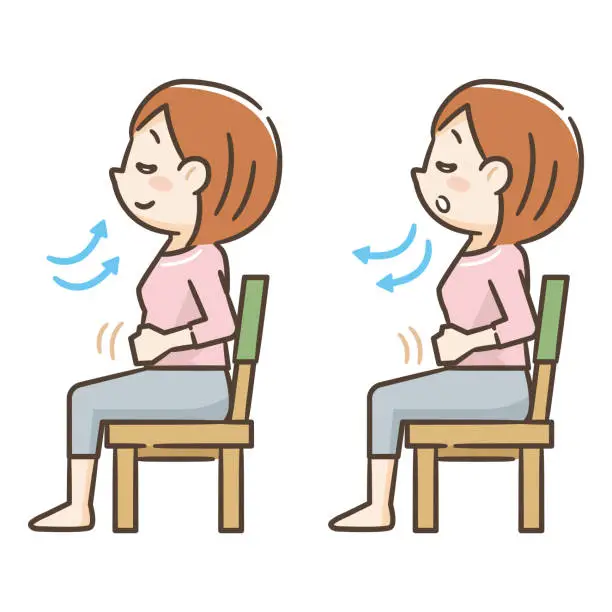
- Inhale through your nose until air fills your stomach.
- As you breathe, let your abdomen rise and go toward your chin as the case expires via his lips.
- Inhale deeply three to five times at a time.
What are the health benefits of deep breathing?
- Reducing anxiety
- Improving lung function, such as vital capacity
- Reduces cough
- strengthen diaphragm muscles
- managing stress
- improving sleep
- enhance focus
- recovering tense muscle
- natural pain removal
- Enhance the blood supply of the body
- reduces inflammation
- improve digestion
- and effective in blood pressure
- improve the quality of life of patients with chronic obstructive pulmonary disease(COPD)
3 Breathing Exercises to Learn Deep Breathing
Each of the breathing exercises that follow will help you develop the awareness and strength necessary to go on to the next. They are structured in a progressive manner.
1. Breath awareness
- The breath awareness practice helps you slow down and enter a calm breathing rate by providing a basic introduction to your breathing pattern.
- Choose a comfortable posture that you can hold for a few minutes, either sitting up straight or reclining on your back.
- Gently bring your consciousness to your breath and let go of any unneeded stress. You just need to watch how you breathe; nothing else has to be altered.
- As you breathe in and out, pay attention to how your body moves and feels. Feel the expansion of your chest and belly as you follow the air through your nose, throat, and lungs.
- For a few minutes, keep repeating this.
2. Three steps to deep breathing
You must first recognize and practice the three types of breathing that make up deep breathing. If at all possible, lie down on your back for this exercise.
Put your left hand over your chest and your right hand over your navel. For a few cycles, start by paying attention to how your breath naturally flows.
- Abdominal breathing
- The next time you breathe in, consider purposefully directing the air into your navel by allowing your abdomen to lift and expand. While the left hand stays nearly still on top of the chest, feel the right hand rising.
- As you exhale, feel your right hand descend while maintaining a calm abdomen. For a few minutes, keep doing this while letting the abdomen expand and relax naturally rather than pushing it.
- Return to your regular breathing after a few repetitions.
- Thoracic breathing
- You will now focus on your ribs without adjusting your posture. Consider purposefully directing the air into your ribs rather than your belly with the subsequent breath.
- As you continue to breathe, let your thorax rise and expand freely, allowing your left hand to glide up and down. Breathe deeply and slowly through your chest without using your diaphragm. You should keep your right hand nearly motionless.
- For a few minutes, keep repeating this breathing rhythm.
- Clavicular breathing
- Repeat the thoracic breathing pattern with the subsequent inhalation. Once the ribcage is fully extended, take a few more breaths, focusing on letting the air fill the top part of your lungs near the base of your neck.
- Gently lift your collarbone and shoulders to create room for more air to enter. Breathe out gently, allowing the shoulders and collarbone to drop before continuing to relax the ribs.
- For a few minutes, keep doing this. Return to your regular breathing after a few repetitions.
3. Yogic breathing
- Lying on your back with one hand on your abdomen and the other on your chest, begin by performing this meditation practice. You may attempt this while seated, as you have more experience.
- As you did in the previous exercise, begin by concentrating on your natural breath. Maintain your sequential practice of the three phases of deep breathing. The next time you breathe in, consider purposefully directing the air into your navel by allowing your abdomen to lift and expand.
- Keep breathing while focusing on forcing the remaining air into the ribcage so that it may expand completely. Let your shoulders and collarbone rise while you continue to breathe in as much air as you can.
- Breathe out gently, letting go of your shoulders and collarbone first, then your ribs, and lastly your belly. For a few minutes, keep doing this.
- As you breathe, pay attention to how your hands rise and fall. As you breathe in and out while maintaining the same ratio, you can begin counting. For instance, you can count to four for each inhalation and four for each exhalation.
- Return to your usual breathing after a few repetitions.
What are the types of deep breathing exercises?
- Diaphragmatic breathing
- Pursed deep breathing
- Box breathing
- The 4-7-8 breathing technique
- Alternate nostril breathing
Diaphragmatic breathing exercise:
Using a diaphragm will improve breathing. This technique is known as diaphragmatic breathing. The diaphragm, a dome-shaped muscle near the heart, is employed in this breathing technique. It is situated at the base of the lung.
How to perform the diaphragmatic breathing exercise:
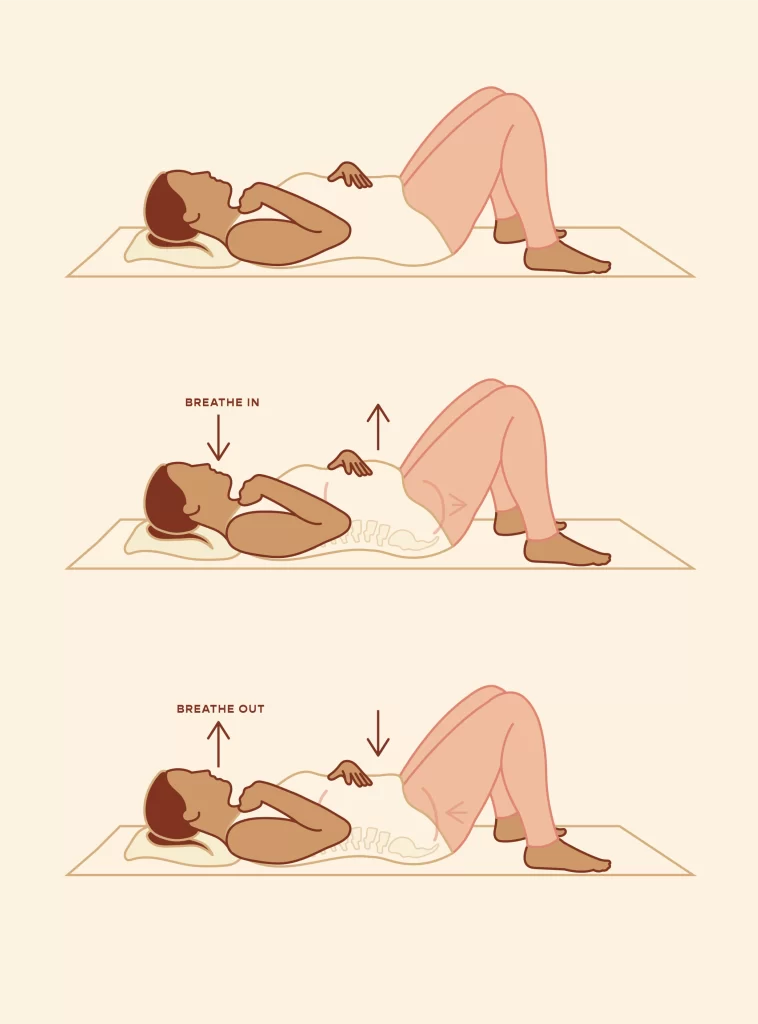
breathing exercise
- Lying on your back on a flat surface or in bed, bend your knees and support your head. To support your legs, place a cushion beneath your knees.
- Place one hand on your upper chest and the other directly beneath your rib cage. This will enable you to sense the movement of your diaphragm when breathing.
- Breathe in gently via your nose, causing your hand to rise as your tummy expands. As much as possible, try to keep your hand on your chest.
- As you exhale through pursed lips, contract your stomach muscles to cause your hand to drop as your stomach moves in. Try to keep your hand on your upper chest as still as you can.
Pursed lip breathing:
Pursed lip breathing is a straightforward technique that involves using your nose for relief and your mouth for expiration with the aid of pursed lips. It is recommended that a patient use their nose for many seconds while keeping their mouth open, and that they expire slowly over a period of five to seven seconds while keeping their lips in an energetic posture. Compression of the abdominal muscles was either done or not.
When someone has dyspnea, pursed lip breathing can help with illnesses like asthma or habitual obstructive pulmonary disease. Pursed lip breathing reduces dyspnea and offers a quick, soothing method to slow down your breathing, improving the efficiency of your breathing patterns.
How to perform pursed lip breathing?
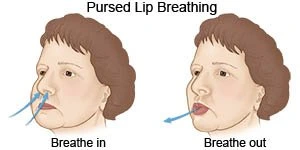
- Your shoulder and neck muscles should be relaxed.
- Close your mouth and take a slow, two-second breath in via your nose. A regular breath will do; a big breath is not necessary. Counting to yourself could be beneficial. As you breathe, your stomach should gradually swell. Placing their hands on their tummy might be beneficial for some people.
- As if you were about to blow on a hot beverage or whistle, purse (pucker) your lips.
- For at least four seconds, softly and slowly exhale through your pursed lips. Counting to yourself could be beneficial. As you exhale, your stomach should gradually contract.
Box breathing
Box breathing, often referred to as square breathing, is a deep breathing method that uses slow, deep breaths. Another name for it is four-square breathing.
Although anybody can benefit from this breathing method, people with lung problems that make breathing difficult may find it particularly useful.
How to perform box breathing?
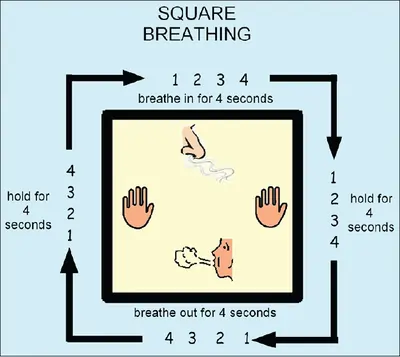
- Sit or stand with your back straight to start box breathing. You can also lie down with your arms by your sides if that’s more your style. Select the most comfortable posture for you.
- If you are relaxed, close your eyes.
- Take a minute to allow your body to settle, let go of any tightness in your jaw, and relax your shoulders.
- Inhale gently for four counts. Put your hands on your stomach and feel it swell like a balloon if you’d like.
- Hold your breath for an additional four counts after inhaling.
- Breathe out gently and steadily through your lips while mentally counting to four once more.
- Hold your breath for an additional four counts after exhaling.
- Repeat step 1 as many times as you would like.
The 4-7-8 breathing technique
This method is based on pranayama, an old yogic breathing practice. People claim it makes it easier for them to handle stress and fall asleep faster.
How to perform the 4-7-8 breathing technique?
- Maintain a straight back when sitting comfortably. Alternatively, you might lie down if you’re utilizing this activity to help you fall asleep.
- Your tongue should softly rest on the roof of your mouth, directly behind your upper front teeth, for the whole session.
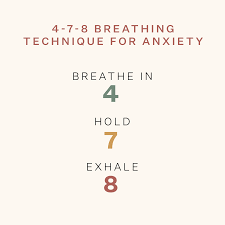
- For four counts, quietly inhale through your nose.
- Hold your breath for seven counts after inhaling.
- Make a “whoosh” sound as you aggressively exhale through your mouth for eight counts. Pursing your lips could make this simpler.
- For a total of four rounds, return to step 1 and continue the procedure up to three more times.
Alternate nostril breathing
Alternate nostril breathing is based on yoga breathing techniques. This does not mean you have to practice yoga to try it. Alternate nostril breathing can be an independent practice.
How to perform Alternate nostril breathing?
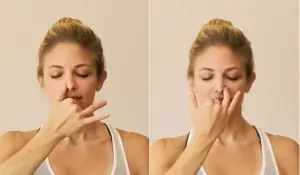
- Sit comfortably on the floor or on a chair, with your back straight yet relaxed.
- To seal your right nostril, push softly with your right thumb.
- Inhale slowly and deeply through your left nostril.
- Close your left nostril with your right ring finger (near your little finger) and remove your thumb from your right nostril. Exhale softly via your right nostril.
- Breathe in via your right nose while your left nostril remains closed. Then seal this nostril again.
- Open your left nostril and exhale through it.
- Return to step 1 and continue the procedure for as long as you wish.
Tips before practicing
- Wear comfy clothing.
- Avoid practicing after eating since food can exert pressure on the diaphragm and lungs, making deep breathing more difficult to achieve.
- Set a time and location where you can fully concentrate on the breathing practice.
- Always breathe via your nose.
- If you have an obstruction that keeps you from breathing easily through your nostrils, gently open your mouth to improve ventilation.
- Before you begin, blow into a tissue to clean your nose.
- Sit in a comfortable position that you can hold during the workout, or lie on your back.
- Maintain a straight spine and avoid stressing the body.
Under what conditions do we use deep breathing exercises?
- cystic fibrosis
- bronchiectasis
- lung abscess
- chronic obstructive pulmonary disease
- neuromuscular diseases
- atelectasis
- acute or chronic lung disease
- airway obstruction
- pneumonia
- any condition related to the lungs
- postoperative pain
- dyspnea
- shortness of breath
- cough and sputum in the lungs
Under what conditions do we not use deep breathing exercises?
- pain and discomfort due to injury
- increase intracranial pressure
- head and neck injury
- hypertension
- Any type of fracture around the chest
- If the patient has an abdominal incision
- recent operation in the chest
- airway obstruction
- diaphragm and intercostal muscle weakness
Conclusion
Deep breathing provides several health and well-being advantages to both healthy people and those suffering from certain clinical illnesses. In addition, it is affordable, simple to learn, and typically safe.
These activities take only a few minutes and may be simply introduced and practiced in a clinical or therapeutic setting to supplement conventional therapies. They can also be used in educational settings with children and in businesses with adults.
Practicing what you teach is essential for successful implementation. Before directing others into deep breathing, the individual presenting the method should actually experience it, just as they would with mindfulness or meditation.
Although breathing may appear as an automatic function, it may be consciously trained to enhance your breathing patterns and habits. Simply breathe, practice, and relax!
FAQS
How long should you take deep breaths every day?
To improve your deep breathing skills, its recommend practicing for 10 minutes twice a day.
What are the risks of deep breathing?
Certain breathing habits might cause changes in your body’s carbon dioxide levels. Taking particularly deep breaths (or breathing too fast) can result in respiratory alkalosis, a condition in which you exhale an excessive amount of carbon dioxide.
What is the purpose of deep breathing exercises?
Deep breathing is a calming method. Relaxation techniques have been shown to relieve stress, anxiety, sleeplessness, and other forms of chronic pain.
When is the ideal time to practice deep breathing?
Deep breathing before bed may be a relaxing aspect of your nighttime ritual. Choose a time that is convenient for you and your children, if they are participating.
To get the most out of your regimen, stick to the same one every day. Once you understand how to deep breathe, you may utilize it to relax anywhere.
What happens if you don’t breathe deeply enough?
Shortness of breath is the unpleasant sensation that you are running out of air or are unable to breathe deeply enough and are “air hungry.” The medical word for this is dyspnea, and it can occur when walking, climbing stairs, doing everyday tasks like cooking or cleaning, or even sitting quietly.
Is it preferable to breathe via your nose or mouth?
Breathe through your nose. It is substantially more beneficial to health than mouth breathing since it filters, warms, and humidifies the air while improving oxygen intake. Nose breathing increases nitric oxide levels, which enhances oxygen circulation, reduces blood pressure, and has antibacterial properties.
What is the most healthful breathing technique?
Effective breathing methods, such as diaphragmatic (belly) breathing, box breathing, and the 4-7-8 method, are effective for stress reduction, increased oxygen flow, and reduced blood pressure. To induce relaxation and quiet the nervous system, these approaches involve taking deep, purposeful breaths that often engage the diaphragm.
References:
- Mapp, D. R. P. C. (2025, December 12). The Power of Deep Breathing: 7 Techniques and Exercises. PositivePsychology.com. https://positivepsychology.com/deep-breathing-techniques-exercises/
- Professional, C. C. M. (2025, December 22). Diaphragmatic breathing. Cleveland Clinic. https://my.clevelandclinic.org/health/articles/9445-diaphragmatic-breathing
- Professional, C. C. M. (2025a, June 30). Pursed lip breathing. Cleveland Clinic. https://my.clevelandclinic.org/health/treatments/9443-pursed-lip-breathing
- Breathing exercises. (2026, January 12). British Heart Foundation. https://www.bhf.org.uk/informationsupport/heart-matters-magazine/wellbeing/breathing-exercises



One Comment