Virabhadrasana II ( Warrior II)
Introduction
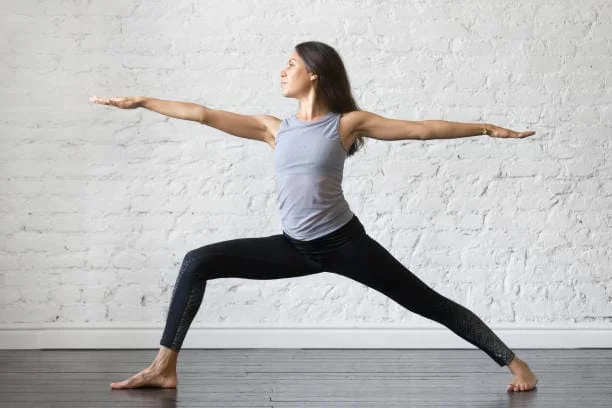
Virabhadrasana II, sometimes referred to as Warrior II, is a fundamental standing position in yoga that enhances attention, strength, and stability. In this position, both arms are stretched parallel to the floor, one knee is bent, and the other leg is extended straight while the torso faces sideways.
Virabhadra is the name of a fierce warrior who is an avatar of Shiva. He is said to have a thousand eyes, a thousand feet, a thousand heads, a thousand clubs, and a tiger’s skin.
This position opens the hips and chest, strengthens the legs, and enhances endurance and balance. It is a crucial pose in many yoga sequences, particularly in forms like Hatha Yoga and Vinyasa Yoga, because it also promotes mental focus and grounding.
Muscles Involved
- Lower Body Muscles
Quadriceps – Activate to bend and stabilize the front knee
Hamstrings – Support the legs and assist in stability
Gluteus muscles – Help maintain hip alignment and power
Adductors (inner thighs) – Stabilize and control leg positioning - Hip Muscles
Hip abductors – Keep the hips open and aligned
Hip external rotators – Assist in turning the front thigh outward - Core Muscles
Abdominals – Maintain balance and upright posture
Obliques – Support trunk stability and alignment - Upper Body Muscles
Deltoids (shoulders) – Keep arms extended and lifted
Trapezius – Support shoulder stability
Rhomboids – Help maintain proper posture - Stabilizing Muscles
Calf muscles – Assist in balance
Ankle stabilizers – Improve overall stability and grounding
Warrior II Pose (Virabhadrasana II) Video
How to do the Warrior 2 Pose?
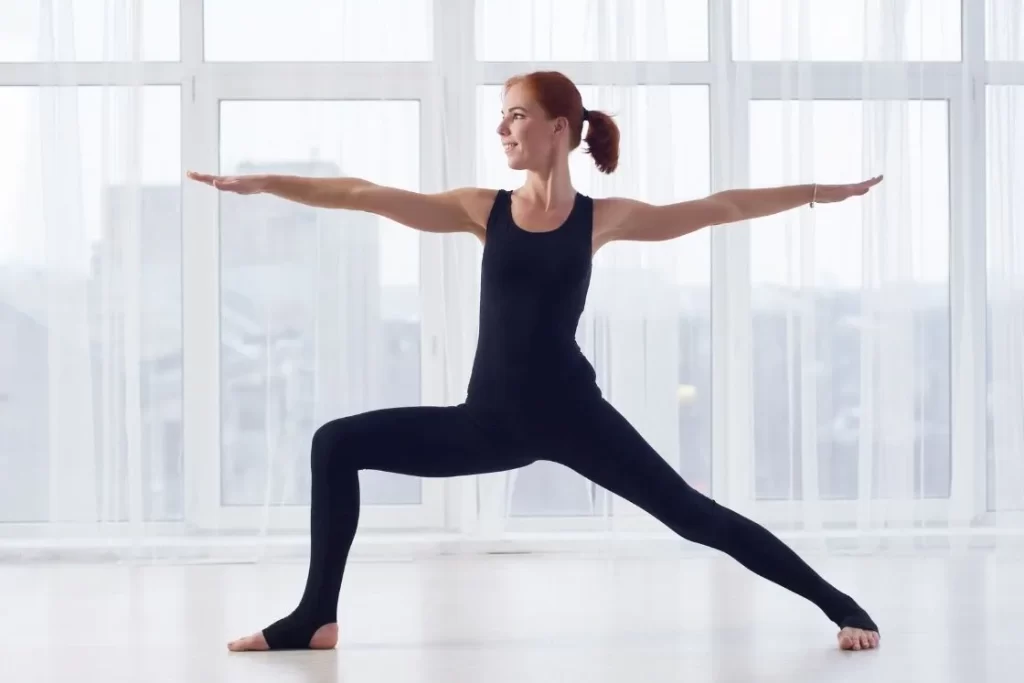
- Place your feet hip-width apart and stand up on the front of the mat. Focus on your breathing, find your center, and engage your core.
- Depending on your size and degree of flexibility, step your feet three to four feet apart. While your left foot is rotated slightly to the right (about 15 degrees), turn your right foot 90 degrees toward the front of the mat.
- Imagine a line that extends from the toe of your forefoot to an arch in your back foot. Stability and grounding will be provided by this alignment.
- To get your right knee level with the floor, bend it. Make sure your knee is not shaking to either side and is exactly above your ankle. Keep your back leg stable and straight.
- Maintain a straight posture and extend both arms to the sides, palms facing down. Spread your fingers as if they were being gently pulled apart.
- You should relax your neck and rotate your head to gaze at your right hand. In yoga, the focus of your gaze, or “drishti,” represents purpose and attention.
- For five to ten minutes, remain in this posture. As you expand your chest, stretch your spine, and feel your feet firmly planted on the ground, feel your strength rise.
- To gain stability, make sure you straighten your right foot, drop your arms, and then return to Mountain Pose or switch to the left.
Benefits
Physical Benefits:
- Strengthens Muscles: The Warrior 2 yoga pose is good for strengthening the arms, legs, core, and glutes. Over time, the effort needed to maintain this position produces muscles that are powerful and well-defined.
- Boosts Endurance and Stamina: Warrior 2 is an ideal posture to increase your overall stamina since it will test your endurance if you hold it for a long time.
- Enhances Flexibility in the Hips: The warrior yoga pose’s hip-opening feature releases tension and increases hip and groin mobility.
- Strengthens knees and ankles: Warrior 2 encourages joint stability with a set of exercises that focus on the muscles surrounding your knees and ankles.
- Encourages Proper Posture: You may straighten your spine and expand your chest by doing the Warrior II yoga stance. It lessens the detrimental consequences of prolonged sitting and slouching.
Mental Benefits:
- Improves Clarity and Focus: Warrior 2’s focused eye teaches you to minimize distractions while being present and focused.
- Increases Self-Confidence: Being self-assured in this role develops resilience and self-confidence.
- Reduces Stress: The parasympathetic nervous system, which helps lower tension and anxiety, is triggered by breathing in time with Warrior 2’s movements. This position gives us the chance to remind ourselves that balance and attention, not physical strength, are the real sources of power.
Common mistakes to avoid
Front Knee Misalignment:
Maintain a straight front knee over your ankle. It may cause tension if it slides outward or inward. Assessing the alignment could be made easier by drawing a straight line from your knee to your second toe.
Lowering the Back Arm:
Keep your back arm from relaxing. As if you were extending both ways, both arms must keep on working the same amount of effort and strength.
Excessive Spinal Extension:
Don’t stretch your lower back too far or lean too far back; instead, maintain an upright torso. Engage your core while keeping your chest up.
Neglecting the Back Leg:
Some people neglect to activate their rear leg because they are too busy with their front leg. To aid with balance, keep it straight and active.
Variations
Warrior II up against a wall:
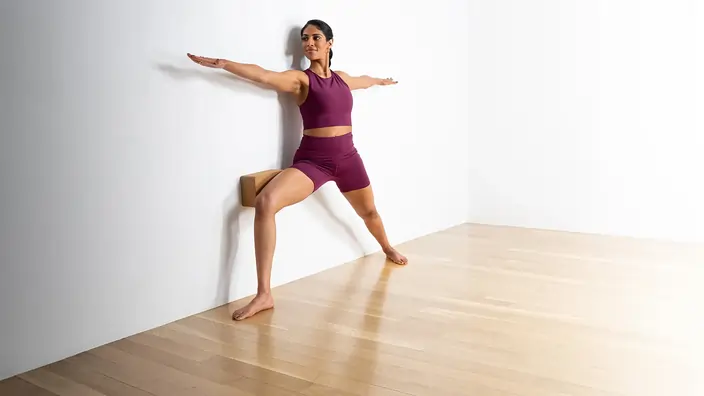
Put a block between your shin and the wall for stability to help you stay balanced in this posture. Additionally, it keeps your knee from moving ahead of your ankle.
Warrior II is utilizing a chair:
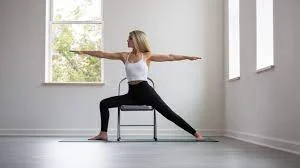
As described above, place your thighs in Warrior II posture while sitting on the edge of a chair. Keep your hands on your hips or raise your arms parallel to the floor.
Contraindications
- Diarrhea
- High blood pressure
- Cardiac condition, heart palpitations
- Heartburn
- Neck problems: Don’t turn your head to look over the front hand; continue to look straight ahead with both sides of the neck lengthened evenly.
Tips for Beginners
- Start with a shorter stance
- Don’t step too wide initially—focus on stability before deepening the pose.
- Avoid bending your knees 90 degrees.
- Keep your front knee in line with your ankle and only bend it as far as is comfortable.
- Continue to walk slowly and deliberately.
- To prevent tension, softly enter and depart the stance.
- Use assistance as necessary.
- For stability and self-assurance, you can utilize a chair or wall.
- Prioritize alignment above depth.
- The depth of the pose is not as vital as proper posture.
- Initially, adopt a shorter stance.
- Focus on steadiness and refrain from taking too many steps initially before extending the position.
- Do not bend your knees to a 90-degree angle.
- Only bend your front knee as much as is comfortable, keeping it in line with your ankle.
- Keep moving at a slow pace.
- Enter and exit the position gently to avoid tension.
- Ask for help when you need it.
- You can use a chair or a wall for support and confidence.
- Put alignment ahead of depth.
- Proper posture is more important than the depth of the stance.
Conclusion
Warrior 2 is more than just a yoga pose. It is a representation of grace, power, and resolve. Regardless of your expertise level—beginner or expert—this position provides many chances for personal development. Every time you practice Warrior 2, you develop your muscles, pay attention to your breath, and create a serene atmosphere.
If you want to roll your mat, focus on this stance and embrace your inner warrior. Virabhadrasana II will provide you with power and clarity in both your everyday life and your yoga practice if you practice it consistently and with attention.
FAQS
How long should I keep Warrior II?
Warrior II may be held by beginners for 15 to 30 seconds on each side. This can be extended to 45–60 seconds with consistent practice to improve stability, strength, and endurance.
Is Warrior II suitable for beginners?
Due to its ease of modification, Warrior II is appropriate for beginners. While learning appropriate alignment, using a shorter stance or using a wall for support might aid with balance.
What are Warrior II’s primary advantages?
Warrior II strengthens the legs, widens the hips and chest, and boosts endurance. Additionally, it improves focus and body awareness, which is useful for mental and physical health.
In the Warrior 2 position, which muscles are used?
Warrior II, also known as Virabhadrasana II in Sanskrit, is a yoga position for beginners that falls under the standing and hip openers category. This pose works the biceps, chest, hamstrings, knees, and triceps muscles in addition to the glutes and hip flexors, quads, upper back, and lower traps.
Can Warrior 2 improve with balance?
Warrior II: Transition from ego to genuine alignment and feel the posture support you from the inside out. This is where strength and stability meet. Benefits include strengthening the shoulders, legs, and core; improving hip stability and spinal alignment; improving balance and body awareness; opening the hips and chest; and increasing attention and endurance.
Is flexibility improved by Warrior II?
Yes, it strengthens muscles and increases hip, groin, and shoulder flexibility. Range of motion and general mobility are gradually increased with regular exercise.
How frequently should I practice Warrior II?
Warrior II can be practiced every day or at least three to four times a week. Over time, consistency promotes the development of strength, balance, and self-assurance in the position.
References:
- School, A. Y. (n.d.). Warrior 2 pose : How to Practice Virabhadrasana 2. https://www.arogyayogaschool.com/blog. https://www.arogyayogaschool.com/blog/warrior-2-pose-virabhadrasana-ii/
- Virabhadrasana II | Warrior II Pose – Yoga Poses Encyclopedia. (2023, August 16). Yandara Yoga – Teacher Trainings and Retreats in Mexico and Sweden. https://yandara.com/yoga-poses/virabhadrasana-ii-warrior-ii-pose