Ab Wheel Rollout Exercise
Introduction
The Ab Wheel Rollout is a complex core-strengthening exercise that works the deep stabilizer muscles, obliques, and abdominals by carefully stretching the body forward while keeping the spine strong and stable.
- Also known as the Swiss ball rollout, TRX standing rollout, ab wheel rollout, and exercise ball rollout.
- Targets include the shoulders, upper back, and core muscles (rectus abdominis, obliques, and erector spinae).
- Equipment includes training mats, ab wheels, rollers, and medium to large exercise/stability balls.
- Level: Intermediate to Advanced.
The ab rollout targets core muscles such as the rectus abdominis, obliques, and erector spinae (lower back). The latissimus dorsi (upper back) and shoulder muscles are also addressed. Similar to a plank, the stability ball ab rollout requires you to place your hands and arms on the ball rather than the training mat.
The stability ball ab rollout is classified as intermediate to advanced because the ball adds an element of instability, causing the core muscles to work harder. Before doing this exercise, be sure you can hold a regular plank with perfect form for 30 to 60 seconds.
Keep the rollout distance low until you’re comfortable with the entire maneuver. Because it is intended to improve your core, the stability ball ab rollout is commonly included in intermediate to advanced-level abdominal workouts.
The ab wheel rollout is one of my absolute favorite exercises for improving anterior core function and strength.
Your core, often known as your midsection, six-pack, or abs, is the power center of your body. Some downplay its relevance, some exaggerate it, and some fail to isolate and reinforce the core. Regardless of your position, you should work on your core and incorporate the ab wheel rollout exercise into your program.
Although the core performs a variety of functions in performance both inside and outside of the gym, its fundamental duty is to resist movement and keep your spine in neutral alignment. The ab wheel rollout is one of numerous workouts that accomplish this and more.
Ab Wheel Rollout Exercise Video
What Is an Ab Wheel?
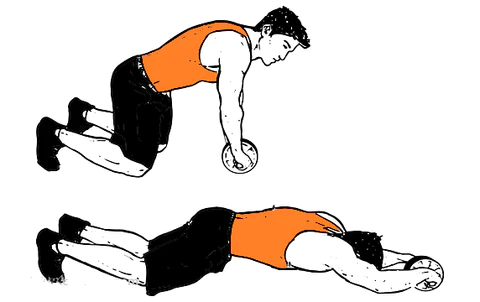
The ab wheel is not very difficult. Despite the fact that it is manufactured by multiple companies, the device’s core design remains consistent. It’s a hand-operated wheel that lets you roll over the floor while holding on with both hands.
If you don’t have an ab wheel, you can nearly always create one yourself by using a barbell with rounded plates for “wheels,” or you can use sliders on a very smooth floor or a towel instead.
The ab wheel rollout involves extending your torso toward the floor while preventing lower back extension with a barbell loaded with round plates, an ab wheel, or a stability ball. Hanging knee raises and crunches are examples of core workouts that flex or compress the core.
This exercise, known as eccentric strength, stretches the core. Strength in this position stimulates muscular fibers that would not normally be engaged, resulting in improved core stability.
Muscles Strengthened by the Ab Wheel Rollout Exercise
Lower Body
- The glutes are isometrically engaged to keep the lower back neutral.
- Transverse abdominis: Maintains a neutral posture by tightening your stomach in the same manner as a belt tightens a baggy pair of jeans.
- Rectus Abdominals: As you roll out, they extend and contract isometrically.
- Obliques: The internal and external obliques are utilized isometrically to avoid rotation and keep the spine neutral.
Upper body
- Shoulders and Biceps: During the rollout, you will work your anterior deltoids by flexing your shoulders.
- Triceps: During the rollback phase of the exercise, the long head of the triceps assists the lats and is isometrically engaged to maintain a straight elbow.
- Latissimus Dorsi: During the rollout, it lengthens and then contracts concentrically to bring your hands back behind your shoulders.
The ab wheel allows you to train your whole core—abs, glutes, lower back muscles, and obliques—possibly more than any other core workout. Any opportunity to develop your core in this manner is beneficial since that is how it works in real life.
The ab wheel rollout is the most popular workout using the instrument, since it targets the rectus abdominis, obliques, and spinal extensors. When you do the workout correctly, you will face a shoulder mobility issue. This means that you will target both your rotator cuff muscles and your mid-back muscles, such as your rhomboids.
How to Do the Ab Wheel Rollout Exercise?
- Place a stability ball in front of you and fall to your knees on the floor. Kneeling on a mat might provide extra support. It should be possible for you to reach the ball with your arm.
- Hold the ball in a loose fist. You’ll also rest your forearms on the ball. Make sure you’re bending your elbows 90 degrees. Retain a flat back and a straight body.
- Use your hands to slide the ball forward as your torso and arms straighten. This must be a planned, slow-motion. Keep your eyes on a straight path.
- Go as far as you can. Your chest will make contact with the ball. Hold this position for a few seconds.
- Bend your elbows slightly to reverse the action and roll the ball back to the beginning position. Keep your core stiff to keep your hips from falling.
Common Mistakes
Adding equipment, such as a stability ball, might lead to movement mistakes, especially if you don’t know how to utilize it correctly. By choosing the right ball for your level of fitness, you can protect your back and improve your core.
Choosing the Wrong Ball Size
It’s essential to choose a stability ball that suits your body type and degree of fitness. With a bigger ball, the motion is simpler to do. Using a big, solid ball will assist you in staying stable and balanced while doing this workout.
As you go with this exercise, try moving to a lower ball size. You will need to utilize your core even more than you would with a larger ball because of the instability this will create.
Not Engaging Your Core
The entire workout requires you to use your core. If you relax these muscles, you run the danger of lowering your hips, which might result in a depression in your lower back. This might cause pain in your lower back.
Pulling With Your Back, Not Your Core
This exercise primarily uses your abdominal muscles, but it also partially uses your shoulder and upper back muscles. Make sure your core is tight when you roll the ball out. These same muscles work hardest to help you reverse the movement.
Don’t start with the hips.
Starting this exercise with your hips pushed downward is not advised. As a result, the tension in your core is released when your lower back arches. Starting with rolling forward while keeping your glutes engaged, avoid moving your hips backward during the concentric contraction. It’s critical to keep your range of motion under control.
Correct setup and tension
Setting up or finishing this workout should take you some time. Hold the barbell or ab wheel firmly, squeeze your glutes, and position yourself as described above to maintain a neutral spine.
Do not bend your elbows.
Some lifters unknowingly bend their elbows, which draws attention away from the abs and onto the triceps. Put simply, it makes this practice easier, which is not what you want. Make sure to maintain your elbows locked throughout the whole workout.
Don’t let the hips sag.
Avoiding low back extension is the main goal of the ab wheel rollout, and you can be sure that it’s happening when your hips sink toward the floor. By keeping your glutes engaged and limiting your range of motion, you may prevent this.
Benefits
The development of “anti-extension” is the ab wheel’s finest feature. Your core is responsible for five key functions as a whole. Similar to Russian twists, it makes torso rotation easier. During the Palmar hold, it prevents rotation, a phenomenon called “anti-rotation.” It also supports your spine (think of planks and hollow holds) and bends it, much like in regular sit-ups.
Conversely, the idea of “anti-extension” aims to stop you from overextending your back. Arching your back may indeed be a useful stretch, and you should do it in some circumstances. But it’s a strong set of abs and obliques that protects your spine and increases shoulder mobility by preventing you from living in that arched-back position. If your abs weren’t keeping your back from arching, every workout would constantly strain your lower back.
Other anti-extension training techniques include plank walkouts and weighted hollow holds. However, you may use the ab wheel to address that anti-extension in new ways.
Nevertheless, the ab wheel rollout is hard to execute, or at least challenging to execute accurately. Over time, strengthening your core and protecting your back may be achieved by following an appropriate rollout sequence at your own speed.
The stability ball ab rollout targets the erector spinae (lower back), rectus abdominis, and obliques. During the contraction (bringing the ball back to the body) part of the stability ball ab rollout, the shoulders and upper back muscles are worked.
Your core muscles are used in most, if not all, of your daily motions. This includes everyday activities, exercises at the gym or during athletic events, and basic motions like rotation, flexion, and extension. Examples include looking over your shoulder, swinging a golf club, and mopping the floor.
Additionally, the stability ball ab rollout can assist in strengthening your core, which may lead to improved trunk flexion, extension, and rotation, as well as decreased back pain and improved balance. Stronger core muscles can also boost your level of fitness and sports performance.
Better squats and deadlifts
When doing a deadlift or squat, maintaining a neutral spine and correct body alignment will enhance your technique and keep your lower back from giving you the finger. A stronger core due to increased anti-extension strength will enable both of these.
Easy to progress (and regress)
Like most effective exercises, the ab wheel rollout may be either easy or tougher. If you’re not quite prepared for the difficult barbell and ab wheel variants, the stability ball rollout in the raised position is a fantastic place to start.
Ab hypertrophy and strength
The ab wheel rollout’s eccentric and concentric phases present challenges that might enhance the growth of the well-known and beloved six-pack muscle. Because it calls for stability and control, this exercise provides you with a longer time under strain for increased abdominal strength.
Lift more weight
You may be familiar with the phrase “You’re only as strong as your weakest link.” When it comes to your core strength, it is nearly accurate. If you’re having problems keeping your spine neutral under large loads, your first objective should be to improve your ab wheel rollout.
Ab Wheel Rollout Progression and Modifications
Make it easier :
If getting all the way down is too difficult, you can modify this motion by going halfway. Roll the ball out a couple more inches until your arms are completely stretched, and your core is strengthened.
Expanding your arms or legs is another option to modify the stability ball ab rollout. A larger base improves stability and makes the action easier to accomplish.
Make it challenging:
If you’ve mastered the basic stability ball ab rollout, you might be asking how to make it better. This maneuver may be made more challenging by using a smaller ball. Using a softer ball is an additional option that will increase the difficulty of the motion.
To test your core, try moving the ball in various directions. Using the ball, make both clockwise and counterclockwise circles.
Finally, you can arrange your body in different ways. For example, raise your knees off the ground or move your feet or legs closer together. This will put you in a traditional plank posture on the ball.
When performing ab wheel rollouts, the most common mistake individuals make is to focus too much on rolling out as far as possible at the beginning. However, that is a guaranteed method to develop pain in the lower back. Your spine will be strained if you don’t learn to feel your abs resisting lower back extension before completing the complete ab wheel rollout.
Incline Bench Rollouts
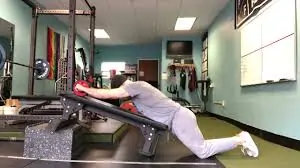
To begin your rollout exercise, position the bench at a 30-degree angle. Hold the ab wheel on the bench’s seat and execute a strong standing plank with your abs and glutes tight. Maintain a strong plank stance and steadily move the wheel up the bench over five counts, stretching your arms straight out.
Only go as far as you feel comfortable, keeping your elbows gently bent. If you have shoulder difficulties, avoid completely extending your arms. Shoulder soreness should not come with the ab wheel rollout.
Throughout the action, maintain your core firm and your spine slightly rounded. Continue to tense your abs; the more you roll your arms forward, the more you should do so. By doing so, you intentionally teach your abs to do “anti-extension.”
Once you’re comfortable, lower the bench to its regular flat position. Be comfortable with that. You can then move on to the complete version of the activity.
Rollout to Weight
Performing the exercise with a limited range of motion is an extra step. Place a weight in front of your desk and extend only as far as the weight allows.
Knee Elevated Ab Wheel Rollout
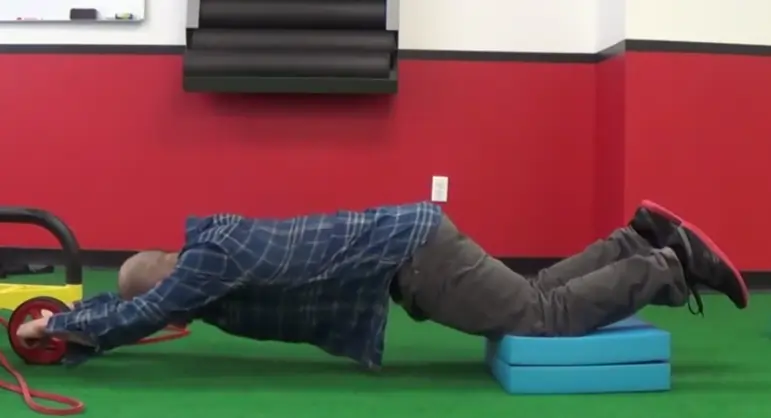
Similar to how an incline bench press enhances range of motion (ROM) as compared to a flat bench press, the ab wheel rollout becomes much more difficult to balance and prevent lumbar hyperextension if your knees are slightly raised onto an elevated platform.
I strongly advocate for starting with this sequence because it requires little equipment and just increases the effort by progressively expanding the range of motion.
Band Resisted Ab Wheel Rollout
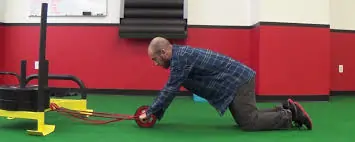
The band resisted an ab wheel rollout, another incredible variant that adds an original component since you must overcome tension on the way up (concentric) and resist pull on the way down (eccentric). I recommend that you begin with very light bands and progressively increase your distance from the anchor until you are ready for a heavier band—it is much tougher than it appears.
Continue to increase the effort until you can complete 10 perfect repetitions and are ready to try the standing ab wheel rollout.
Safety and Precautions
To do the stability ball ab rollout, you must be able to hold a regular plank without using a stability ball. If you cannot execute the plank stance with perfect form, you risk injuring yourself while performing the ball and roll-out exercise.
Pregnant women, anyone with persistent knee pain, back pain, or other problems should avoid doing this exercise. Consult your doctor or physical therapist before performing this activity.
If you develop back pain while performing this exercise, pause and examine your form. Until your core is strong enough to handle the full action, you may need to alter or decrease the distance you roll the ball. If the pain persists, cease the activity and check with a physical therapist or your doctor before doing it again.
FAQS
What exactly is an ab wheel roller?
The ab roller, like push-up bars, is a useful piece of core training equipment, but a six-pack requires more than one workout. The ab roller works your lower back, abs, and obliques, providing an excellent core exercise.
How many reps does an ab wheel rollout require?
If you’re new to utilizing an ab roller, begin with 2-3 sets of 8-10 slow, controlled reps, concentrating on form rather than speed. If you’re just getting started with core strength, beginning on your knees while rolling might be beneficial. As your core strength improves, progress to 3-4 sets of 12-15 repetitions per session.
How to select an ab wheel?
If you’re a beginner, it’s usually a good idea to buy an ab roller with a huge, broad wheel because it will provide more stability (unlike small wheels, which might fall unless you have strong balance). A narrow wheel is ideal for advanced athletes looking to push their core stability.
What are the negative aspects of ab rollers?
The Ab Roller is meant to engage the abdominal muscles; it also puts tremendous strain on the lower back. Using the apparatus requires the user to roll forward and backward in a kneeling position, which exposes the spine.
Is an ab wheel helpful for your posture?
Maintaining proper form in an ab wheel rollout also improves the ability to activate the core correctly and maintain a neutral spine, which can assist in preserving the lower back in complex movements like squats and deadlifts. Over time, ab wheel rollouts can improve posture, alleviate back pain, and promote mobility.
Can AB rollers help decrease belly fat?
Ab rollers are an excellent tool for engaging and strengthening your lower back, obliques, and abs.
Increases metabolism: A stronger core leads to more muscular mass, which boosts metabolism and overall energy consumption.
Aids in overall fat loss: While it will not be the only place affected, you will lose fat from your belly when you combine diet and exercise to reduce body fat.
Why is the ab wheel so effective?
This is because the ab roller works all of your core muscles, including the rectus abdominis, obliques, and lower back muscles. Regular ab roller exercise will help you develop a stronger, more stable core, allowing you to perform better in other activities and sports.
References:
- Hopes, S. (2023, July 5). I did 50 ab wheel rollouts every day for one week — here are my results. Tom’s Guide. https://www.tomsguide.com/news/i-did-ab-wheel-rollouts-every-day-for-a-week-here-are-my-results
- Lindberg, S. (2021, November 30). How to do the AB rollout. Verywell Fit. https://www.verywellfit.com/how-to-do-the-ab-rollout-4685018
- Nasm, B. W., & CSCS, E. S. (2023, November 28). How to do the AB wheel rollout the right way. Men’s Health. https://www.menshealth.com/fitness/a30677116/ab-roller-exercises/
- Syatt, J. (2021, April 21). The Ab Wheel Rollout: 2 Advanced Variations You’ve Never Even Heard Of. Syatt Fitness. https://www.syattfitness.com/coaches-and-coaching-tips-for-trainers/the-ab-wheel-rollout-2-advanced-variations-youve-never-even-heard-of/
- Vkim, & Vkim. (2023, January 5). Roll out the Core Strength Red Carpet with the Ab Wheel Rollout. Muscle & Fitness. https://www.muscleandfitness.com/workouts/full-body-exercises/the-ab-wheel-rollout-how-to-benefits-variations/
- White, A. (2016, December 19). 5 ways to maximize your use of an exercise wheel. Healthline. https://www.healthline.com/health/fitness-exercise/exercise-wheel