Alternate Nostril Breathing
Introduction
Alternate Nostril Breathing (also known as Nadi Shodhana) is a calming yogic breathing technique that helps balance the body and mind. This simple yet powerful practice involves inhaling and exhaling through one nostril at a time in a controlled pattern.
You may include this kind of breathwork in your yoga or meditation routine. You may also practice alternate nostril breathing on your own to help calm and rest your thoughts.
Breathing control, or pranayama, comes in a variety of forms. The two most popular forms of alternating nostril breathing are nadi shodhana and anulom vilom.
Variations to know
Yoga practitioners use a variety of positions and breathing techniques in their practice. There are two types of alternating nostril breathing:
- Anulom vilom is a pranayama technique that includes deliberate intake through one nostril and exhalation through the other.
- Nadi shodhana: This practice, like anulom vilom, requires breathing from one nostril to the next. On the inhale, you briefly hold your breath.
What are the benefits of alternate nostril breathing?
In general, breathwork can improve your mental and physical health, but alternative nostril breathing offers certain unique advantages. Here’s how this approach may help you and why it’s worth practicing.
Relieves stress
- Even when you are not in immediate danger, your body might activate the “fight or flight” response. Blame it on your sympathetic nervous system, the part of your body that controls this function and activates when you’re stressed.
- However, you may counteract it by activating your parasympathetic nervous system, which plays an important part in making you feel calm and relaxed. Alternate nostril breathing is an excellent strategy for doing this.
- The body can actually begin to heal and repair while it is in that state of relaxation.
Sharpens your focus and energy
- Relaxing your parasympathetic nervous system does not imply becoming a limp noodle. In fact, this form of breathwork may make you feel pleasantly energized.
- “Like all breathing techniques, alternate nostril breathing is very calming,” according to Dr. Young.
Could improve lung function and respiratory endurance
- Yogic breathing techniques may enhance lung function and respiratory endurance. Improved respiratory endurance may also boost sports performance.
Lowers heart rate
- Lowering your heart rate can help improve cardiovascular health. There is a link between normal autonomic function and comprehensive yoga practices that incorporate posture and breathing techniques.
- Alternate nostril breathing may also be effective for lowering your heart rate in the moment.
Promotes well-being
- Alternate nostril breathing might improve general health and well-being. It’s also been proven to improve mental health by lowering stress and anxiety.
- The psychological advantages of pranayama exercises may also include decreased tiredness, tension, and worry in cancer and CVD patients.
- Alternate nostril breathing has also been shown to improve nervous system function and raise awareness of the breath.
How to do alternate nostril breathing
You can practice alternate nostril breathing on your own, but you might want to have a yoga teacher explain to you how to do it so you know you’re doing it right.
Concentrate on maintaining your breath slow, smooth, and consistent. Focusing on your breathing can help you recall where you are in the cycle. You should be able to breathe comfortably during the practice.
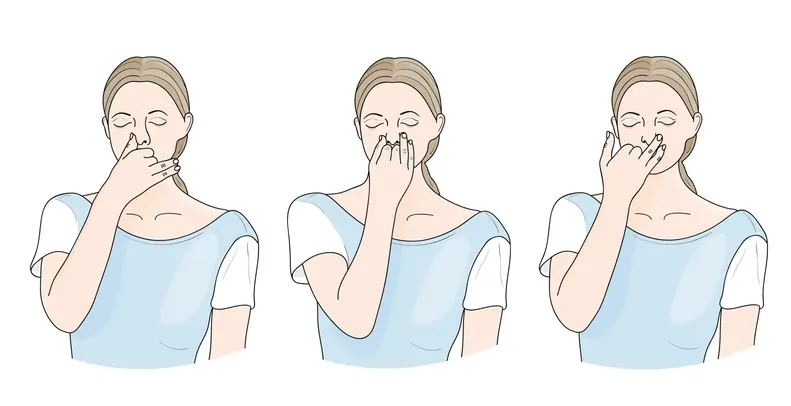
Here’s how to practice this breathing technique:
- To begin, exhale through your mouth, producing a “whooshing” sound.
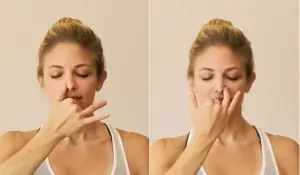
- Bring your right hand up to your nose, index finger over the left nostril, and thumb over the right.
- Use your thumb to cover your right nostril. Inhale via the left nostril.
- To cover your left nostril, use your index finger. At this stage, both nostrils should be kept closed.
- Hold your breath for a couple of beats while both nostrils are blocked.
- Exhale after releasing your thumb to unclog your right nostril.
- Pause at the bottom of your exhalation. Then, keep your left nostril closed and inhale through your right nose.
- Use your thumb to obstruct your right nostril. Hold your breath for another beat or two while keeping both nostrils closed.
- Exhale after releasing your index finger to unclog your left nostril.
- This represents one cycle.
- Continue for up to five minutes.
- Always end the exercise with an exhalation on the left side.
When to practice alternate nostril breathing
- You can practice alternate nostril breathing whenever and wherever it seems most comfortable for you. You may discover that you prefer doing it in the morning or evening. It can also be used during the day when you need to concentrate or unwind.
- Alternate nostril breathing works better on an empty stomach. If you’re unwell or congested, avoid alternative nostril breathing.
- Alternate nostril breathing can be done before or after a yoga session. Find the approach that works best for you, as everyone’s outcomes and experiences are unique. Alternatively, you might perform it at the start of your meditation. This may allow you to deepen your meditation.
Tips
- The majority of people may safely practice alternative nostril breathing. If you have asthma, COPD, or any lung or heart disease, see your doctor before beginning the practice.
- If you experience any negative consequences while using the breathing method, such as shortness of breath, you should discontinue the exercise immediately. This involves experiencing lightheadedness, dizziness, or nausea.
- If the breathing causes anxiety or prompts any mental or physical symptoms, you should discontinue the practice.
Conclusion
- Alternate nostril breathing might help you relax and clear your thoughts. Increasing your awareness of your breathing might help you become more aware of other aspects of your life.
- While the potential advantages are encouraging, keep in mind that alternate nostril breathing must be practiced on a daily basis to notice and sustain improvements.
- Breathing practices are not an alternative to medical therapy. Always consult your doctor before starting any breathing exercise, especially if you have any medical issues or illnesses.
FAQS
What are the benefits of alternative nostril breathing?
Long-term alternate nostril breathing (ANB) has been found to improve cardiac autonomic regulation by boosting parasympathetic modulation.
How long should I alternate nostril breathing for?
Alternate nostril breathing can be a standalone practice. According to research, practicing regular alternate nostril breathing for 30 minutes every day might reduce stress levels. Other studies show that it reduces heart rate, lowers blood pressure, promotes emotions of well-being, and improves lung function.
When is the ideal time to practice alternate nostril breathing?
You can practice alternate nostril breathing whenever and wherever it seems most comfortable for you. You may discover that you prefer doing it in the morning or evening. It can also be used during the day when you need to concentrate or relax. Alternate nostril breathing works better on an empty stomach.
Who should avoid alternating nostril breathing?
Alternate nostril breathing is safe for most individuals, but if you have any lung or heart problems, such as asthma, see your doctor before starting.
Is it safe to do breathing exercises every day?
You want to attempt them when you’re breathing normally, and then when you’re more comfortable, use them when you’re short of breath.” Ideally, you should do both exercises for 5 to 10 minutes every day.
What is the golden rule for breathing exercises?
The golden rule for most strength training exercises is to exhale as soon as you push yourself. For example, if you’re doing a squat, you’ll inhale gently as you descend and exhale as you ascend. For a curl, exhale as you elevate the weight and inhale as you drop it back down.
References
- Cronkleton, E. (2023a, May 24). What are the benefits and risks of alternate nostril breathing? Healthline. https://www.healthline.com/health/alternate-nostril-breathing#takeaway
- Alternate nostril breathing: How & why to practice. (2022, September 7). Cleveland Clinic. https://health.clevelandclinic.org/alternate-nostril-breathing

One Comment