Standing Oblique Crunch
Introduction
Standing oblique crunches are a sort of exercise that strengthens the oblique muscles, which are located on the sides of the belly. Unlike traditional crunches, which are performed while lying on the floor, this exercise is done standing up.
As a result, it is an excellent solution for those who want to improve their core strength without having to get down on the ground. The activity entails bending your upper body to the side, which activates and engages the obliques.
Regularly executing this exercise can help you tone and strengthen the sides of your abdomen, resulting in enhanced core stability and definition.
Muscles Worked
- External Obliques: The principal movers in a standing oblique crunch; these muscles run diagonally down your sides and aid in twisting and side-bending movements.
- Internal Obliques: These muscles, located beneath the external obliques, help in torso rotation and core compression, particularly during the “crunch” portion of the activity.
- Rectus Abdominis, or “six-pack” muscles, aid in spine flexion and upper body stability during oblique training.
- Transverse Abdominis: This deep core muscle functions similarly to a corset, bracing your spine and pelvis during the activity. It is always active behind the scenes.
- Hip Flexors (Iliopsoas): These muscles link the lower spine to the thighs and play an important role in knee-lifting.
- Quadriceps: Located in the front of the thigh, these muscles support the standing leg and power the moving leg. They also serve an important function in maintaining equilibrium.
- Glute Medius and Minimus: The smaller side glute muscles are critical for single-leg stability and hip alignment. They flare up during the crunch’s balancing phase.
- Erector Spinae: These back muscles operate isometrically to maintain a tall posture and align the spine, providing postural stability.
Benefits of Standing Oblique Crunches
- Strengthens Your Core: Standing oblique crunches provide the major advantage of strengthening your core muscles, which include the obliques, lower back, and lower abs. A strong core helps with posture, balance, and general fitness.
- Improves Flexibility: This workout uses a side-bending action to increase the flexibility of your spine and waist.
- No Equipment Needed: Standing oblique crunches require no extra equipment, making them a perfect exercise for home workouts or on the road.
- Engages Multiple Muscles: Although the focus is on the obliques, this exercise also works your shoulders, arms, and legs to some extent.
- Low Impact: Standing oblique crunches are a low-impact workout that is appropriate for people at all fitness levels, including beginners.
- Improves Balance and Functional Stability: Standing core exercises, such as the standing oblique crunch, can recruit more stabilizer muscles than floor workouts. Standing ab motions help improve neuromuscular coordination and proprioception, or your body’s sense of location in space.
- Promotes better posture and spinal alignment: Strengthening your obliques and surrounding core muscles with exercises such as the standing oblique crunch will help you achieve better postural alignment.
- Burns more calories than floor-based abdominal exercises:
- Because standing exercises target broader muscle groups including your legs, glutes, and stabilizers, they require a larger energy expenditure.
How To Do A Standing Oblique Crunch?
Standing oblique crunches are simple to perform, but good technique is essential to minimize injury and maximize the effectiveness of the exercise. Here are step-by-step instructions:
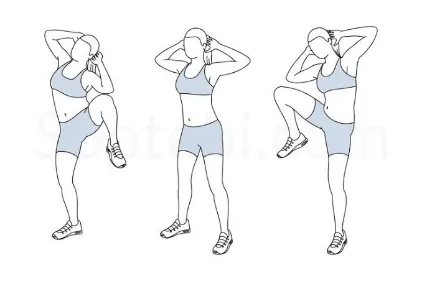
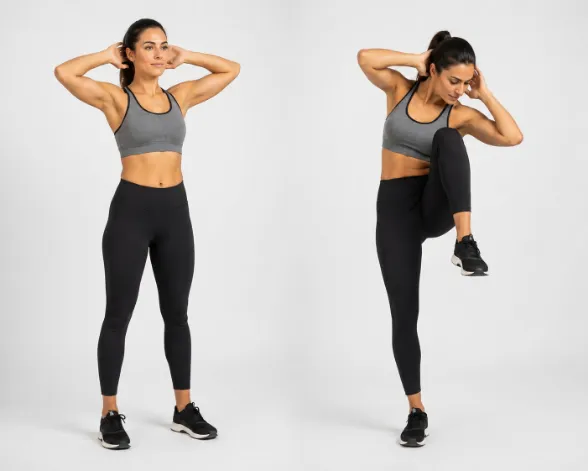
How to do:
- Standing tall with your feet hip-width apart will ensure a solid platform.
- Draw your navel towards your spine and brace to gently engage your core.
- Place your hands loosely behind your head, fingers interlaced or only touching. Keep your elbows wide. Avoid pulling on your neck.
- Maintain a high chest and a neutral spine.
- Exhale while simultaneously doing two actions: Lateral Flexion: Crunch your right side to move your right elbow closer to your right hip. Knee Lift: Raise your right knee up and slightly across your body, toward your right elbow.
- The idea is to bring the elbow and knee as near together as possible using oblique contraction and controlled hip flexion, rather than rounding your shoulders forward or twisting excessively.
- Pause briefly at the time of maximal contraction and intentionally squeeze your right obliques.
- Inhale. Slowly and steadily reverse the movement.
- Lower your right leg back to the beginning position while uncrunching your right side to bring your body back to an upright, neutral position.
- Complete all desired repetitions on one side before moving to the opposite, or alternate sides.
Variations Of Standing Oblique Crunch
Standing Dumbbell Oblique Crunch
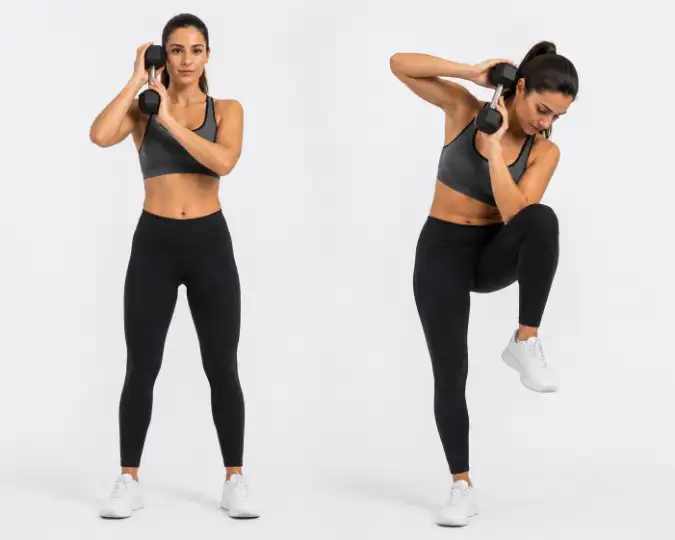
- The standing dumbbell oblique crunch targets the internal and external obliques, strengthens the lateral flexion of your spine, increases spinal mobility, and aids in the development of a strong and solid core.
- This is one of the greatest entry-level weighted oblique exercises I recommend for clients who are new to resistance-based core training. When performed with full range and control, it enhances mind-muscle connection and produces a deep burn in the obliques.
Standing Oblique Crunch With a Twist
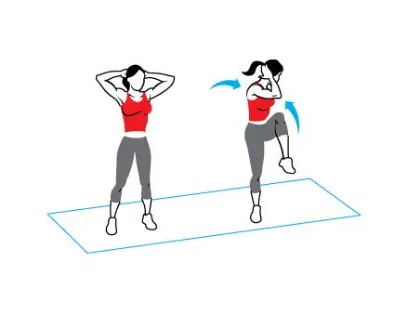
- Instead of crunching directly to the side, twist your torso slightly as your elbow touches the opposing knee. This targets both your obliques and the deeper transverse abdominis for a more complete core burn that you’ll undoubtedly benefit from.
Standing Cable Oblique Crunch
Cable resistance provides continuous tension across the range of action, which bodyweight alone cannot supply.
Cable resistance stimulates neuromuscular activity and promotes deeper core engagement, particularly in the external and internal obliques and quadratus lumborum.
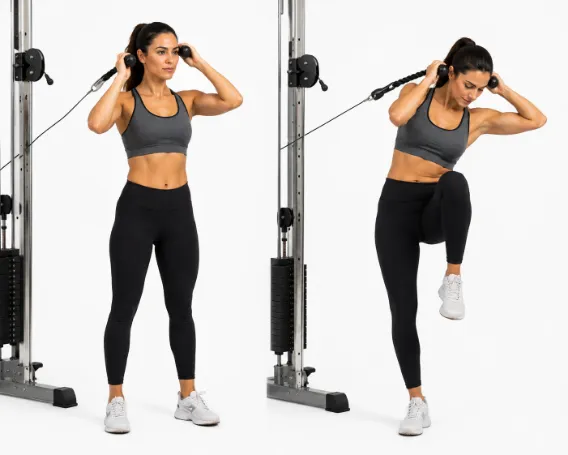
- Attach the D-handle to a high pulley and stand side-on to the weight stack.
- Hold the D-handle with your left hand and stand with the pulley to your left side.
- Position your forearm at a 90-degree angle to your upper arm, and your feet shoulder-width apart.
- Keep your head up and your back straight, and use your left oblique muscle to bring the weight downward.
- Pause for a second, then return to your starting location.
- Do 10 to 12 repetitions.
- Turn around and repeat the cable side bend on the left side.
Common Mistakes to Avoid While Performing Standing Oblique Crunches
- Twisting your torso: Rotating your chest or shoulders to the front transforms the exercise into a standard twist. Keep your hips and shoulders absolutely square.
- Leaning forward or backward: Hunching at the hips or arching your spine directs the work away from your obliques. Maintain a straight spine and only move in the side-to-side plane.
- Shrugging shoulders: Tensing your neck and shoulders increases upper-body tension. Keep your upper body calm and focus the movement on your waistline.
- Relying on momentum: Swinging your leg up or jerking your upper body decreases muscular engagement. Actively move your ribcage towards your hip using your core.
Tips for Effective Standing Oblique Crunches
- Execute each repeat with perfection. Avoid quick movements; steady reps increase muscle activation and make each exercise more effective.
- Maintain an upright chest and avoid arching your lower back. Your rib cage and pelvis should shift toward each other rather than away. This guarantees that the obliques perform the effort, not your lower back.
- If you place your hand behind your head, use it simply for gentle support; never pull on your neck. Maintain a neutral neck position and let your obliques lead the action.
- Exhale during the effort phase (when the elbow and knee come together) and inhale during the return. Never hold your breath; this might raise blood pressure and impair balance.
- Bend just at the torso while keeping your back upright and your eyes pointing forward.
- If you’re practicing a weighted standing side crunch, avoid using big weights at first. Start with small weights and work your way up.
- Allow for plenty of breaks between sets.
Incorporating Standing Oblique Crunches into Your Fitness Routine
Standing oblique crunches are a flexible exercise that can be included in nearly any training plan. Here are a few ways to include them.
- Warm-up: To stimulate your core muscles before harder activities, perform standing oblique crunches.
- Core Workout: For a more complete core workout, combine them with planks, Russian twists, and leg lifts.
- HIIT Workout: Combine standing oblique crunches with high-intensity interval training (HIIT) for a quick and efficient core workout.
- Cool-Down: Include them in your cool-down regimen to stretch and relax your core muscles following a workout.
Conclusion
Standing oblique crunches are a simple yet efficient way to strengthen your core and tone your oblique muscles. They require no equipment, can be performed anywhere, and are appropriate for all fitness levels. Incorporating this workout into your program will not only increase your core strength but also your general fitness and posture.
FAQs
Are Standing Ab Crunches Effective?
Yes, standing abdominal crunches are! They’re an excellent technique to target your core, particularly the obliques, without having to lie on the floor, which, let’s be honest, no one wants to do at a public gym. They also help to improve balance, posture, and functional strength. Because they are performed upright, they can activate more stabilizer muscles than standard floor-based ab exercises.
What Happens When You Do Standing Oblique Crunches Every Day?
Doing ab crunches on a regular basis may appear to be a quick way to achieve fantastic results, but your core muscles, like any other muscle area, require rest and rehabilitation. Overtraining can cause fatigue, poor form, and even injury. Instead, work for two or four targeted core exercises per week.
How frequently should I do standing oblique crunches?
Aim to work in standing oblique crunches into your training program 2-3 times per week. This frequency enables your muscles to heal while maintaining regular exercise.
Are standing oblique crunches beneficial for losing weight?
Standing oblique crunches, while effective in targeting and toning your oblique muscles, will not result in considerable weight reduction. However, when paired with a healthy diet and frequent cardiac activity, they can help with total fat reduction and a more defined waistline.
Do I need any special equipment to do standing oblique crunches?
No, standing oblique crunches don’t require any equipment. You may perform them anywhere, making it a perfect exercise for home workouts or traveling.
Can beginners perform standing oblique crunches?
Yes, standing oblique crunches are ideal for beginners. They are low-impact and simple to practice, making them an ideal beginning point for anybody new to core workouts.
References:
- Debutify. (2025, June 13). Master the Standing Oblique Crunch: Tutorial, tips, & Benefits. Back Muscle Solutions. https://backmusclesolutions.com/blogs/the-ql-blawg/standing-oblique-crunch?srsltid=AfmBOoqon898S5imsCPEdqeeRz5DMu1yvb3TsDeJGGSDTgKbeWEA1qNz
- Standing Oblique Crunches – Exercise guide & Proper form | GymStreak. (n.d.). https://www.gymstreak.com/exercises/standing-oblique-crunches
- Parker, J., & Parker, J. (n.d.). How to do Standing Oblique Crunch. Fitbod. https://fitbod.me/exercises/standing-oblique-crunch
- MyFitnessCoach. (2026, July 22). Standing Oblique Crunches: a simple guide to strengthen your core. MyFitnessCoach. https://myfitnesscoach.fit/blogs/workout/standing-oblique-crunches
- Kumar, M. (2025, May 15). Standing Oblique Crunch: How to do and muscles worked. Fit Life Regime. https://fitliferegime.com/standing-oblique-crunches-how-to-do-benefits-and-variations/?srsltid=AfmBOooxkB_VHODcpoqzM2bej7Wk6tKM2pHTCdy-SzPKJYrO78LTE8of