
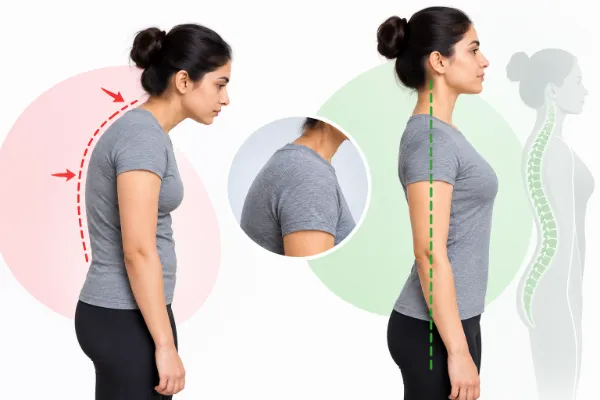
Rounded Shoulder Posture
Introduction
Rounded shoulders refer to a posture in which the shoulders lie forward and inward rather than remaining more naturally aligned over the trunk. This is frequently associated with a forward head posture and greater rounding of the upper back. For many people, it develops gradually as a result of daily habits like prolonged sitting, device use, or desk work.
Although rounded shoulders are often treated as a simple postural issue, the reality may be more complex. Muscle tension in the chest, weakness in the upper back, discomfort that alters movement patterns, and spinal form can all contribute. This is why care involves not just “standing up straight,” but also determining why the posture arose in the first place.
In moderate circumstances, rounded shoulders may primarily influence appearance or comfort. Other persons may have shoulder stiffness, neck pain, upper back fatigue, or trouble keeping appropriate posture for extended periods of time. A healthcare specialist can assist in identifying whether the change is primarily postural or due to a larger bone, joint, nerve, or soft tissue condition.
Basic Shoulder Anatomy Explanation
The shoulder is one of the body’s most complicated joints, allowing for up to 12 different motions. We rely on our shoulders for a variety of tasks, including catching ourselves when we fall, throwing a baseball, lifting items above, and so on.
To perform these actions, we require a large number of tiny muscles to operate together over time because the shoulder joint is so compacted; all of these tiny muscles have little space to function in.
Overworked or repeated actions cause muscles and tendons to enlarge, compromising such areas. This is what causes shoulder impingement, often known as soreness with overhead movement.
Signs and symptoms
The most obvious symptom is that the shoulders sit forward when viewed from the side. A person may also say that the head tilts forward, the upper back seems more rounded, or the chest feels tight. Clothing may hang differently, and keeping a straight posture may feel exhausting rather than natural.
Rounded shoulders are not necessarily painful, but they might create aches in the neck, shoulders, or between the shoulder blades. Some people experience stiffness while reaching above, soreness after desk work, or fatigue in their upper back muscles at the end of the day. Lifting, carrying, and exercising may feel worse if your shoulder mechanics are impaired.
- Forward shoulder position
- Upper back rounding
- Neck or shoulder tension
- Chest tightness
- Upper back fatigue
- Reduced shoulder mobility
Causes
Any action that requires the body to gaze down and forward for extended periods of time might lead to drooping shoulders.
These postures affect the natural function of the muscles in the neck, back, and shoulders. These muscles manage the body’s posture throughout the day.
Daily actions that may contribute to rounded shoulders are:
- using a smartphone or tablet
- using a computer or laptop
- sitting for long periods
- driving a vehicle
- bending over repeatedly
- carrying heavy objects all day
others like:
- age-related postural change
- shoulder injury,
- arthritis,
- pain that changes how a person moves
- Nerve problems
- inflammatory conditions
- previous surgery may influence posture
- Due to upper spine or to structural issues such as scoliosis
Risk factors
Rounded shoulders can have a negative effect on both health and looks.
Over time, the muscles mistakenly educate the body to be leaned forward, interpreting this slumped position as the body’s normal condition. If not handled, this may be extremely harmful to one’s body.
High stress on the shoulder joints can cause pain in the neck and upper back.
Diagnosis
- Posture assessment: The doctor may initially examine the patient’s resting posture as they stand. A person with drooping shoulders may appear to slouch, even if requested to stand up straight. Their hands are also likely to be facing behind them, thumbs pointing at each other. A proper standing posture will have the hands facing the body and the thumbs facing forward. This is a basic exam, but it will provide physicians a decent idea of a person’s daily posture.
- Muscle strength testing and Range of motion assessment: Strength and flexibility tests are also necessary. Tightness in the chest and front of the shoulders, weakness in the upper back, and restricted mobility in the thoracic spine can all contribute. The doctor may look for discomfort, joint stiffness, rotator cuff strain, or nerve-related symptoms including altered feeling or weakness.
- Imaging tests: these are not usually required for simple posture-related issues. However, X-rays or other testing may be required if there is damage, substantial pain, a suspected spinal deformity, progressive change, or neurological problems. Assessments for patients with shoulder pain or restricted mobility may overlap with those for shoulder impingement syndrome or other shoulder problems.
Treatment
The treatment depends on the cause, the severity of the symptoms, and whether the posture is flexible or structural. For many people, the initial step is to begin a planned fitness regimen. This often involves extending tight chest muscles, increasing thoracic spine mobility, and strengthening the muscles that support the shoulder blades and upper back. Physical therapy is especially beneficial since it offers supervised, specific treatment rather than general recommendations.
If pain is evident, therapy may also target the painful location. Depending on the findings, this may involve a rehabilitation plan, supervised exercise, and care of any associated neck, back, or shoulder issues. When shoulder dysfunction is present, professionals may determine if physical therapy and rehabilitation, or orthopedics and traumatology, are required.
Surgery is often performed to treat basic rounded shoulders caused by bad posture. It is only considered when an underlying structural issue, major deformity, or other identified disease requires specialized treatment. The objective in most situations is to enhance comfort, function, and long-term alignment rather than to require a rigid posture.
Best Exercises to Correct Rounded Shoulder Posture
Stretching Exercises
Doorway Chest Stretch
How to do:
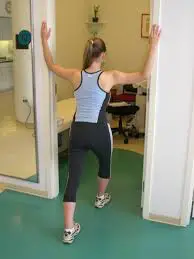
- Begin by putting your forearms and elbows on a doorframe while standing in a split stance.
- Raise your elbows to around shoulder height.
- Slowly lean forward to feel a stretch at the front of your shoulder and chest. Hold this stretch for 20-30 seconds, then gently release it by leaning backward.
- Rest for 20-30 seconds before beginning the next repetition.
- This stretch is typically performed in one set of two to three repetitions.
Corner Stretch
How to do:
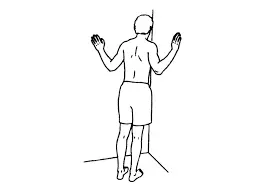
- Stand up straight, facing the corner of a room.
- Bend both elbows and lay your forearms against a single wall, palms facing forward.
- Step forward onto one leg and place your weight straight onto the wall.
- Make sure to move your hips and body forward.
- You should feel a stretch on the front of your chest.
- Hold this position.
- The height at which you position your arms affects where you feel the strain.
Upper Trapezius Stretch
How to do:
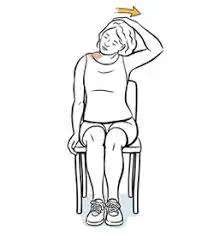
- Begin by placing one hand on the opposite side of your head.
- With your other hand, hold the bottom of your seat.
- Pull your head slightly to the side and rotate it so that you are gazing in the other direction.
- Hold the stretch for 20-30 seconds, or until you feel relieved.
Levator Scapulae Stretch
How to do:
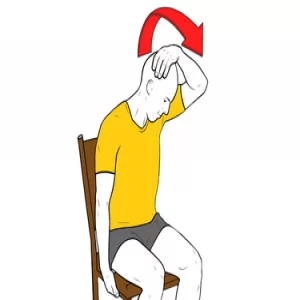
- Sit upright on a firm chair, feet flat on the ground.
- Maintain a comfortable posture with your shoulders and back straight.
- Turn your head 45 degrees to the side (as if looking into your armpit).
- Tuck your chin toward your chest.
- You should feel a stretch down the side and back of your neck, down to the shoulder blade.
- Hold for 20-60 seconds and then return to the center.
- Repeat on the opposite side.
Strengthening Exercises
Band Pull-Aparts
How to do:
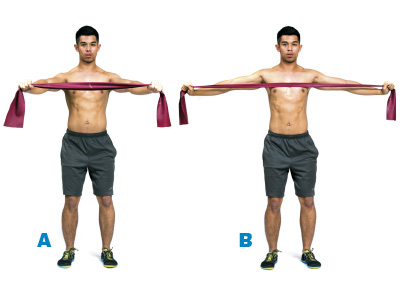
- Stand tall with your feet shoulder-width apart and both hands holding an exercise band in front of your chest.
- Raise your arms straight up to shoulder height in front of yourself.
- Pull the band as far as possible by moving your hands forth and back, without bending your elbows.
- Keep your shoulder blades pressed together and hold for one second.
- Slowly return your hands to the beginning position, maintaining tension in the band, and continue for the specified number of reps.
Wall Angels
How to do:
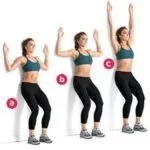
- Place your feet about 6 to 8 inches (15 to 20 cm) away from the wall. Rest your buttocks, back, shoulders, and head against the wall.
- Attempt to start with a neutral spine by pulling your belly button toward the spine. Draw your ribs in and down, allowing the backside of your ribcage to meet with the wall while keeping your lower back slightly away from it.
- Tuck your chin slightly, aiming to have the back of your head contact the wall. If it’s difficult to place your head against the wall, consider placing a small cushion behind it.
- Next, extend your arms straight up and place them on the wall overhead, attempting to have the back of your hands meet the wall in a “V” shape. If you are having trouble with some aspect of this alignment, move your feet further away from the wall and see if it resolves the problem.
- Then, bend your elbows and glide your hands down the wall until they are just over your shoulders. Meanwhile, place your head, trunk, and buttocks against the wall.
- Lower as much as possible while keeping proper posture and avoiding pain. Hold for a count of 5 at the lowest point before returning to the “V” starting position with position intact.
- Repeat 5-10 repetitions.
Prone Y Raise
How to do:
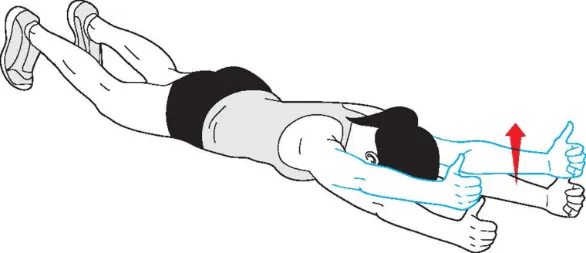
- To begin this exercise, lie face down with your arms above and thumbs toward the ceiling. For added comfort, place a small, rolled-up towel under your head or tummy.
- Stretch your arms wider apart from you in the shape of a “Y” while contracting your core.
- Lift both arms off the floor without arching your back until you feel your midback and rotator cuff engage. Hold this position for a few seconds before gently lowering down to start the repetitions.
Prone T Raise
How to do:
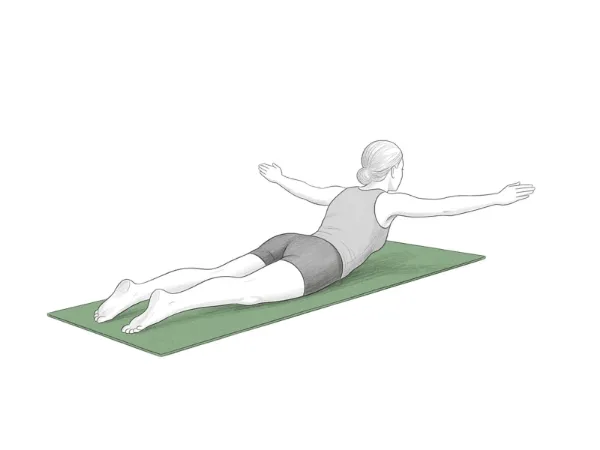
- Begin by lying down on the ground with your arm abducted to approximately 90 degrees.
- Use one forearm to cushion your forehead, allowing your neck to relax throughout this exercise.
- Raise your arm towards the ceiling while holding the end range for up to 7 seconds. To create this movement, focus on scapula retraction throughout this exercise.
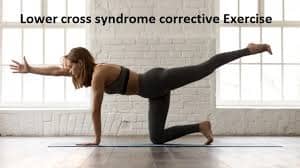
Bird Dog
How to do:
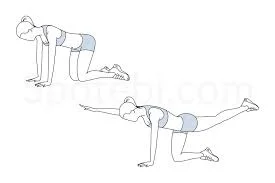
- Kneel on an exercise mat or other cushioned surface, keeping your knees hip-distance apart and your hands firmly positioned on the ground, shoulder-width apart. Engage your abdominals.
- Make a straight line from your extended hand to your extended foot by pointing one arm out in front of you and extending the other leg behind you. Keep your hips square to the ground. Raise your leg as high as you can while keeping your back straight if your lower back begins to drop.
- Hold for a few seconds, then drop back to your hands and knees. Keep your core engaged throughout the exercise, and try to reduce any additional motion in your hips during the weight transfer.
- Switch to the opposite side.
- Aim for five reps on each side, completing ten.
Scapular Retractions
How to do:
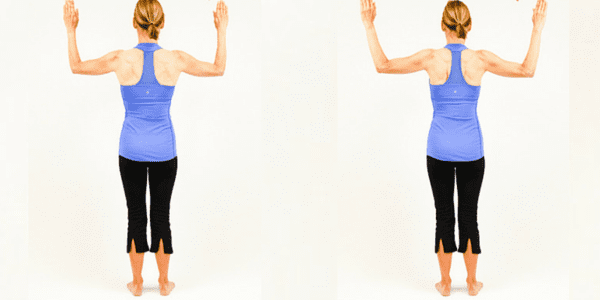
- Sit up straight on a chair with your feet flat on the ground.
- Place your hands on your thighs or leave them hanging naturally.
- Pull the shoulder blades back and together.
- Hold for 10-20 seconds and then release.
- Repeat the required number of times.
Resistance Band Rows
How to do:
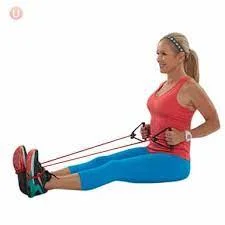
- Sit on the gym mat on the floor. Extend your legs straight in front of your body, toes pointing up.
- Place the resistance band around the center of your feet and pull it slightly towards your upper body without applying too much force. Make sure the band is the same length on both sides. It should sit securely on your feet, with no wiggle room, so that it does not slip over your toes or heels during the rowing motion. If possible, place the band in the center of your feet.
- Straighten your upper body with mindful effort. Pull your shoulder blades back, creating a little arch in your lower back. Keep your head high and your chest out. You are currently in the starting position.
- Pull the resistance band equally back toward your upper abdomen with both arms while bending your elbows. Hold in this position for a moment.
- Allow the band to move back towards your feet by extending your arms, then repeat the process.
External Rotation with Resistance Band
How to do:
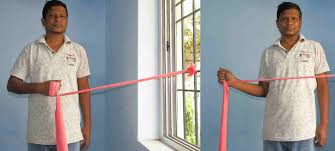
- First, tie a band to a solid object next to you at around mid-torso level.
- Grab the band with your most distant arm and elevate your elbows to just below 90 degrees of shoulder flexion.
- Externally rotate the arm 90 degrees and hold in the end-range position for up to 2 seconds.
Prevention
Proper posture
- Maintaining proper posture consistently is one of the most effective preventive measures for rounded shoulders. Sitting up straight and using the core muscles to hold the shoulders back and down can aid in maintaining good alignment and preventing the shoulders from rounding forward.
Regular exercise
- Rounded shoulders can be avoided by taking frequent breaks from extended sitting and engaging in regular physical exercise. The muscles involved can be strengthened and stretched by swimming, walking, and other activities that require arm and shoulder movement. This improves posture and reduces the chance of having rounded shoulders.
Ergonomic correction at Workstation
- Position the chair with the thighs perpendicular to the calves and the knees perpendicular to it.
- Maintain a low-back arch.
- Ensure that the top 1/3 of the computer monitor is at eye level.
- Sit in a comfy seat that helps you keep excellent posture.
- Take regular breaks to move around and stretch your muscles to relax.
Complications of untreated rounded shoulders
- Chronic pain
- Chronic pain and discomfort caused by chronic tension in the muscles of the upper body can have a significant impact on daily living. This soreness causes decreased agility and range of motion, making it difficult to do daily tasks.
- Reduced lung capacity
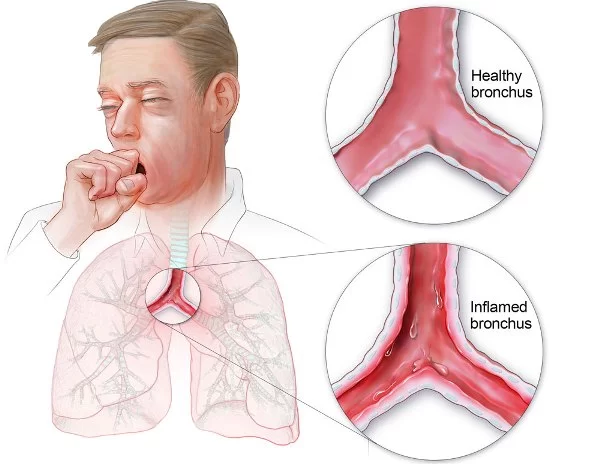
- Another concern related to rounded shoulders is reduced lung capacity. When the shoulders are positioned forward, the chest cavity may become restricted, making deep breathing more difficult due to decreased total lung capacity. Furthermore, the kyphotic posture and posterior pelvic tilt, which flatten the lumbar lordosis, weaken secondary inspiratory muscles such as the serratus anterior, sternocleidomastoid, and pectoralis minor. The overactivation of secondary muscles of inspiration as a result of weakness causes atypical breathing patterns. This may cause shortness of breath and tiredness, making physical activity more challenging.
- Psychosocial health
- Rounded shoulders can also influence behavioral and mental health. Depression and anxiety are common psychological side effects of chronic pain. Individuals suffering from chronic pain may be concerned about their capacity to cope with the pain in the future, as well as experience depressive symptoms as a result of the pain’s harmful influence on their quality of life.
- These feelings might be especially difficult to deal with if the pain is not being treated correctly or if it interferes with daily activities. Chronic pain may have an influence on social relationships. Patients with chronic pain may find it difficult to work, exercise, and socialize.
When to seek medical care
If your rounded shoulders are sore, painful, or interfering with everyday activities, consult a healthcare expert. Medical assessment is also recommended when posture changes unexpectedly, after an accident, or is accompanied by weakness, numbness, tingling, or recurrent headaches. These characteristics may indicate a problem beyond typical postural habits.
Assessment may be beneficial for children, teens, and older individuals if the upper back looks to be gradually bent or if one shoulder is notably different from the other. This helps determine whether a spinal problem, skeletal alteration, or other musculoskeletal issue requires care. When structural deformity is suspected, some persons may require a more thorough spine assessment, including a visit with a spine surgeon, although conservative therapy is usually sufficient in most cases.
Conclusion
Rounded shoulder posture is a common postural issue that can lead to neck pain, shoulder discomfort, reduced mobility, and poor upper-body alignment if left unaddressed. Fortunately, it can often be improved through a combination of regular stretching, strengthening exercises, ergonomic adjustments, and increased awareness of daily posture.
Consistency is the key to lasting results. If your symptoms are severe, persistent, or accompanied by numbness or weakness, consult a physiotherapist or healthcare professional for a personalized assessment and treatment plan. The right method can help you improve posture, reduce pain, and support long-term shoulder and spinal health.
FAQs
Can rounded shoulders be corrected?
Many people say yes. Exercises, ergonomic adjustments, and constant movement can typically improve posture that is primarily caused by habit, muscular stiffness, or weakness. Improvement often takes time and works best when the root reason is discovered.
Is rounded shoulder the same as kyphosis?
Not accurately. While kyphosis refers to an increased curvature of the upper spine, rounded shoulders show a forward position of the shoulders. The two can occur simultaneously, but they are not the same and might require separate modes of evaluation.
Are rounded shoulders usually painful?
No. Some people detect a shift in posture without feeling any pain. Some have stiffness in their neck, shoulders, or upper back, especially after prolonged sitting or frequent activity.
Does working out at the gym make rounded shoulders worse?
It is possible if training focuses largely on the front of the body without balancing the upper back and postural muscles. Poor technique or ignoring pain can also contribute. A balanced program that involves pulling, mobility, and posture-focused strengthening is often more beneficial.
When should someone worry about rounded shoulders?
If rounded shoulders worsen, cause substantial pain, or are accompanied by weakness, numbness, trouble breathing, or a noticeable spinal deformity, get medical attention. Sudden changes following injury should also be evaluated. These conditions may indicate a condition requiring more than just self-care.
Can sleeping posture result in rounded shoulders?
If you sleep on your side, your sleeping position may contribute to rounded shoulders. Spending hours with your shoulders leaning forward will tighten your chest muscles and weaken the ones that maintain your posture erect.
References:
- Johnson, J. (2023, July 11). Ways to fix rounded shoulders or “mom posture.” https://www.medicalnewstoday.com/articles/318556
- Orthoadmin, Clinic, O., & Orthoadmin. (2022, December 19). Rounded shoulders:s- tips to improve posture. https://www.orthocure.co.in/rounded-shoulders-tips-to-improve-posture/
- Hmdg. (2023, December 8). Rounded shoulders – Reach Physiotherapy. Reach Physiotherapy. https://reachphysiotherapy.com/rounded-shoulders/
- Orthopaedic Medical Group. (2023, November 1). Rounded Shoulder and How You Can Fix It. Orthopaedic Medical Group of Tampa Bay. https://www.omgtb.com/rounded-shoulder/
- Take2Health. (n.d.). Spotlight on Posture: Rounded Shoulders | take2health. Take2health. https://www.take2health.com.au/spotlight-on-posture-rounded-shoulders/
- Rounded Shoulders: An Evidence-Based Guide for Patients. (2026, July 30). Acibadem Hospitals Group. https://acibademinternational.com/health-library/rounded-shoulders-an-evidence-based-guide-for-patients/
- Song, D. (2023, October 18). Seated Upper Trapezius Stretch — Rehab Hero. Rehab Hero. https://www.rehabhero.ca/exercise/seated-upper-trapezius-stretch
- Levator scapulae stretch | neck and shoulder stretch for older adults — More Life Health – Seniors Health & Fitness. (n.d.). More Life Health – Seniors Health & Fitness. https://morelifehealth.com/levator-scapula-stretch
- Scapular Retraction Exercise Singapore | Healing Hands. (n.d.). Healing Hands Singapore. https://healinghands.com.sg/scapular-retraction-exercise/

One Comment