
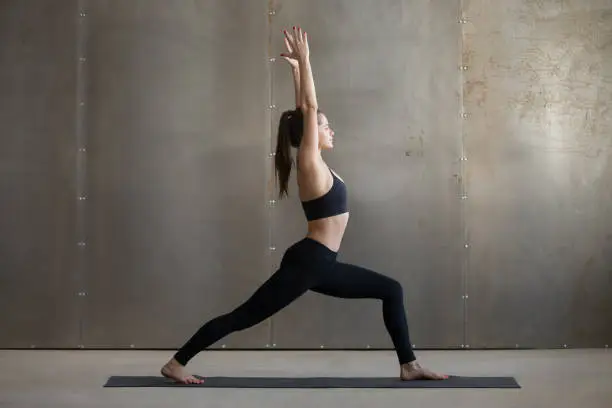
Virabhadrasana I (Warrior I)
Introduction
Virabhadrasana I (Warrior I) is a powerful standing yoga pose that symbolizes strength, stability, and focus. Rooted in ancient yogic tradition, the pose is named after the fierce warrior Virabhadra, representing courage and determination. In this posture, the body is grounded through the legs while the arms extend upward, creating a sense of expansion and upward energy.
Warrior I primarily targets the lower body, strengthening the legs, hips, and glutes, while also engaging the core and improving overall balance. At the same time, it opens the chest and shoulders, promoting better posture and deeper breathing. The alignment of the pose encourages both physical stability and mental concentration, making it an essential asana in many yoga sequences.
Regular practice of Virabhadrasana I can enhance flexibility in the hip flexors and improve coordination between the upper and lower body. It also helps build endurance and body awareness. Suitable for beginners and experienced practitioners alike, this pose serves as a foundation for developing strength, confidence, and mindfulness on the mat.
How to do Virabhadrasana I step by step
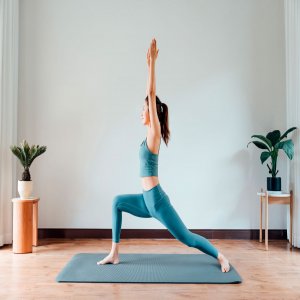
- Start with your feet together, extend your spine, engage your legs, and take deep breaths. Prior to starting the movement, center your concentration.
- Take a long step back. Retrace the left foot by one to one and a half meters. Extend the rear foot by 45 to 60 degrees. To provide your pelvic stability, make sure your feet are hip-width apart and not in the same line.
- Flex your front knee. The right thigh should be as parallel to the floor as possible after bending the knee. The knee should be exactly above the ankle, and the shin should be vertical. The knee should never extend past the toes.
- The back foot should be rooted. The left foot’s heel and outside border should be firmly pressed into the mat. Reduce the space between your feet until you can maintain it on the ground if the heel rises.
- Pull the pelvis forward. Aim to point both iliac crests in the direction of the mat’s front. Don’t push: raise your pelvis as far as your body permits without risking your lower back or knee.
- Lift your arms. Take a breath and raise your arms next to your ears, palms either together or facing each other. The ears are separated from the shoulders. Stretch your fingers toward the sky and fully extend your elbows.
- Extend your spine. Grow upwards from the pelvis to the crown. To avoid excessive lower back arching, gently engage the abdomen. The lower ribs do not flare, but the sternum does.
- Focus your eyes. Gently raise your eyes to your hands if your neck permits. Keep your eyes forward, at the horizon level, if you are experiencing neck discomfort.
- Breathe and hold. For five to ten deep breaths, maintain the posture. Repeat on the opposite side after that.
Benefits
Physical Benefits:
- The deep lunge is heavily supported by the quadriceps, hamstrings, glutes, and adductors. One of the best yoga postures for strengthening the legs is Virabhadrasana I, which involves a prolonged isometric contraction of the knee at a 90-degree angle.
- One of the deepest psoas stretches that yoga offers is for the back leg. This position directly opposes the stiffness caused by the hip flexors shortening with prolonged sitting.
- The thoracic spine lengthens, the shoulders retract, and the chest expands. One of the most common postural effects of sedentary work in front of a computer is kyphosis, or rounded shoulders forward, which is countered by this.
- Additionally, a deep core activation is necessary to keep the pelvis neutral as the hip flexors are stretched. As a natural corset, the transversus abdominis stabilizes the entire body and shields the lumbar region.
Mental Benefits:
- Maintaining the position for a few breaths improves mental stamina and focus. The strain mounts, the legs shake, and the mind looks for ways out.
- The mind is trained to remain present by holding the stance while maintaining a steady gaze over the front hand (drishti). This improves focus and lessens mental distractions.
Common Mistakes To Avoid
- The orientation of the pelvis is the most debated error. The traditional guideline calls for “squareing the hips forward,” although most individuals are physiologically incapable of doing so. Individual differences exist in the bony border of the hip joint. Forcing won’t solve the problem. Try to “drag” the rear foot in the direction of the midline by pressing it on the mat. This mechanically and safely moves the pelvis forward by engaging the adductor longus of the rear leg.
- Another classic is valgus, or the inward folding of the front knee. The medial collateral ligament is put under harmful tension as a result. To fix this, aggressively guide the knee toward the foot’s little toe while pressing the front foot’s outside border into the floor.
- Additionally, the back heel frequently lifts off the ground, transforming the pose into a high lunge (Ashta Chandrasana). To do Virabhadrasana I, reduce the distance between your feet and raise your rear foot until your heel settles.
- The most frequent error in the upper body is lumbar hyperextension. The L4-L5 vertebrae are compressed by the lower back’s ability to arch excessively when the arms are raised. The rear leg’s psoas strain, which forces the pelvis forward, is typically the reason.
- To fix it, gently pull the navel in the direction of the spine to activate the transverse abdominal. Instead of allowing the coccyx to rise backward, lengthen it toward the floor. Feeling the gap between your pelvis and lower ribs is an indication that you are doing it right.
- Lastly, the shoulders that lift toward the ears cause unneeded strain in the neck and upper trapezius. Breathe out, spread your collarbones, and drop your shoulder blades. Instead of seeming like a separate effort, the arms should feel like a natural extension of the spine.
Variations and modifications
For beginners
- Hands on the hips. By removing the arms over the head, one can concentrate only on the alignment of the legs and pelvis, which lowers cardiovascular effort. For people who are learning the position or have shoulder restrictions, it is the greatest choice.
- Shorter lunge. Cutting the distance between the feet helps to align the pelvis and lessens the strain on the hip flexors. Only the depth is altered; the posture’s structure is maintained.
- Cushion beneath the heel of the back. Put a folded blanket or a yoga cushion below if the heel is unable to touch the ground because of strain in the Achilles tendon or gastrocnemius. Without sacrificing posture, this support enables the entire leg’s posterior chain to contract.
For advanced
- Ashta Chandrasana, or the High Lunge. Orienting the hips forward is tremendously aided by keeping the knee extended and the back heel lifted. It works well as an intro to the full expression with the heel on the ground and is a valid and powerful variation in and of itself.
- Baddha Virabhadrasana, the humble warrior. Raise your arms behind you, interlace your hands behind your back, and bend your body inward toward your front knee. Incorporate forward bending, chest opening, and shoulder external rotation.
- Arms of a cactus. Palms looking forward, elbows bent at a 90-degree angle at shoulder height. keeps the thoracic aperture open while reducing shoulder strain. A great choice for people who have rotator cuff problems.
Contraindications
- The position with your arms up may cause your blood pressure to momentarily rise if you have uncontrolled high blood pressure. Practice Anjali mudra with your hands at chest level or on your hips.
- Reduce the depth of the forward bend, shorten your stride, and prevent the knee from going past the ankle if you have knee ailments (meniscus, cruciate ligaments, patellofemoral syndrome). Avoid the position entirely if there is current inflammation.
- Don’t push the pelvis forward if you have hip issues like femoroacetabular impingement or a new prosthesis. Respect your body’s range of motion and let the back hip stay more open.
- Don’t gaze up if you have neck pain. Maintain your gaze downward or forward. Existing issues may be aggravated by cervical compression from a forceful neck hyperextension.
- Reduce the depth of your stride, extend your base of support, and think about practicing with your hands on your hips rather than lifted during the second trimester of pregnancy.
Tips for Beginners
Make sure your pelvis is not leaning forward during this posture, since this might compress your lower back. Make sure your tailbone is extended, and your pubis is raised toward your navel while you perform the knee bend. Additionally, watch out that the front knee doesn’t drop in; try to maintain it above the heel in the center of the foot.
Conclusion
Virabhadrasana I, or Warrior I, is a powerful standing posture in Yoga that builds strength, balance, and focus. By grounding through the legs and lifting the arms overhead, this pose strengthens the lower body, opens the chest and shoulders, and improves overall posture. It also enhances flexibility in the hips and encourages better coordination.
Beyond physical benefits, Warrior I promotes mental clarity and confidence. The act of holding the pose with steady breathing helps develop concentration and inner stability. It teaches determination and resilience, making it an excellent addition to any yoga routine.
With regular practice and proper alignment, Virabhadrasana I can support both physical fitness and emotional well-being. It serves as a strong foundation for other standing poses, helping practitioners build strength, awareness, and a deeper connection between body and mind.
FAQS:
How can you strengthen your core with Warrior 1?
Improves core stability: In Warrior 1, your core muscles automatically contract to sustain strength and balance as you raise your body and engage your legs. This improves posture and core stability by toning and strengthening the abdominal muscles.
Who should not perform Virabhadrasana 1?
If you have high blood pressure, heart problems, recent hip, knee, or spinal injuries, or diarrhea, you should either avoid or modify Virabhadrasana I (Warrior I). Modifications such as shortening the stance or keeping hands on the hips should be used by people with severe back pain, shoulder pain, or balance problems.
Can beginners use Warrior I?
Warrior I is indeed accessible to beginners. To increase comfort and balance, it can be altered by shortening the stance or gently broadening the feet.
For what duration should I hold Warrior I?
Beginners may hold the posture for 15 to 30 seconds on each side, progressively extending the time as their strength and stability increase.
Does Warrior 1 reduce tension?
Try warrior posture if you want to, especially to increase your strength, concentration, and willpower. You will feel refreshed and reenergized by this well-liked yoga sequence and its modifications, which will also help you reduce stress.
Is Warrior 1 capable of opening the hips?
The traditional hip opener, Warrior 1, increases hip mobility and stability. Sun Salutation B is where it is most frequently found. Feel free to substitute High Lunge for the position if you find it difficult because it calls for the external rotation of the hip in the back leg.
References:
- Requena, C. (2026b, March 4). Virabhadrasana I: Warrior I Pose and the strength of the inner warrior – kavaalya. kavaalya. https://kavaalya.com/blog/virabhadrasana-warrior-1
- YogaRenew. (2025, October 7). How to practice Warrior I (Virabhadrasana I). https://www.yogarenewteachertraining.com/yoga-poses/warrior-1/

2 Comments